
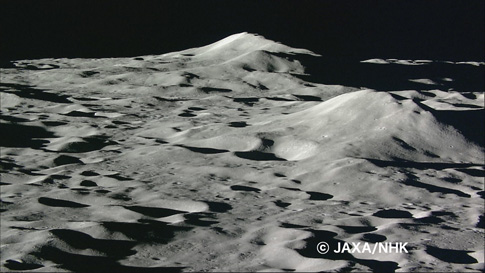
Kaguya's Farewell Transmission (1) Before crashing to the surface last week, Japan's Kaguya probe sent back a series of seven high-resolution images just a few thousand feet above the lunar surface. Return to Article JAXA/NHK

Before its planned end-of-life crash landing, which it broadcasted dutifully in HD, Japan's Kaguya lunar craft used its gamma ray spectrometer to find the "first conclusive evidence" of uranium on the lunar surface.

Robert Reedy – a scientist involved with the project though the Planetary Science Institute in Tuscon – told Space.com that the team “has already gotten uranium results, which have never been reported before. We're getting more new elements and refining and confirming results found on the old maps."

If the surface uranium is abundant, it could fuel nuclear power plants on the moon, making long-term operations on the surface more feasible.

[Space.com]

Want to learn more about breakthroughs in electronics, medicine, nanotech, and more?
Subscribe to Popular Science and enter to win $5,000!

16 Comments

Is this not already feasible without a lunar Uranium source?

Sorry for double post. On second thought wouldn't it be less feasible to enrich Uranium on the moon than on Earth?

You make a good point, I suppose that would mean getting it there...

Great instead of using solar to power a moon base, we are already looking at something completely non renewable

http://prosportnutrition.net/?a=633808700294218750

What? Solar isn't a good option? Solar is the best option. Every second, the sun produces and provides more energy in that 1 second of light than man has ever created in history. How is solar a bad option?

Just the thing that future explorer would use on mission to Mars and beyond. Going all the way back to the early 60ths nuclear propulsion was frowned on because of the threat of an exploding rocket contaminating areas of Earth. Even though the technology was rigorously tested they gave up on it they tried to sell it to the public over and over again but failed.

There was another big push to go nuclear in 2005, a NASA presentation at the 2005 Mars Society Conference with all the big players there, NASA, ESA, even the Russians were in the crowd talking about their push for nuclear - electric propulsion. This was the time that NASA was seriously talking about reintroducing it back into the mix. Nuclear attraction comes from the fact that it could fly anywhere in the solar system, solar power looses it’s benefit when we get past Mars no matter how big your solar collectors are.

The speed that we could go to Mars from the moon would be less than 39 day a huge saving for the safety of the crew because less radiation exposure and muscle atrophy to contend with while traveling to Mars. Using Nuclear propulsion we wouldn’t need to establish a permanent settlement on Mars right away, explores could be on Mars almost 6 months before they come home not the 2 year minimum stay a chemical rocket would take. It would take about 9 months traveling time with a chemical rocket just to get to Mars. As a result a nuclear rocket trip to Mars and back would take less time than a one way trip to Mars with a chemical rocket.

In short if the finding of Uranium on the moon turns out to be true and there are some places with abundant Uranium fuel then we wouldn’t need to export it from Earth and fly through our atmosphere. We could build a Nuclear Space Shuttle type craft minus the wings on earth then load it up with the nuclear fuel once we got to the moon.

Before anyone gets too excited about finding Uranium on the moon, Mars also has a small amount of Uranium; nevertheless NASA, ESA, China, Russia etc, etc must be very excited about the possibility of Uranium on the Moon. If Uranium is found by the Japanese probe to be in large quantity later on then this will boost the push to go back to the moon more than finding Helium III and solar power would. We had nuclear fission propulsion technology for over 40 years yet we haven’t broken even in fusion reactors yet. For those of us who want to explore our solar system within our lifetime then Fission is the energy we need today fusion is the energy we will need tomorrow.

Besides the Hall Effect, ion propulsion, etc. there are some fusion like engines available today that accelerate plasma out the back, thrust, of a spacecraft very fast such as a VASIMR engine. A VASIMR engine would need a high amount of electricity, enter the nuclear-electric propulsion fission engine to speed spacecraft efficiently to Mars and beyond.

Another downside to solar power is that our collectors we have right now aren't efficient. I'm not certain on the efficiency, but I think it's about 18% or something of solar light getting changed to electricity.

*Responding to Skillet*
Not sure what type of reactors they plan on using, but you can run a nuclear plant with unenriched uranium. They are called Pressurized Heavy Water Reactors. Here is a link to multiple reactor types and the pros/cons of each: http://www.world-nuclear.org/info/inf32.html

And for all the go-green people, nuclear power is fantastic and safe. As for those worried about the contaminated waste, we can severely reduce waste produced in the US if we lift some idiotic rules that force nuclear reactors to not transport the material off-site and begin re-enriching like the french have for many years. Only like 5% of a fuel rod is actually used before it becomes too contaminated to be efficient in fission. So you send the 95% back to be re-enriched instead of packaging it as useless. Personally I would love to see a solar+nuke powering the future.

I would think that solar would be more efficient on the moon, than on earth, due to little atmosphere distorting the sun's rays. Once they find something like diamonds, or ultra rare metals on the moon, I am sure you will see a lot of private companies setup their own moon based mining operations. Greed has always been the #1 motivator for progress.

http://prosportnutrition.net/?a=633808700294218750

"How is solar a bad option?"

Um... because night on the Moon lasts 14 days?

Most of the moon's surface is lit for only half a month at a time. Solar would be useless for the approximately 2 weeks of darkness (i.e. during the new moon phase for the side that faces the Earth).

It's true that the moon is in darkness for 2 weeks a month, but that doesn't mean solar can't be used, and quite effectively. A simple flat mirror in orbit could redirect solar light to to just about any area of the moon. Remember, there's no atmosphere to disperse the reflected light.

And as regards nuclear processing on the moon, it's gonna happen, folks, if not by us then by others. I just hope we grow up as a race in short order. Nuclear rockets make good sense - as long as they stay in space!

Good common sense post, Joe. Hopefully the current administration will keep your argument in mind when they consider the fate of the Constellation program and America's future presence on the moon. No nation can lay claim to the moon, but I'd like to at least see ours be part of the effort to colonize this century. In addition to your comment about mirrors in orbit, I'd add that any base at the lunar poles seeking to exploit the suspected ice deposits in permanently shadowed craters could also take advantage of the fact that high ground at the poles remains in permanent sunlight. Solar collectors on the rims of shadowed craters would simply need to rotate to follow the sun during the month to supply power to a base in the floor of the crater.

bdhoro87

from coral gables, fl

Lets turn the moon into another Sun!!

First one would need to extract the uranium. On earth uranium is concentrated by natural processes involving water. No water no concentration. Then the process of enrichment. Better it seems to rely on solar energy which strikes the mooon unimpeded by atmosphere.

When the Moon was first formed it would have been geologically active. This will have created ores where some minerals are more concentrated. Meteorites will have concentrated ores too, and where large eteorites have hit the lunar surface the intense heat will also help concentrate minerals as the heat slowly dissipates.

Mining and enriching lunar uranium certainly makes sense.
. it's high security, noone is going to sneak up and steal it
. nuclear propulsion can be used in space exploration without any need to transport it from Earth
. zero environmental impact
. no greenies protesting on the Moon
. lots of lunar rock is going to need processing to extract hydrogen and oxygen (or He3 maybe), why not get some other useful material out of it as well


Download Our iPhone App

Stay up to date on the latest news of the future of science and technology from your iPhone with full articles, images and offline viewing


Grab the Tech Buyer's Guide iPhone App

Carry everything you need to make a smart buy on HDTVs, cameras and 14 other product categories right in your pocket


Follow Us On Twitter

Featuring every article from the magazine and website, plus links from around the Web. Also see our PopSci DIY feed


Become a Fan On Facebook

Share links with friends, comment on stories and more


January 2010: The New Space Rush

Who needs NASA? Take a look at all the players in the crowded civilian space race, plus the tech behind Avatar's groundbreaking 3-D, a trip to Ray Kurzweil's Singularity University plus our predictions for the year to come in science.

Read the issue here.

Popular Science Photo Pool


Share your photos in the Pop Sci pool at www.flickr.com!
tags_sprite.png
POP_embeddedForm_cover_May09.jpg