UCLA scientist give mice an E. coli gene that burns fat over carbs, preventing obesity
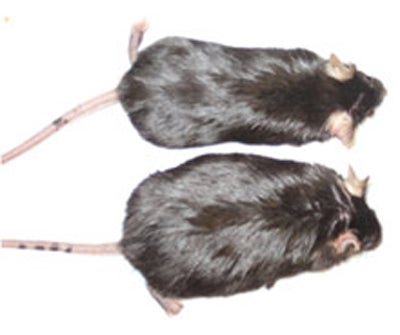
Fat Mouse, Skinny Mouse This is a scene from the all-mouse version of Tommy Boy Jason Dean, University of California, Los Angeles, via Technology Review

Since lab mice have been kind enough to start making baby formula for us, it might be nice to pay them back. Luckily, two UCLA scientists have the perfect gift: a bacterial gene that, when inserted into the rat genome, adds a new metabolic pathway that makes it impossible to get fat, no matter the carb content of the mouse's diet.

As detailed in the latest issue of the journal Cell Metabolism, the E. coli gene affects the glucose metabolism of the mouse's liver by adding a new chemical pathway that preferentially metabolizes fat over carbohydrates. So even if the mouse keeps packing away a never ending pasta bowl and free bread sticks, it will burn fat instead of gaining weight from the carbs.

Researchers discovered the obesity-preventing power of this gene by accident. They knew the gene related to carbohydrate metabolism, and engineered the gene into the mouse genome simply to help them identify important enzymes, not help the subject's waist line.

Sadly, despite the unexpected obesity result, this discovery does not have an immediate clinical application. However, the enzymes identified by the study do hold the promise of some day imbuing humans with the same fat burning power the mice displayed.

"This is an interesting and viable way to look at metabolism," said Katrina Dipple, an associate professor of human genetics and pediatrics and UCLA and a coauthor of the paper, "but we need to look deeper into the pathways to develop therapies.”

Want to learn more about breakthroughs in electronics, medicine, nanotech, and more?
Subscribe to Popular Science today, for less than $1 per issue!

8 Comments

This sounds dangerous. Ya know, for most of human history a good layer of fat was translated as healthy and attractive (and probably for good reason). Lets not get rid of fat like its some sort of useless cancer.

Nah. Let anyone who wants to sign a waiver have all their fat bled off of them. When the winter to end all winters comes, The Fat shall be the pride of the land! -maniacal laughter-

Lets hope this slips under the radar...

I get wary any time I hear someone mention weight gain / loss and fat vs. carbs. It is things like this that brought us the Atkins diet, which has left many unfortunate people (although slightly thinner) with dangerous cholesterol levels and a severe lack of fiber. The way this article is written implies that carbs are bad, because no matter how many carbs the mice were given, they didn't get fat. We need to always remember that we don't have that gene and we need to be wary of making people think that carbs are bad; we need them for energy, and an excess of anything is never good!

Were this gene to be inserted into humans and the goodness or badness of carbs to be taken out of the equation, we still need to remember that fat is important as well. Sure, historically obesity was a good thing because it tended to mean that you were rich and didn't have to work, but the capacity to become obese is a good thing. In our society, we don't have problems with famine, so we don't need to become obese any more to tide us over in thin times, but we still need fat. Fat is not just for energy; fat is insulation. If you give someone the capability to never get fat, and if they have a child who carries that gene, you greatly endanger the child; brown fat is essential after birth in keeping up the temperature of one's head and torso.

This article does not point out whether or not it is just impossible to get fat, or impossible to build up necessary stores of body fat. The reason marathon runners carbo load the night before a race is because they want to build up such energy stores as glycogen in their liver, and at the end of the race (or when they "hit the wall") many collapse with exhaustion. If the human body has such extensive capabilities of burning off carbohydrates, if we can completely exhaust them, then imagine what would happen if we had the ability to use fat as an energy source and completely exhausted it (which is exactly what happens when you exert yourself to physical exhaustion)! We have fat for a reason, evolution has given us fat, and we would be wise to not tinker with Mother Nature's design.

Alice Reilly
Department of Biology
Mercer University

Well instead of something that make,s you never gain wait make a drug that make,s you not feel hunger and use your fat cell,s it would be like the new thing for sports and with out the nasty problems because fat can be used for a long time also the drug can be used slowly for people who want to lose weight and can,t walk maybe because of his/her weight.

While I agree that we all need fat for brains, curves, padding, insulation, etc., being someone with more than my fair share makes me interested in anything that could possibly help with my quality of life. This article seems to be saying that this gene would cause the body to burn fat first over carbohydrates, that is if I'm reading for content correctly. This shouldn't change the way the body produces fat, usually from the over intake of the carbohydrates we all know and love too much in urban societies. Also, it doesn't keep us from storing this necessary fat in our bodies like we do now. The only real change is that before, our body fat was stored away for a time of famine that I'm not likely to see or even live through, were it to occur. Now, if the gene was successfully adapted for humans, I will lose fat faster if my intake of food changes because the long term parking that is my belly roll will clear out before I start using the carbs directly. I wonder what effect this would have on blood sugar and diabetes. It would certainly be a happy accident if this could help with that.

Nice rat, fat very fast, but what for?
http://tinyarticle.com


June 2013: American Energy Independence

Five amazing, clean technologies that will set us free, in this month's energy-focused issue. Also: how to build a better bomb detector, the robotic toys that are raising your children, a human catapult, the world's smallest arcade, and much more.


Online Content Director: Suzanne LaBarre | Email
Senior Editor: Paul Adams | Email
Associate Editor: Dan Nosowitz | Email
Assistant Editor: Colin Lecher | Email
Assistant Editor: Rose Pastore | Email

Contributing Writers:
Rebecca Boyle | Email
Kelsey D. Atherton | Email
Francie Diep | Email
Shaunacy Ferro | Email

circ-top-header.gif
circ-cover.gif
bmxmag-ps