An East Antarctic Odyssey: The Final Segment
The team returns to the land of minus-50 temperatures and hurricane-force winds
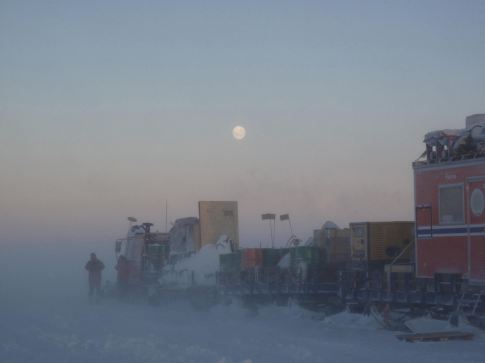
Think you’ve done the ultimate road trip? Think again. That tour de force can only be rightfully claimed by a team of scientists who spent this winter driving 2,000 miles across East Antarctica — at a top speed of about 9 miles per hour.
In late December, twelve American and Norwegian scientists set out to complete the second segment of a two-season overland traverse of East Antarctica. This year’s expedition began with the team traveling in two groups, with one heading first to ‘Camp Winter’ to repair the vehicles that were damaged during Season 1 and then driving to the South Pole, and the second group testing equipment at McMurdo Station before meeting up with group one at the South Pole. The entire team then headed to Troll Station, a Norwegian research station located about 150 miles from the East Antarctic coast, stopping at various points along the way to fly unmanned aerial vehicle (UAV) missions and drill for ice core samples.
Moving in Granny Gear
The team having learned from the vehicle failures that occurred near the end of the Season 1 traverse, the first item on the Season 2 agenda was a complete overhaul of the vehicle transmissions. “Last year, so many transmission and drivetrain parts broke that by the end of the traverse, there were parts for which no replacements were available anywhere on Earth because the entire inventory of parts had been consumed,” said Ted Scambos, lead scientist at the National Snow and Ice Data Center in Boulder, Colorado, and satellite data specialist on the Season 2 traverse. “This year, we had zero failures on the vehicles.”
And East Antarctica isn’t a place where you want your only mode of transportation to fail — even if it does only keep you moving at 6-8 miles per hour. Scambos says that in the beginning, it was hard to get used to the slow pace. “We kind of had this feeling of…oh crap, this is gonna take a long time. I’ve been watching that same snow dune go by for an entire day,” he said. “You’re there for weeks and weeks and weeks — in granny gear the entire time.”
Frozen Faces and Fingers
When they weren’t driving, the team spent most of the day outside doing science work, in temperatures of -10 to -20 F. “That might not seem that cold to some, but to try and get scientific work done in those temperatures is a big deal,” said Scambos. Scambos recalls one day when he was working outside and another team member looked at him and said, “You need to go inside right way.” “So I went in and was taking all my gear off, and it felt like I had a piece of duct tape stuck to my cheek,” Scambos said. It wasn’t duct tape — his cheek was frozen, and it took about 3-4 minutes for it to thaw out. “Over the next couple of days it was like a bad sunburn, and several layers of skin fell off,” he said.
Working in the cold temperatures was a constant balancing act of keeping warm and getting tasks done. “The trick was to be able to manipulate things delicately with your fingers without freezing them,” Scambos said. “If you take your gloves off for two or three minutes to wire something, your fingers start to freeze. Then you have to get them into a mitten and wait for them to warm up before you can start working again.”
The Ice Core Drill Saga
The team was presented with the ultimate test in performing delicate tasks with their fingers in late January, when the cable attached to the ice core drill snapped, leaving the $100,000 piece of equipment about 200 feet down in the bottom of a hole. Figuring out how to extract the drill from the hole was a saga that took several days, Scambos said. The team’s engineer fashioned a four-barbed fish hook that was designed to cut into the wire and grab it. On the third try, they managed to snare the wire and pull the drill up to within 10 feet of the surface. But rather than risk losing it again by pulling on it too hard, they decided they could instead reach the drill by digging down to it. “We excavated a trench in the ice and eventually got down to where the hook was holding the wire attached to the drill, but it’s -50 degrees down there, and by this time it had been in there a day and a half and the drill pipe had really frozen into the hole,” said Scambos. So, after almost two days of effort, the final dilemma was how to get the ice around the drill thawed so that they could move it. “I’d like to say that we sacrificed our stash of drinking alcohol and threw it down into the hole to un-freeze the drill in the interest of science. But no — we called the cavalry at that point,” said Scambos.
The cavalry was the National Science Foundation, which flew in an extra drill, in case the one that was stuck couldn’t be retrieved, and a small drum of denatured pure ethanol, which the team threw down the hole to thaw out the ice around the drill. “It’s like standing on the roof of a 25-story building and trying to pour liquid down a tube and have it hit a pipe that’s sitting on the ground,” said Scambos. “It’s almost unheard of to recover a drill that’s fallen into a hole, but we did recover it and were able to use it again.”
At various points during the traverse, the team collected ice cores that will provide a record of past climate in Antarctica, going back at least 1,000 years, and possibly 2,000 years. “This is important because it will help us understand previous cooling and warming cycles,” said Scambos.
On the next page: temperatures fall.
44 Below
Pushing the Limits on the Plateau
The team spent most of January in the middle of the Antarctic ice sheet doing extensive surveying at Recovery Lakes, deep pools of water under the ice sheet. The weather was good, but they still had a lot of driving to do — about 500 miles to get to Kohnen Station where there was more fuel. So they finished their work at Recovery Lakes and set out to drive 10 days straight. A day after arriving at Kohnen, the team saw its first sunset — a sign that Antarctic winter was looming. But they still had one more science stop to do at a location high up on the Antarctic (or Polar) Plateau, which sits at an average elevation of 10,000 feet. “It’s now February, the sun is setting in the evening, and there is this nagging concern that you really shouldn’t be there,” said Scambos. “All the other programs had pulled their people off the Plateau by that time because of declining temperatures and the increasing possibility of katabatic windstorms.” Katabatic winds are intensely cold winds that blast toward the coast of Antarctica and can blow at hurricane force.
As the team was wrapping things up at this last science stop, the wind began to pick up, snow started blowing, and the temperature dropped…to -30, -35, -40. “It was like the Plateau was flexing its muscle and saying ‘get out’!” said Scambos. “Everybody who was outside for that last half-day of science work got some frostbite.”
That night, the temperature dropped to about -50 F, and the wind chill reached -85 F. And the next day, the vehicle engines wouldn’t start, even though block heaters had been on the engines continuously. “It took us eight hours to get all the vehicles rolling again and out of these snow dunes that had formed around us during the strong windstorm,” Scambos said.
At this point, the team decided to drive around the clock until they were off the Plateau, so they left that evening and drove for 24 hours straight until they were about 3,000 feet lower. They camped at this lower elevation, and then first thing in the morning began driving down what Scambos describes as “a slalom course through crevasse fields.” “We’re pulling a heavy train of vehicles on skis, and there are no brakes on these things that we’re towing. At a certain point, they can start to jackknife under their own weight,” he said.
Despite the white-knuckle drive down from the Plateau, the team was happy to see something they hadn’t seen in two months — solid ground. “We did not see land from December 10 until February 12. All this time we had been traveling on frozen ice sheet with about two miles between us and the nearest land,” said Scambos.
On To Troll Station, Cape Town, and Home
On February 16, the team arrived at the Antarctic coast. There, a ship met them and they loaded it up with the ice cores and the science gear, then did a two-day drive back inland to Troll Station. Ten days later, they departed for home via Cape Town, South Africa.
Scambos says a lot of people ask whether it was a challenge for all the team members to get along with one another, especially living in such close proximity, under stressful conditions, for an extended period. But Scambos says it was a non-issue. “The challenges weren’t between one another. The challenge was doing this thing — getting all these vehicles across the continent to Troll Station and getting the work done,” he said. “When the drill was stuck, literally every team member was out there trying to assist in some way. I know it sounds like a ‘sweetness and light’ story, but we had an experienced crew that knew how to avoid the things that lead to conflict. And we really did have a great time.”
To read the traverse team’s Expedition Diary, visit http://traverse.npolar.no/expedition-diary/
Sled Dogs
Loaded and Ready
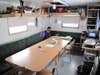
Main Room
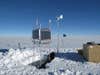
GPS Station
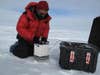
Measuring Gravity
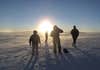
Midnight Sun

Christmas Party
44 Below
The End of the Traverse
Lost Drill
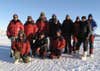
Ready to Go Home