
Plus, read on for a PopSci.com giveaway!
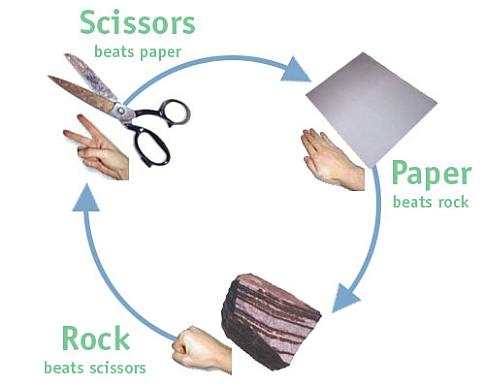
Chances are you've played Rock, Paper, Scissors, but how do you calculate your strategy, if you have one at all?
In Rock, Paper, Scissors: Game Theory in Everyday Life, physicist Len Fisher points out that putting yourself in your opponent's mindset is a key to success in the game.
It's all part of game theory, which has to do with everyday strategies and commonplace interactions -- and not just those designed for winning at Monopoly or trapping wild elk, as it may sound. Fisher, a visiting research fellow in physics at the University of Bristol and author of several science books for lay audiences, argues that a teaspoon of this sort of thinking can illuminate a range of human behaviors. Not to mention that game theory offers a handy explanation of why all those teaspoons keep disappearing from the communal lunchroom at work. (Individuals think it won't hurt the collective if they take "just one" spoon, but, voilĂ , in no time, there are very few, if any, left for the collective to use.)
Laura Silver recently joined Fisher by phone at his home in Blackheath, Australia to discuss his new book and, as it turned out, to play a long-distance game of Rock, Paper, Scissors. (Fisher and his wife divide their time between his home country and hers, England. And yes, they do use aspects of game theory to determine how much time to spend in each place.)
You mention that game theory touches on some of the big issues of our time, from the credit crunch and the energy crisis to how to help kids -- and entire nations -- share their resources. Is there one area where you think game theory can have the most profound effect?
Global warming is one of those things I think are incredibly important. If somebody's personal interest is in politics and keeping power you have to maneuver the situation so they're going to lose power if they don't do something about global warming.
One of the strategies you can maneuver is that countries will lose out economically if they don't do something. You have to maneuver around everyone's economic interests to do something in the shorter term as well as in the longer term.
I wonder if that can work on a smaller scale, at least as it relates to stewardship. For example, I noticed a guy in Brooklyn, New York, with his dog off leash. After the dog did its business, the man picked it up with a stray piece of paper and deposited in a trash can. As soon as he walked away, the piece of paper he used blew out of the trash can. When I called it to his attention, he scowled and walked away.
Do you know where the guy lives? I've known some people who've put the result in an envelope and returned it in a letterbox.
That's quite a coup.
It doesn't have to be rude. If you can build on community awareness, you don't have to have more than a moderate core of people express disapproval.
It all comes back to his future reputation being at stake. You can only build it up through a few examples: Put it in an envelope and give it back or write a letter to the local newspaper, perhaps with an identifier, "a person in a blue shirt, a person walking in this neighborhood." That kind of thing multiplied a few times turns out to have a rather remarkable effect.
In places like Switzerland or the Scandanavian countries, if someone drops something in the street, someone is likely to pick it up and return it to them.
That idea of a community chipping in to receive a result greater than they could possibly achieve individually makes me think of open-source... as in software development and idea sharing.
It works, doesn't it? It operates brilliantly. I think what you can take that as -- what I take it as anyway -- is a demonstration that people really do like to feel as if they're part of a cooperative community, that people aren't totally all take and no give. People like to give so long as others give as well. When others stop giving, then the whole system falls apart.
Is there a tie-in between open source systems and game theory?
This just shows the strength of the giving feeling in individuals. Giving is one of the strongest drives. We like to be part of a family. We like to be part of a community. You can still argue that it's self-interest. Somehow you've got to serve people's self interests. But one of the big ones is an interest in feeling that you're part of a community.
And if you can lock into that, then you're giving them the reward for being part of a community. And that's their reward for cooperating. It's one of the biggest rewards we have.
It's a pity that the politicians just don't seem to have that feeling quite that strong, isn't it?
I'm always struck by examples of everyday people, especially those outside of the Western world. When I was in Senegal, I was shocked when a ten-year-old girl refused to open a package of snacks until she could share them with her extended family. It didn't even occur to her to keep the whole thing for herself or to sample one before being with the group.
That is brilliant. We seem to have lost that a lot in Western countries. Maybe one of the things we should be doing is to rework our culture, to change the thought of 'reward' would really get people cooperating. It's as much of a reward to share.
On the other end of the spectrum, I'm also interested in your take on the Madoff scandal, in light of your recent article. The investors are to a large extent being portrayed as victims.
I've got to be very careful with my wording of that.... I'd reckon that a substantial proportion had a very, very good idea of what was going on. But they thought they were gaining an advantage, so no one cared to look closely.
Do you ever find that in your own life? You think you've gotten away with something, but you don't really want to know... in case it turns out that it was really illegal, what happened or rather bad in some other point of view.
Yes, of course. Do you have any examples of that from your own life, by chance?
I'm just trying to think of a publishable one...
I'll tell you what happened a few weeks ago with me. No one will ever know the names in America, so it won't matter too much. We're very fond of garage sales. We've basically furnished the whole house from garage sales. Of course, occasionally at a garage sale, people are going to be selling stuff that's not theirs. We went to one where this guy had a whole heap of stuff for the workshop, including some wonderful high-tensile bolts.
Then he pointed out as I was taking them, that these bolts weren't an awful lot of money, because they were airplane bolts. And he also gave me his card, which I didn't look at until later. At the bottom of the card it said 'firearms dealer.' And his title was Colonel someone or other. And you can just bet that he came by this stuff, sort of 'fell off the back of the truck' when he was working for the army or the air force. But I already got my bargain. There's no way I can give it back to whoever it belongs to. So I'm OK, I don't have too bad a conscience.
I came not choosing to know who this guy was, when I just saw he had high-tensile bolts. I didn't inquire too closely. I just bought the bolts. So I'm a naughty boy as well.
Maybe not on the same scale.
I hope not.
How many did you buy?
Probably quite a few hundred. Enough for an airplane to fall out of the sky, I think.
And how many games of Rock, Paper, Scissors have you played?
Very few. I find that I can always win now, when people challenge me to it. So if they haven't read the book, I just play paper, because they play rock.
If they have read the book, I just play scissors, because they play paper. I hardly ever lose. That is the classic game theory, actually. Game theory started on this idea that you try to put yourself in the other person's head and think for them, 'What's they're best strategy going to be?' And you assume they're going to use their best strategy.
Then and only then do you start thinking about your own strategy. If the other person knows as much about game theory as you do, that's when you can do better by being unpredictable, by being random.
The best thing you can do in Rock, Paper, Scissors is to randomize the throws.
Well, I'm sorry we can't play a game in person.
Do you want to play one now?
[Listen to the game]
Anything else you'd like to add?
I just think it's so important for people to be aware of the ideas of game theory, especially being aware of the Tragedy of the Commons, and how it arises...
That notion of individuals all taking spoons from the common cafeteria, each thinking their appropriation of a single spoon won't effect others...
If you're cooperating with someone and one of you cheats, you can get away with it. But when you both cheat, you do worse than if you kept on cooperating.
It's this huge trap that underlies most of the problems we run into and it never gets mentioned. Never gets mentioned at all. If you read books on the credit crunch, some of the major ones, you look in the index, and you won't even find game theory mentioned. It's crucial to what's going on. Game theory belongs to everyone, not just the specialists.
And if anyone can come up with a better name than game theory, God, wouldn't that be good. Something that really grabs you.
Do you have any ideas?
If I had, that would have been the title. If anyone has an idea, put it on my blog; they'll get an acknowledgment.
For a chance to win one of five copies of Rock, Paper, Scissors, post a comment (any comment) below, by January 31st, 2009
Five amazing, clean technologies that will set us free, in this month's energy-focused issue. Also: how to build a better bomb detector, the robotic toys that are raising your children, a human catapult, the world's smallest arcade, and much more.


Online Content Director: Suzanne LaBarre | Email
Senior Editor: Paul Adams | Email
Associate Editor: Dan Nosowitz | Email
Assistant Editor: Colin Lecher | Email
Assistant Editor: Rose Pastore | Email
Contributing Writers:
Kelsey D. Atherton | Email
Francie Diep | Email
Shaunacy Ferro | Email
I'd rather get Jan-Ken-Pon book, but I guess Rock Paper Scissors will work just fine.
I find the theory (or what I gather of it) fascinating. When I was young my father played thumb war with me and we used to discuss what you could learn from a person and human behavior based off of their actions and reactions. As I got older I grew into using rock, paper, sciccors with my friends. It's unbelievable what one can observe with such a simple playing field.
I play RPS with my son, 15, and I can always psych him out by looking deep in his eyes and reading what he's going to throw. I can win 85% or better and he doesn't get how hahahahahahahah
I recently read about the traffic engineering concept of removing traffic signs and designating specific roads as "shared space" in an effort to make them safer.
http://en.wikipedia.org/wiki/Shared_space
Would this be considered a game theory situation? The idea is that the drivers will not feel comfortable without a designated lane and a green light, and will drive more cautiously. However, the issue of trust seems like a big one. Are drivers going to "cheat," barrelling down the street making everyone stop for them? Or will they cooperate, make eye contact and give way to others?
Some arguments for the theory point out that the "shared space" concept removes liability from the municipality and puts greater responsibility on the drivers. The Cities don't have to think about all the signs, rules, etc. that may be necessary for a safe street. Since there are none, if there's a wreck, no one can blame the City saying "there should have been a stop sign there!"
This intersection looks like it works just fine!:
http://www.youtube.com/watch?v=RjrEQaG5jPM
Its amazing the things we can learn by observing simple things like RPC. If only politicians payed more attention to this stuff.
You know, it's really quite amusing that I've been using this type of thinking to get out of household chores for years, but only today learned what it actually was. Three cheers for game theory! (Now use the theory to deduce which will be the loudest.)
My son always throws out Rock - I mean always - and I've still lost to him. I could really use this book...
I don't see how throwing paper every time assures a win!?
What about "Holistic Strategization"? Doesn't quite roll off the tongue as nicely as "Game theory" though...
"The best thing you can do in Rock, Paper, Scissors is to randomize the throws."
No kidding? Best way to play a random game is to be random? Good thing I don't always pick paper.
Knowledge is not information, it is transformation. ~ Osho ~
I have not read the book so don't know if the book mentions why people choose rock first. I think the reason people choose rock usually is because unless someone has thought out what they are going to play before the game starts they might panic and choose what word comes to their mind first. Since in RPS you say rock first they might choose rock.
Interesting theory! I look forward to reading the book and learning more.
Interesting topic. I've done some reading on game theory and it does have broad reaching usefulness. It would be good to give this book a read.
I took a course in college about Game Theory and found it very interesting. I enjoyed learning about the Prisoners Dilemma. I haven't read this book (but hope to with a free copy!) but I think any book on this topic would be well worth the time to read. Thanks!
This sounds like an espisode on Numb3rs! Keep it coming ... the book and Numb3rs.
It's amazing how such an easy game could morph into something this huge. I guess it's not a simple game anymore, there is actual theory involved.
wow
Wow, gaming theory must have several applications to the real world and theoretical world. It would be interesting to know how it would help in things such as studies and relationships, etc.
This book sounds very interesting. I'd love to win it to learn more.
I've taken pens home from work thinking that there are still dozens left over and no one will miss one or two but it's still theft from the company you work for.
i want to win
Actually, Game Theory is a great name, even if some minimize the term "game".
"The Duty of Privilege is Absolute Integrity." John O'Donohue, poet, philosopher.
On the CBS TV show, "The Big Bang Theory", two more variables are added: rock, paper, scissors, lizard, Spock.
Scissors cut paper, paper covers rock, rock crushes lizard, lizard poisons Spock, Spock smashes scissors, scissors decapitate lizard, lizard eats paper, paper disproves Spock, Spock vaporizes rock, and rock crushes scissors.
Probability is pretty neat stuff. If you’re interested in this kind of thing read 'Chances Are...' it’s a great book.
Sounds like an interesting book. Can't wait to read it!
Rock, paper, scissors or any other seemingly luck-based game can be played two ways. Those that believe the game really is all about luck may win once in a while. But those who know the real strategies can increase their wins substantially. People are binary: either we think or we just accept. As with the game, choosing the latter of the two in life is usually (if ever) not the best route.
Len Fisher says that the key to winning is to put yourself in your opponents mindset. He says that he ALWAYS wins by doing this. He is in direct opposition to what he says about the game being random. I would like to read this book just to see him explain himself.
I've got an interesting theory... Say you'll give someone something and they post a comment... More people have posted comments on this entry than I've ever seen on this site( : ( ). It's a very interesting theory though (what the article was actually about), my teacher always talked about stuff like this (and about RPS). No book needed for me, I'll never read it.
If We Were All Better People The World Would Be A Better Place
hi
hi
hi
Well, I'm certainly game to learn more about your theories ...
I live in Las Vegas. There is a casino card game of War. There should be a casino game of Rock/Paper/Scissors.
I always thought that playing only one option all the time in Rock, Paper, Scissors was the best way...but it makes for a boring game. Now that Extreme Rock, Paper, Scissors is available it revives the old classic and makes it interesting again. http://www.popculturemadness.com/Trivia/Bits/RPS-Extreme.html
Sounds like an interesting book, will look forward to reading it whether I win it or not.
Very interesting. Mr Fishers other books look interesting as well. I'll be getting this book on my own, if I don't win.
just for the giveaway.
Sounds like as long as we are all working together for the good of the community instead of the good of ourselves, we would be in a better position in life. The contrary to this is so engrained in us it would be difficult to effectively reverse.
i work with middleschool kids, and i ALWAYS lose playing this game, hopefully this will help.
I am keenly interested in the future because I plan to spend the rest of my life there. I think living by this motto allows me to see how working for the good of the community can actually be a self serving, individually motivated action.
I'm interested to see what else these concepts touch in our lives.
Interesting theory.
It is always nice to see another take on game theory. This one seems interesting and I'm looking forward to reading more about it.
Long ago writing was more "open source" or communal. A times it was even in bad form not to copy sections of writing from others to include into your own writing. While I'm not sure I would want a full return to that, I do think present day U.S. copyright laws are a bit too stringent (and sometimes a bit hypocritical). I'm not speaking in black and white here - there are shades of grey - and thus saying we should do away with copyright. But people should have, for instance, a bit more freedom to mix, remix, sample in their creations.
I agree with the author that we should increase cooperation in our culture, and that being part of a community is "one of the biggest rewards we have." However the reason politicians "just don't seem t to have that feeling quite that strong" is related to the admonition in the Bible that the love of money is the root of all evil (and maybe one reason why the Bible says it is extremely difficult for a rich man to get into heaven). It is hard to be greedy and to have a sense of community - the reward of excessive greed for money and/or power overrides, for these individuals, the reward of community.
I haven't read this book, but the interview makes me wonder if one's score in JKP/RPS might be a good way to measure someone's perceptiveness. Also, are people good at acting randomly to prevent someone who's more perceptive from winning?
The book sounds quite interesting. Love a chance to win it. Thanks and good luck all!
I thought this article was really interesting. I guess I never realized what I was doing to win at RPS, but I win a majority of the time. The book sounds great. If I don't win the book, I might just have to buy it.
[url]www.TalkManKind.com[/url]
There are many names for RPS, but all of them are for the same game. My strategy for winning is to not have one and play on the randomness of the game.
Wow, very interesting article. Rock, Paper, scissors can teach us a lot about modern day life in politics and other things. Yes, the main reason I commented was for the chance to win the book, but it was still a very good article.
I haven't seen the book, and the way I win at R.P.S. is normally more of a psychological approach. Of course, this only works about 75% of the time, but that is still above average. But it is indeed true, most people start with rock, unless they have played me several times before, then they start with paper.
My sister always beats me at RPS, maybe I should read the book.
In the Ohio valley area, we've always played with a fourth option- Rock, Paper, Scissors, Dynamite. Dynamite is represented by an extended index finger. It beats Rock by "blowing it up" and loses to Paper (wraps it up) and Scissors (cuts the fuse).
Sounds very interesting. Would love to read more about game theory.
I think its great that we have come so far to be able to predict the 'unpredictable'. Its this kind of spirit which will lead to the future we once dared to dream of.
Who in his or her right mind would ever pick Dynamite? Maybe the rules aren't complete? Or maybe people in the Ohio valley just like blowing things up.
Considering a draw to be a "no loss," I'd rather stick with basic RPS and not complicate things with lizard and Spock. If there's a Vulcan greeting involved, I don't imagine Spock would be called very often, anyhow.
Live long and prosper.
Wow, book sounds really interesting, I hope I win a copy!!!
i've got the same problem eric thegrey, my sister always beats me at RPS and for the life of me i cannot figure out how she does it. pretty sure it's just coincidence
nice!
I want one
I want a copy....so I can be RPS CHAMPION OF THE WORLD!
Playing as a youngster I never gave a thought to theory. I almost never won though. Hummmm
Game theory? Sounds like it could be applied to many things...Hook me up.
Excellent review ... a novel approach to human behavior! Definitely 5-star (although I don't seem to be able to enter my rating :( )
I like books...can I have this one?
it's interesting of all the things people have time to study these days. very interested on the game theory
I always choose scissors, with mixed results.
Maybe we could get a copy of the book to Plankton, who could use it to beat Mr. Krabs and finally steal the secret Krabby Patty formula.
Can you tell that I have two young boys?
Ohhhhhhh, who lives in a pineapple under the sea.....
John Nash would be proud!!!!
This looks very interesting.
