The Sex Files
Scientists discover that breakups can lead to neurochemistry changes by dashing voles' romantic relationships
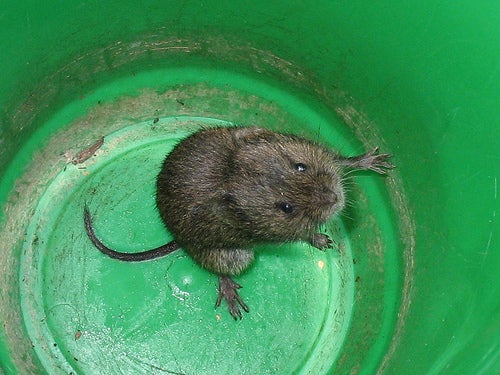
There's a Vole in the Bucket Voles are prone to heartbreak. Gilles Gonthier (CC Licensed)

The cute and cuddly prairie vole, one of only a few mammals that remain monogamous for most of their lives, has long been a favorite “lab rat” for scientists studying love and attachment. Now researchers at Emory University and the University of Regensburg have found that prairie voles actually show signs of grieving—the opposite of attachment—when they’re taken away from their romantic partners.

After pairing nine male voles with females and letting them bond for five days (an eternity for these short-lived rodents), researchers wrested the fledgling couples apart. Compared to voles who had not been separated—and to a control group of males who had been bonded to other males in ”friendship,” then separated—the voles who had been taken away from their “romantic” partners showed signs of suffering. The level of stress hormones in their blood rose sharply, they grew passive and sluggish, and their performance on “forced swim and tail suspension tests”—which are just about as dauntingly unfun for the voles as they sound—decreased quite a bit from pre-separation levels. In short, they were depressed: bonding with an opposite-sex partner had measurably changed the neurochemistry of the voles’ brains. The researchers found that they could reverse this effect by administering a drug that blocked a chemical called corticotropin-releasing factor (CRF), which regulates the body’s stress responses. This suggests that CRF plays a part in generating the array of emotional and physical sensations that we call grief.

The same phenomenon might be at work in human romantic pairs, which could explain why we get so violently unhappy when a partner is taken away from us by death, divorce, or circumstance, or even why we remain in abusive or unhealthy relationships. It’s even possible that, at some point in the future, doctors could prescribe a CRF-blocker to sad Heloises and Abelards to assuage symptoms of acute partner loss.

Got a burning question about the science of sex? Hoping to see a particular topic covered here? Submit your tips, requests, and queries to popsci.sexfiles@gmail.com. I'll answer some selected reader questions in an upcoming column. Keep track of The Sex Files at popsci.com/sexfiles, where you can also sign up for an rss feed.

Want to learn more about breakthroughs in electronics, medicine, nanotech, and more?
Subscribe to Popular Science today, for less than $1 per issue!

4 Comments

I feel there's something missing in this article.

What unnerves me is that nowhere in the article do you draw the obvious conclusion: if one knows moles feel like that, one must be a sociopath to continue doing tests like that on them.
In the name of science some people decide to willfully ignore their instincts and feelings which tell them something is fundamentally wrong.
A sociopath does not feel remorse, willing yourself to eliminate pity and remorse and compassion is one step up: being the occasional sociopath.
I'm as yet undecided which type is more scary.
The world really doesn't need any rodent torturer to tell it that love is pain.
Leave them alone and get back in touch with your inner human,I'm sure it's in there somewhere cowering.

I'm not some earth radical freak; I really do not think anyone outside the scientific community actually finds it acceptable to "find out that animals can suffer" only to then leave it at that, without further thought about the ethics of it all.

breaking up is hard for humans and animals!

www.lipoaspiracao.org

I find the implications of this rather frightening - if one can simply pop a pill to end the grief of losing their lover, how will people strengthen themselves emotionally? If such a treatment were ever made an option, it should only be for those who grow suicidal or homicidal tendencies/feelings as a result of their inability to handle that grief, and even then only if counseling is ineffective.

A strong romantic bond has to have a clear ending to it for people to be able to truly move on. If a pill makes the grief go away, their emotional development and change can't take place (i.e., finding something enjoyable to do with the time that would have been spent with the lover).

@Onihikage

(i.e., finding something enjoyable to do with the time that would have been spent with the lover).
Eh - the thing with grief is that you can't enjoy anything while you are grieving. You are just trying to stay alive until the grief subsides.

Plus allowing people to suffer in the name of "strengthening themselves emotionally?" is sadistic, cruel and stupid. A lot of bad things happen to people and some morons say "but you are stronger for it" - no, you don't come out emotionally stronger, you come out emotionally scarred.


138 years of Popular Science at your fingertips.

Innovation Challenges


Popular Science+ For iPad

Each issue has been completely reimagined for your iPad. See our amazing new vision for magazines that goes far beyond the printed page


Download Our App

Stay up to date on the latest news of the future of science and technology from your iPhone or Android phone with full articles, images and offline viewing


Follow Us On Twitter

Featuring every article from the magazine and website, plus links from around the Web. Also see our PopSci DIY feed


February 2012: The Future of Fun

Science is reinventing play, from extreme sports to gamification to ridiculous roller coasters to the playgrounds of tomorrow, and this issue is chock full of fun. Also, on a less fun note: Did global warming destroy my hometown?


circ-top-header.gif
circ-cover.gif
bmxmag-ps