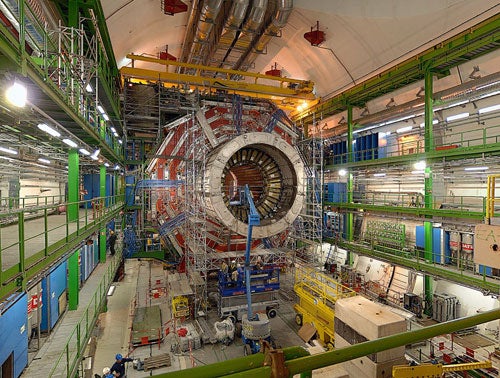
Today’s most ambitious scientific instruments are modern-day cathedrals in their size and complexity, if not in their purpose—these are, after all, structures built to shatter worldviews, not to reinforce them. And the grandest of all, pictured on these pages and fired into action today, will take us on a journey to one of the least-accessible places imaginable: the realm of quantum particles, less than a billionth the size of a single atom.
This is CERN’s Large Hadron Collider, the most magnificent scientific instrument ever constructed. Nearly 17 miles in circumference, buried 300 feet below the city of Geneva and a succession of picturesque French villages, and costing in excess of $6 billion, the LHC will be a window onto a profound and unexplored world that we hope will hold the answers to some of the biggest possible questions: What are we made of? Why are we here? And how could objects as marvelously complex as human beings evolve to ask these questions in such a violent and inhospitable universe?
The LHC is designed to recreate the conditions that were present in the universe less than a billionth of a second after the big bang—and to do so again and again, up to 600 million times a second. It accomplishes this by accelerating protons, the atomic nuclei of hydrogen atoms, so close to the speed of light that they zip around the 17-mile ring 11,000 times a second, before colliding head-on with another beam of protons traveling in the opposite direction. Four giant experiments, ATLAS, CMS, LHCb and ALICE, “photograph” the resulting miniature “big bangs.” I work with more than 2,000 other physicists from 37 countries on ATLAS, a detector that’s been built from more component parts than a space shuttle and that fills a subterranean cavern bigger than the nave of St. Paul’s Cathedral in London. The scale, ambition and unique international cooperation at CERN make it one of the greatest human endeavours of this or any century.
But I’ve found that for many people the focus is not on the sheer audacity and majestic possibility of the LHC, but on the cost. I recently gave a talk about CERN that appeared on the Web and attracted plenty of comment in this regard: “Have we gone out of our freaking minds? How much did this thing cost to build? . . . Billions of dollars, no doubt, and for what? To collide two atoms in the hope of discovering a new particle . . .” In other words, can’t we do something more useful with that kind of money?
Let me answer with an emphatic NO. Finding out how our Universe works has never been a bad idea. In fact, it is the quest for a deeper understanding of nature that has given us everything we now take for granted in modern life. In an eloquent speech to the U.S. Department of Commerce in 1966, the theoretical physicist and then Philips research director, H.G.B. Casimir, pointed out that virtually all of the great discoveries of the 19th and 20th centuries came from curiosity-driven research. The transistor emerged from the quantum theory of solids, not from a desire to build computers and televisions. Radio waves were not discovered by men in government-directed laboratories in order to connect the world together with better communication systems, but by Heinrich Hertz, a man whose overriding concern was for the beauty of physics. In his speech, Casimir went on to list many of the great innovations of the mid-20th century—from nuclear power to automobile starter motors—and point out that none of them came about as a result of some kind of pragmatic process of innovation. The lightbulb, as the saying goes, was not invented through research and development on the candle.
Stay up to date on the latest news of the future of science and technology from your iPhone with full articles, images and offline viewing
Featuring every article from the magazine and website, plus links from around the Web. Also see our PopSci DIY feed
Share links with friends, comment on stories and more
In our December issue, Popular Science names the 100 best innovations of the year: bombproof wallpaper, self-parking cars, the fastest helicopter, and 97 more. Plus inventor profiles and videos.
Check out the best of what's new here.
from Austin, TX
6 Billion for one LHC or 2.6 B2 bombers. Hmmm...discover the deepest secrets of the universe or kill more people...? You can't complain about this when money is wasted on the worst of items, including Halliburton contracts, corporate severence packages, and bridges to nowhere.
Time flies like the wind,
Fruit flies like bananas.
You know. Put that way. This looks pretty cheap. Specially considering how little the B2's have been used. And that whats they've done so far hasn't been irreplaceable.
Afterall a little human error, a lucky bullet or a good missile and there goes 1 billion. Come to think of it. This is a much safer investment too.
from Baltimore, Maryland
I thought it would be good to mention that while the amount of $6 Billion is being tossed around, the US has only contributed 1/12 of that amount, or $521 Million to be exact.
I find it difficult to understand how anyone could criticize the efforts and capital that has been put into this machine. You cannot compare the cost of B2 bombers to the cost of the LHC. They will never equate. B2 bombers were and are created in highly classified and secured warehouses by the government with the purposes of espionage and destruction. The money used to assemble and arm a B2 is the same as money used to build a car. They are not used to find scientific information that could change how every person in the world has come to be. They are not used to gain a greater understanding of the Universe that we live in. They will not aid the future of all humanity.
When you think about the capital, resources, efforts, years of scientific research and development, and entire lifetimes that come together to create the Large Hadron Collider, you should begin to see the importance of this machine. This isn't the collaboration of a select group of individuals with the goal of creating an virtually undetectable aircraft to infiltrate enemy territories.
This is the collaboration of over eight thousand physicists from over eighty-five countries as well as hundreds of universities and laboratories. The analyzed data from this machine, once it is running full blast, will not be useful to only one country, but rather the entire world.
Since as long ago as the birth of the Big Bang theory, humans have wondered how we came to be. If we can create something to help us find out more about our origins, as well as the environment we, everyone in the world, live in, I believe that $6 Billion of global economy is dirt cheap.
It's easy for someone who has only known the investment of a few hundred or a few thousand dollars to look at a six billion dollar price tag and scoff, thinking that nothing could possibly be worth that much and that the capital could be used in more advantageous ways. I'd like to leave you with just one quote:
"A cynic is a man who knows the price of everything, and the value of nothing."
--Oscar Wilde
6 billion really ain't a whole lot of money when you're talking about the collaboration of this many countries. B. Gates could write the check himself. Man to think what we will see in the next 50 years if technology advances even close to what the last 50 years gave us. Wow.
I find it a bit irrational, impulsive and emotional (seemingly frequent US liberal political behavior) to state that the military has not brought much benefit. Far from true. Most of the advances we found were perhaps not directly done by the military themselves, but through funding by government directly related to research to benefit the military, be it national defense or for offensive reasons. Military brought us helicopters, radar, infrared, etc. - all things quickly transitioned for use by the general public. Sure, I feel we waste far too much money on overpriced hardware, especially airplanes and space, but please don't disregard the benefits.
As for this research, it's a gamble - but then again, all research is. Theorists believe there just must be something more here to support their theory/beliefs... wow, they don't differ much from theologists in their ferver.. If they don't see the results they desire, they want more money. I don't blame them. I don't blame religeous types. It is what makes us human. The pursuit of understanding and truth.
..I went off subject, sorry...
But, can anyone tell me what real-world benefits Fermilab has brought to us? Sure, they believe they've empiracal evidence for quarks, bosons, etc., but how has this been applied to other things? Have the discoveries acted as firm building blocks to production of things to help society, such as, I don't know, say, space propulsion, or better energy consumption, or making better electronics?
ymi2b, for one thing, fermilab had to create a network to share data with other scientists, which has now evolved to the internet. Simply this alone, among hundreds of other things, has been a result of massive researches performed by scientists that most retarded people like you consider to be useless. Radar, infrared, and other things have all been achieved through science and military. without science, the military would still be using 18th century weapons.
ymi2b, for one thing, fermilab had to create a network to share data with other scientists, which has now evolved to the internet. Simply this alone, among hundreds of other things, has been a result of massive researches performed by scientists that most retarded people like you consider to be useless. Radar, infrared, and other things have all been achieved through science and not the military. without science, the military would still be using 18th century weapons.
YMI2B... You spelled "religious","fervor" and "empirical" incorrectly. Perhaps you should troll an English site.
BRAVVO ! My hats off to the writer of this artical . A sensible explanation to a vastly complex experiment was in order . Thank You . It scares me to think that our future may be in the hands of people who really believe that money is the most important thing in life .
from Winnipeg, Manitoba
My guess is by recreating the big bang, there going to be creating something somewhere else in Time...
With all that energy, they might just speed up the molecules of everything so much the L.H.C. Either
A)Falls through the ground and The whole thing is somewhere in the Mantle of the Earth
B)The Protons Cease to Exist all Together Perspectively, Into another Spectrum of Matter moving Faster Right through and around All we see.
C) Collides and Explodes into what appears to be nothing, then all of what makes up protons starts to cling to each other out of gravitational field, and builds into a spherical proton once more.. Only in a Vacuum However...
~ You fall somewhere in the Balanced Frequency of Nature. Someone Along the Infinite Spectrum of Life.
FaceBook: www.darkfx.cjb.net
DeviantArt: www.exodusprime.cjb.net
www.youtube.com/d4rkfx
www.myspace.com/exodusprime
T I M E . . .
Fire, gunpowder, LHC. . .
I prefer the latter . . .
60 Billion dollars, a walk on the moon ( if ever it happened ), as against 6 Billion dollars LHC . . .
I prefer the latter . . .
for this expense 6b$ to be justified , you first have to believe that the universe started as a ball of all the known matter , which somehow explodes. is there proof of a big bang theory? or do we take a huge leap of faith (religion like)and trust.
We could have had the Superconducting Super Collider with a 54mi circumference (and 40Tev!) for only 12B if the '93 Democrat congress hadn't killed it...
i dont know where to begin but i am surprised by the ratio of people that actually realize the importance of this machine,however the ignorance of the others makes up for that ratio, the one that sticks out the most is, well the name says it all NIMROD, do you honestly doubt our trips to the moon? do everyone else a favor dont comment anymore because someone might take you seriously and we have enough stupid people in this world we dont need anymore, how many people do think we can fit on the short bus. moving on to mr. bombs and killing and war and oh you must be a republican haha! are you enjoying our new country now that your party has no power? but maybe your right why would we wnt to further our knowledge and understanding of the universe when we could be blowing ourselves up, if we have it your way we wont be around in 50 years, actually we might not even be here by the end of this one cause the LHC is going to create black holes and swallow the Earth. haha! unfortunetly i have to cut this short so i cant get to all of thing but b yes the big bang has been proven do some research.
Everything that has not been proven in a lab over and over many times is nothing more than a theory an idea with merit.
I don't know key word knowledge) about how the LHC will be able to create enough gravity in such a small area of space to enable the creation of a sub miniature black hole the most destructive force in nature.
I always imagined that black holes were a gateway to another dimension a rip in space time I guess string theory would come into play. (key word theory)
I believe in our global scientific community that they are in the pursuit of facts not theories to better the knowledge of human kind,and to what cost well it does not outweigh the benefits such as maybe the ability to send heavy weight payloads into orbit and beyond with the discovery of anti gravity or the ability to generate gravity wells to propel crafts to the speed of 99% of light.
Maybe new cancer fighting medicines.
The cost of such marvelous discoveries does not out weight the human cost if not discovered in the near future.
Good day.
from St. Catharines, Ontario
ahaha...u no...wenever i read this..for some reason i laugh
its jus so ridiculous, but so amazing at the same time 0_0
I'm curious why the writer was so worried about justification for the money spent.Which by the way didn't just vanish into some mysterious other dimension.It was paid to workers,and manufactuers ect.It would have been nice to have heard more about this machine,and how all its parts work together.Of course he does talk about some of the good things the machine may bring about.We don't know what this machines value realy is,but It does give us posibilities that would have been uncomprehendable to the giants from are past that we owe our feeble understandings of the universe to.It may only add one small new fact to our meager stock of knowledge,but it may be a new understanding of spacetime for example.What value would you place on unlimited power,or the ability to not only leave our little dirt ball(earth),but to reach for the very stars we wish to understand.Oh on a earlier comment mass,and energy are the same things in a different form so the big bang could be seen as enough energy to create all the mass in the universe.so you don't have to try to imagine everything there is coming from a singularity,but it is interesting to consider all this energy(a massive amount odviously)has no mass,and perhaps no other dimensional quantities as we think of them(tall,wide,long,and maybe even time),but if you look at the amount of energy released from the small amount of mass in an atomic bomb its pretty much impossible to fathom the energy that would be created by converting all known mass back into energy.Anyway back to the collider,we don't know what value this thing has for sure,but the possibillities,well they are unlimitted.
When we think about the trillions of dollars in bail out money being spent to defeat the capitalist system 6 billion seems like chump change. It is impossible to accurately forsee the benefits of scientific research. What we do know is that an increase in knowledge is nearly always beneficial. The Hadron collider is an amazing piece of science and will probably exemplify the Chinese curse " May you live in interesting times." As we learn more about the tinyest of objects I am reminded of the definition of a specialist. "One who learns more and more about less and less until he knows everything about nothing."
I’ll keep it simple and short, I am not a scientist, but I think that you can’t put a price on science, you can’t say that the outcome doesn’t justify spending $ 6 billion because simply you can’t expect what the outcome might be, you can be certain however that it will be something that will catapult humanity into the future by decades if not centuries.
In my opinion, spending $ 6 billion on such a machine is the equivalent of purchasing a $ 200 million mansion for ONE CENT! I am positive that we are going to look back at this experiment 50 years from now as a corner stone in the advancement of the human race, when we will be travelling between solar systems harvesting resources, with a picture of the LHC hanging on the walls of human space ships!
I hope all goes well, and the benefits and science would be made available to all humanity.
*sigh*
Cox parrots the same tired line that the HEP world has been spinning for decades now: we get to the modern world from fundamental research, and LCH is research in that spirit. To support this bromide he quotes a speech from 1966!
Make no mistake about it: contrary to the claims of this article, the modern world is the result of extremely focused industrial research. The internet, spread spectrum telephony, IC's and processors, CCFLs, car engines, GMR hard drives, everything around you that is new from the last 50 years is the result of industrial research.
Cox uses the transistor as one of his examples, claiming that it sort of fell out of QM. Either he is being disingenuous or really doesn't know the history of it's development. Semiconductor radios pre-date a real understanding of QM by some decades, and the transistor itself was the result of a very focused research program to develop that device specifically. In fact, branches of QM exist _because_ of the development of the transistor, not the other way around.
You can get bogged down in one-off examples though, so let's step back a bit and look at the bigger picture. It is true that in 1966 much of the scientific progress up to that point was due to fundamental, even non-commercial, research. That's because there was no industrial science until the 1940s.
But what if you look beyond that date? Well clearly its no longer true. Very little of modern high-energy physics, which is what the LHC studies, has any relation to the real world at all. I can't think of a single fundamental discovery in the last 40 years that has any bearing on our lives at all.
Be sure you understand what I'm saying there. Modern physics is delivering a constant stream of changes to the world in an ever-increasing rate. But *high-energy physics* is not. HEP is way out on that asymptote, way past the point of diminishing returns. It's mined out.
This isn't a bad thing, it demonstrates how great our understanding of the world is. But to expect that this $6 billion will have some sort of spin-off effect due to the *physics it discovers* is ridiculous. If someone wanted to spend $6 billion refining the 40th decimal place of Boltzmann's constant they'd be laughed at. Yet this is precisely what LHC is doing, refining a model we already claim to understand.
The historical parallels with the development of mathematics is a good one. Calculus opened up a huge amount of the natural world to study for the first time, and the handling of linear equations and matrix techniques helped too. But the study of close-packing spheres in 32 dimensions? Well it's interesting, sure, but not practical. Unlike the HEP world, however, the mathematicians aren't claiming that some great advance will magically appear out of their most esoteric work. So why does the HEP field keep trying to do so?
Well, maybe in the near future, the scientifics could be capable of a real control of the plasma generators, the so-called "tokamaks", and get and mantain a controlled hidrogen-fussion process to get the real clean energy sources that the world is badly needing. The only way to get the know-how about this exciting new way to get low-cost electricity is trough a better knowledge about the real behaviour of the particles in the very high energy range. This instrument is the only way to get the proper observations of that particles and the proper methods of generation and control of the future plasma resources. Is almost incredible that nobody can see the most logical application of that incredibly expensive researching infrastructure. Someday the plasma reactors will produce all the energy needed for domestic and industrial use, leaving only as curiosities the other polluting and expensive methods to generate it, and giving a real brake-time to the natural resources. Maybe then our grandchildren will say "thanks to that intrepid XXI century investigators and the hadron collider was possible to develop our actual plasma tokamaks"...
thanks for a nice share. What a phenomenal article you have shared with us. I really appreciate you for this wonderful work and made this happened.
www.AdvanceLoan.net
Dompee. There was no need to call brother Nimrod stupid. He merely has his own take on things.
To be honest, I think one day you might even find yourself thinking that man has not ever walked on the moon.
Search not for "proof". Instead look at all the evidence available and then make your own mind up. You have to think for yourself and trust your inner voice, your instinct, your own truth..
We are one consciousness, we all know everything. We're impurified with age. Programmed to think a certain way.
The Hadron Collider. All I'#m saying is that if I has $6 billion USD I would spend it to fight against EU reform, I'd sue people like Zbigniew Brzezinski, for crimes against the human race.