
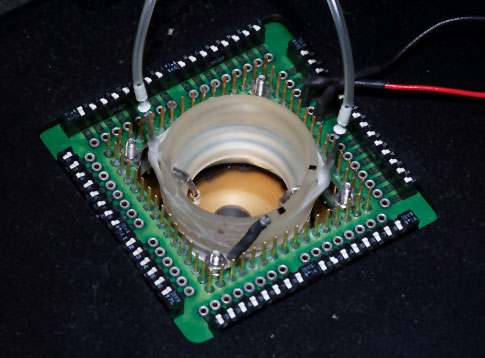
In wet lab 412C on the University of Southern California’s Los Angeles campus, Vijay Srinivasan is poking a long, evil-looking needle at a slice of rat brain about half the size of a fingernail. All around him, coils of cable are piled near hulking microscopes. Glass vials and fluid-filled plastic dishes compete for space with spare keyboards and computer chips. The place looks more like a computer-repair shop than a world-class laboratory.
“Watch this,” says Srinivasan, a design engineer working with USC’s Center for Neural Engineering. A thin wire runs between the needle and a tiny silicon chip hooked up to a boxy signal transmitter. He flips a switch, and a series of small waves shimmers across a nearby screen-waves that mean exactly zilch to me. Watch what? I wonder.
Srinivasan explains that the chip is sending electric pulses through the needle into the brain slice, which is passing them on to the screen we’re watching. “The difference in the waves’ modulation reflects the signals sent out by the brain slice,” he says. “And they’re almost identical in frequency and pattern to the pulses sent by the chip.” Put more simply, this iron-gray wafer about a millimeter square is talking to living brain cells as though it were an actual body part.
Ted Berger, Srinivasan’s boss and the mastermind behind the tangle of coils and electrodes, has arranged this demonstration to provide a small but profound glimpse into the future of brain science. The chip’s ability to converse with live cells is a dramatic first step, he believes, toward an implantable machine that fluently speaks the language of the brain-a machine that could restore memories in people with brain damage or help them make new ones.
Remedying Alzheimer’s disease would, if Berger’s grand vision plays out, be as simple as upgrading a bit of hardware. No more complicated drug regimens with their frustrating side effects. A surgeon simply implants a few computerized brain cells, and the problem is solved.
Down the hall, Berger rises to greet me in his office. An imposing man with a shock of gray hair, Berger, 56, has the thick build of an aging athlete and the no-nonsense manner of a CEO. Can a chunk of silicon really stand in for brain cells? I ask. “I don’t need a grand theory of the mind to fix what is essentially a signal-processing problem,” he says. “A repairman doesn’t need to understand music to fix your broken CD player.”
What the chip is saying is anyone’s guess-the content of the conversation is beside the point, Berger continues. It’s straight mechanic-talk from the man who has created a prototype of the world’s first memory implant, basically a hardware version of the brain cells in your hippocampus that are crucial to the formation of memory. The chip is meant to replace damaged neurons in the same way other prosthetic devices stand in for missing limbs or improve hearing. “If we can mimic even 10 percent of the brain’s efficiency and power, it would be humongous,” Srinivasan tells me later.
Berger’s research team-an all-star roster of neuroscientists, mathematicians, computer engineers and bioengineers from around the country-has so far managed to reproduce only a minute amount of brain activity. Their chip models fewer than 12,000 neurons, compared with the 100 billion or so present in a human brain. Yet researchers within the field say that even this small number represents a stunning achievement in the field of neuro-engineering. “It’s the type of science that can change the world,” says Richard H. Granger, Jr., a professor of brain sciences who leads the Neukom Institute for Interdisciplinary Computational Sciences at Dartmouth College. “Replicating memory is going to happen in our lifetimes, and that puts us on the edge of being able to understand how thought arises from tissue-in other words, to understand what consciousness really means.”
FROM FRINGE TO VANGUARD
Berger walks me outside on this balmy late-summer afternoon and drives us down the Santa Monica Freeway in his lemon-yellow Jaguar convertible. We’re on our way to USC’s Information Sciences Institute at Marina del Ray, just 30 minutes south from Wet Lab 412C, where computer programmers have been helping Berger fine-tune his chip. The big challenge, Berger says as he guns ahead of an 18-wheeler, is to make the chip fully bidirectional, so that it can both generate and receive signals, just like a real cell.
Berger’s professorial monologue seems strangely at odds with his flashy style. The hair flying back from his temples, the designer shirt, the sports car-all this gives him the bearing of a dot-com millionaire, not a researcher who spends his days thinking about rat brains. “To be honest,” he says, “the general reaction to what we’re doing is: Wow, this is really cool, but you guys are nuts.”
Berger has grown accustomed to this reputation. He has spent most of his career on the fringe of his field, only to watch that fringe become the leading edge in recent years. As a young Harvard graduate student in physiological psychology in the 1970s, he published a now-classic study of eye-blinking in the prestigious journal Science that established him as an oddball wunderkind in the competitive field of neuroscience. By the time he earned his Ph.D. in 1976, at the age of 26, he had accumulated 10 papers and an award from the New York Academy of Sciences. But as he ascended the ranks of academia, he grew increasingly restless with the accepted wisdom of his colleagues. “The idea was that you could solve every brain problem with a drug or surgery,” Berger remembers. He began to chart a different path in the 1980s.
At the time, most neuroscientists largely regarded the brain as a poorly understood swamp of biochemical interactions. Berger, however, set out to reduce higher cognitive functions to a set of mathematical equations based on how neurons responded to various stimuli-equations that could then be coded into some form of prosthetic device. Even in casual conversation, Berger seems eager to demystify the brain. “Its cells are nothing but leaky bags of salt solution, 20 microns in diameter,” he says, laughing.
But beyond his professional ambition, it’s the medical and therapeutic potential of neural chips that has most inspired Berger’s singular vision. A machine able to revitalize memory cells would change the lives of millions of Americans who suffer from brain disease, and offer relief to the families that care for them. In 1999, that possibility became personally significant for Berger. At a time when he was keynoting conferences around the world, his mother suffered a stroke and developed strange neurological symptoms typical of hippocampal damage. “She didn’t speak, but she could laugh and sing,” recalls Berger, who grew up in Poughkeepsie, New York, the son of an electrical-engineer father. His mother’s illness and resulting death in 2005 had a profound and grounding influence on his work. “It suddenly made my research more than just a cool laboratory problem to solve,” Berger says. “Instead of just thinking about [the brain chip] as solving one of the great puzzles of neuroscience, I now think mostly in terms of increasing the quality of life for stroke, epilepsy and dementia patients.”
Today an estimated 4.5 million Americans suffer from Alzheimer’s, at an annual cost of some $100 billion, according to the Alzheimer’s Association and the National Institute on Aging. “And those figures are just going to climb as my generation gets older,” says Berger, who can rattle off the grim statistics from Alzheimer’s and other brain disorders that disturb memory. Another 5.3 million Americans are victims of traumatic brain injuries, which can trigger a variety of neurological dysfunctions affecting the hippocampus, including memory loss, epilepsy and Parkinson’s disease.
Where Berger once had difficulty attracting research partners, his recent triumphs in the laboratory, coupled with the emerging medical potential of his work, have put him front and center. He now heads a National Science Foundation review panel on neuro-prosthetics. As the leader of a national project investigating the brain-computer connection, he has attracted some of the country’s most prominent scientists to his 65-member team. One of USC’s top biomedical engineers, Vasilis Marmarelis, developed the modeling theory for his chip, now being road-tested at the university’s Los Angeles labs, where Berger directs the Center for Neural Engineering. And Sam Deadwyler, a national expert on pharmacology, will test the chip on the brains of live rats later this year at Wake Forest University. Berger is no longer on the fringe.
MELDING MIND AND MACHINE
Scientists’ increasing ability to map the basic structure of the brain has already produced a handful of machine implants that can compensate for damaged sensory systems. The artificial cochlea, for instance, has given hearing to the deaf, and artificial retinas are now in patient trials.
But the most dramatic achievement in humans so far is a neurosensor under development by brain researcher John Donoghue and his colleagues at Brown University. When placed over the brain’s motor-cortex area, the sensor enables quadriplegics to open and close a prosthetic hand merely by thinking about doing it. This technology, called BrainGate, allows the machine to convert the electronic signals coming from the brain (“I want to move this hand”) into motor activity by using algorithms embedded in a software chip. “The possibilities are limitless,” says Elizabeth Razee of Cyberkinetics Neurotechnology Systems, a firm in Foxborough, Massachusetts, that hopes to bring BrainGate to market by 2009.
Cyberkinetics’s work bears some similarity to Berger’s. Both convert brain signals into code that can be interpreted and translated by a computer. But Berger has set himself the more difficult challenge. BrainGate offers a one-way link between mind and machine: The user can talk to a computer but not vice versa. Berger’s brain chip operates in two directions, functioning as a bridge over damaged cells.
The challenge of mathematically mimicking brain function-and the internal language it uses to communicate concepts like emotion and memory-is complicated by the fact that brain cells converse in a sort of secret electrical code. One cell “talks” to another through pulses of electricity, the message of which depends on the time and frequency of their firing. These spatiotemporal patterns allow us to, for instance, gauge the distance between objects in a room and navigate around them.
Measuring these patterns, and programming the results in terms that a computer chip can understand, is what occupies John Granacki, a specialist in circuitry and part of Berger’s interdisciplinary research team at the ISI in Marina del Ray. In the elevator on the way up to Granacki’s office, Berger boasts, “These people are really cutting-edge. They’re the ones who invented the Internet.” (Actually, as Granacki later explains to me, they hosted the West Coast sector of Arpanet-the academic proto-Web -in the 1970s, but close enough.)
When we meet Granacki, he’s clad in chinos and a starched button-down shirt. Rectangular, rimless glasses slide down his nose. No sooner do we sit down than he and Berger begin talking shop about chip production schedules and new math models. Suddenly I feel like the only one in the room who’s speaking English.
For the past four years, Granacki has been trying to develop circuitry that could translate Berger’s equations into electrical pulses. The big mechanical hurdle has been figuring out a way to reduce the amount of heat generated by the transistors so that a chip won’t damage healthy brain cells. The solution was to create a more complex version of the same kind of digital circuit that performs computations for a family desktop, except far smaller.
Jeff LaCoss, the senior electrical engineer on Granacki’s team, hands me a working model of the memory chip. Similar to the one I witnessed at Wet Lab 412C and lighter than a feather, it disappears in my palm. The chip, LaCoss tells me, represents 100 neurons that can individually receive analog signals from live brain tissue, convert them to digital signals, and then reconvert them to an analog signal relayed to healthy neurons on the other side. “We still need to do some tinkering,” cautions LaCoss, stealing a glance at his boss. “But I’d say it’s just about ready to go.”
LESS THINKING, MORE DOING
For all their lofty ambitions and recent progress, Berger and his team still don’t understand how the brain processes and sorts information any better than other neuroscientists do-one reason, he admits, why many of them have criticized his work. “They tell me I don’t know what memory is, which is true,” he says, walking with me toward the parking lot. “And they ask how I can replace something that I don’t understand.”
Berger’s answer is simple: Just by doing it. Later this year, Berger’s colleagues at Wake Forest will hook up a more complex version of the chip to live lab rats whose memories have been temporarily disabled by drugs. If the animals’ brains react to the computer-supplied signals with the same regularity as the slice of rat brain in Wet Lab 412C does, it will, Berger says, be a “monumental” moment. “We’ll prove we can replace a central part of the brain that has lost a higher cognitive function, such as memory, with a microchip,” he says.
Within four years, the team aims to wire a chip beneath the skulls of monkeys, whose brains are even closer to humans. Berger predicts that human trials of a prosthetic device that can actually replace impaired memory cells are less than 15 years away.
Unsurprisingly, Berger’s ambitions for the brain tend to court controversy. The misty realm of cognition, the part of us that receives and remembers knowledge, has long seemed impossible to reproduce in the lab. What makes humans unique, after all, is the fact that no two of us think alike-the result of individual patterns of associations, personal memories and thought processes that inherently defy machine-like standardization.
That’s why the notion of a “bionic brain” puts off so many observers of Berger’s work. Tampering with fundamental processes like memory and consciousness could play havoc with notions of identity. For instance, what if a brain chip of the future caused people to recollect things that never happened to them? Or what if it destroyed healthy memories to make room for new ones? “We could be screwing up good memories as well,” Granacki admits.
Walt O. Schalick, a physician and the associate director of the Center for the Study of Ethics and Human Values at Washington University in St. Louis, echoes that concern, asserting that a chip like Berger’s could fundamentally alter one’s identity. Changing the wiring of our memories, he warns, could subtly scramble our patterns of association and, by implication, the “thought structure” that defines our individual personalities. This could happen, he argues, principally because even the best model of hippocampal cells doesn’t tell us everything about how the brain is working. “Modeling or even mimicking is not replacing,” Schalick says. “Dr. Berger’s experiments at this stage offer only an incomplete bridge.”
He points to conceptions of how the heart worked in the early 20th century, when most people assumed it was nothing more than a pump. Then they discovered it was also an endocrine organ, and decades of work had to be done to adjust our grasp of its processes. “Those who view this work as a step toward an uploadable brain-put in a new SD card with your Calculus 1 information, and take the test-are a long way off,” he says.
Another problem is that researchers have found that damage from diseases like Alzheimer’s occurs in many places in the brain. Fixing one broken slice of brain circuit, therefore, may not be enough. “It’s important to remain skeptical,” Dartmouth’s Granger says. “We may make something that looks like an arm, but it can’t pick up a cup of coffee.”
DINING WITH DOCTORS
Although the ethical implications of Berger’s work are significant, there is no shortage of people willing to fund it. The National Science Foundation and the National Institutes of Health contribute to the annual $3-million research budget for Berger’s project. So do the Pentagon’s Office of Naval Research and the Defense Advanced Research Projects Agency, the Pentagon’s experimental-technologies arm. Brain-machine interface research holds obvious potential for tomorrow’s soldiers: Think of mini chips attached to a combat grunt that could provide infrared night vision, for instance.
Meanwhile Berger’s research, once the stuff of fantasy, is already finding its way into the mainstream. In 2003 Berger formed Safety Dynamics, a company in Tuscon, Arizona, that applied his neural-modeling techniques to develop an acoustic-recognition system called the Sentri. It can distinguish the noise of a gunshot from, for example, the sound of a misfiring car cylinder-a handy way for short-staffed police forces to monitor crime-plagued neighborhoods. Police departments in Chicago and in Tijuana, Mexico, now employ the device, and authorities in Phoenix, Los Angeles and Oklahoma City have expressed interest in it.
Yet we are still years away, possibly decades, from getting ourselves fitted for a personal memory upgrade. But, Granger says, “it’s time to take the idea seriously.”
Berger drops me off at the USC campus. He’s headed to another conference in the morning, this one in Paris. Although it’s satisfying to be in demand, Berger says he misses the days of tinkering in the lab. “Sometimes I’d like to just go back to pure research,” he admits. “But it’s nice to see it start to pay off.”
I ask Berger about his plans for the evening. He’s headed to his hilltop home on the Palos Verdes peninsula overlooking the Pacific. “I promised my daughter, Kimberly, and my wife that I’d be home early for once,” he says, and I nod, imagining talk of homework and PTA meetings. But I’m wrong. Berger’s wife, Roberta Brinton, is a leading USC researcher on estrogen-replacement therapies in Alzheimer’s patients and has worked as part of Berger’s team to culture living brain cells onto silicon chips. Suddenly the man’s energy and determination snap into focus for me: He unwinds from being a jet-setting brain scientist by going home-and talking about the brain. “We discuss prosthetics over dinner,” he acknowledges with a shrug, and turns to his car.
