Awed at the pace of technological advances, a faction of geeky writers believes our world is about to change so radically that envisioning what comes next is nearly impossible.

by Jonathan Worth Charles Stross Jonathan Worth

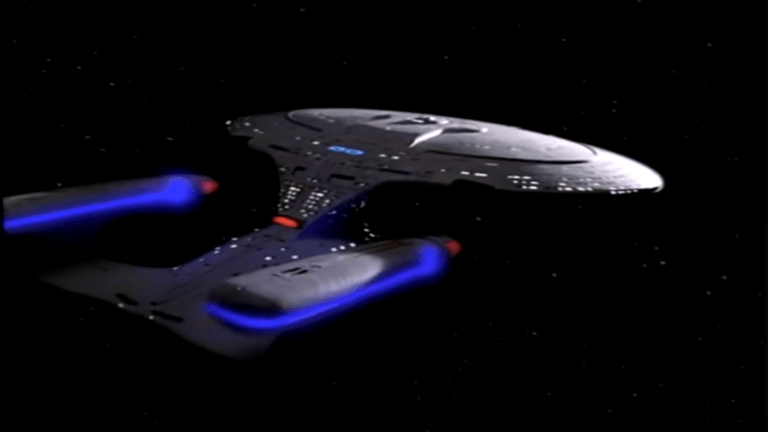
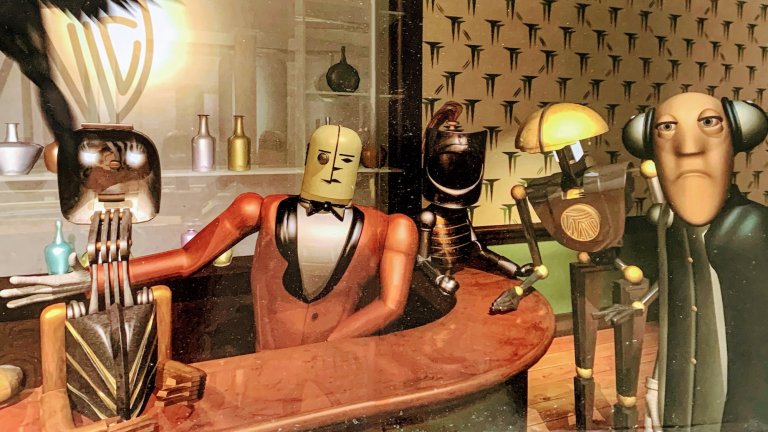
The starship Field Circus is racing through space on a seven-year journey to a brown dwarf three light-years from Earth and, if all goes well, a business meeting with an alien civilization from another universe. It’s around the year 2030, and there’s time to kill, so three crew members, Boris, Pierre and Su Ang, are sitting in the bar, a wood-paneled room modeled after a 300-year-old pub in Amsterdam. There’s a 16-page beer menu, but Boris has opted for a cocktail made of baby jellyfish. Pierre is angling for a sip when Donna the Journalist appears. She isn’t exactly welcome, but she sits down anyway, orders a bottle of German beer from the waiter, and asks the three if they believe in the Singularity.
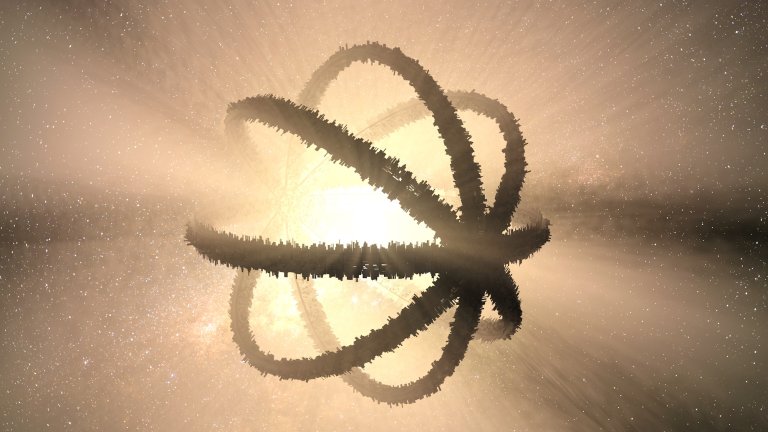
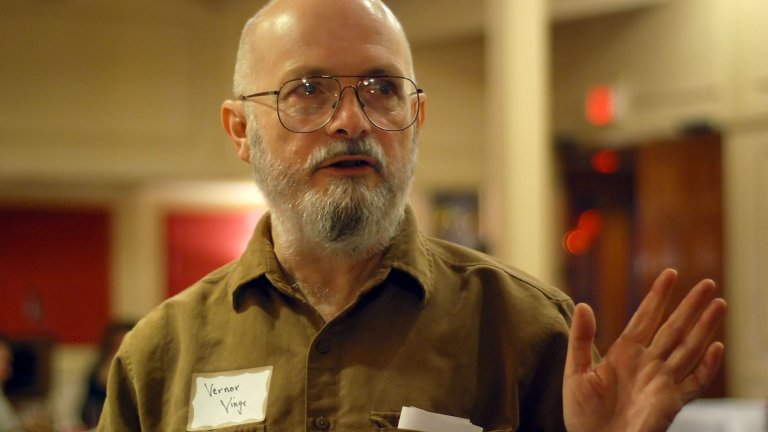
Ah yes, the Singularity. A very real term, although the scene above is taken from a soon-to-be-published novel, Accelerando, by British writer Charles Stross. The idea was conceived by Vernor Vinge, a computer scientist and science-fiction writer who’s now a professor emeritus at San Diego State University. We’re living through a period of unprecedented technological and scientific advances, Vinge says, and sometime soon the convergence of fields such as artificial intelligence and biotechnology will push humanity past a tipping point, ushering in a period of wrenching change. After that moment—the Singularity—the world will be as different from today’s world as this one is from the Stone Age.


Back on board the Field Circus, Donna the Journalist asks the crew members when they think the Singularity took place. “Four years ago,” Pierre suggests. Su Ang votes for 2016. But Boris, the jellyfish drinker, says the entire notion of a Singularity is silly. To him, there’s no such thing. Wait a minute, Su Ang responds. Here we are, traveling in a spaceship the size of a soda can. We’ve left our bodies behind to conserve space and energy so that the laser-sail-powered Field Circus can cruise faster. Our brains have been uploaded and are now running electronically within the tiny spaceship’s nanocomputers. The pub is “here,” along with other virtual environments, so that we don’t go into shock from sensory deprivation. “And you can tell me that the idea of a fundamental change in the human condition is nonsense?”

Accelerando is the story of three generations of a dysfunctional family living through the Singularity. What makes the novel unusual is not the size of the ship or the strange cocktails or even the sexual metaphors—a coital act culminates with the transfer of “source code”—but the fact that Stross is attempting to imagine the relatively near-term future. This is a strangely courageous act, because modern science fiction is facing a crisis of confidence. The recent crop of stories mostly take the form of fantasy (elves and wizards), alternate history (what if the Black Death had been deadlier?) and space operas about interstellar civilizations in the year 12,000 (which typically gloss over how those civilizations evolved from ours). Only a small cadre of technoprophets is attempting to extrapolate current trends and imagine what our world might look like in the next few decades. “We’re staring into a fogbank,” Stross says, “and we literally do not know where we’re going, only that we’re going there very fast.”


The science-fiction legends—Arthur C. Clarke, Isaac Asimov, Robert Heinlein—still loom imperiously. Clarke pulled humanity’s technological reach to the heavens, with visions of communications satellites, space elevators and rotating space stations. Asimov changed our perspective here on Earth, filling our homes with robots that dust, cook—and sometimes turn against their owners [see “Could Robots Take Over the World?”]. And with his rollicking space adventures, Heinlein pushed us into distant galaxies and far-future civilizations. The golden age of science fiction (SF, to those in the know), which spanned the 1940s and ’50s, inspired generations of kids to become astronauts, physicists and engineers, to try to make at least some of the stories real. (And those kids remember their imaginative roots: NASA, for example, sometimes calls in SF writers as consultants.)


Wandering through the exhibition room at a science-fiction convention in Boston a few months ago, I saw plenty of reprints of golden-age SF classics for sale. But I also encountered paintings of half-naked people battling dragons,
vendors hawking crystals and a folk musician warming up for a recital. Where is the science in science fiction? I wondered. Whatever happened to envisioning the future? Anthropologist Judith Berman, who recently surveyed a crop of science fiction published in 1999, has a grim answer: Many modern stories are nostalgic, wary of new technologies rather than enthusiastic about them.


Yet there’s plenty to get excited about: Vinge’s vision of the Singularity springs from his own field, computer science, but change is afoot throughout science and technology. Cosmology is undergoing fundamental revisions, genetics is giving researchers the tools to rejigger the building blocks of life, and nanotechnology has begun creeping from fantasy into reality. “Several lines of progress [are] converging,” says physicist Stanley Schmidt, editor of Analog magazine. “You can’t lock in on one field in isolation because you’ll miss how other fields affect it.”A new kind of future requires a new breed of guide—someone like Stross, whose first novel, Singularity Sky, was recently nominated for a prestigious Hugo Award, or his frequent collaborator Cory Doctorow, who in 2000 won the Campbell Award for best new science-fiction writer. Both are former computer programmers. They are computer geeks and gadget freaks. They follow engineering and materials science and biotech, not to mention politics and economics. And they have latched on to the Singularity as the idea that symbolizes our era’s rush of new discoveries. Whether their stories will usher in another golden age or inspire a new generation of dreamers remains to be seen, but their focus is dead-on. “Right now is an extremely exciting time because there’s an explosion of knowledge in biology, an explosion of knowledge in technology, an explosion of knowledge in astronomy, physics, all over the place,” says David G. Hartwell, a senior editor at Tor Books. “Right now it’s quantity, and Doctorow and Stross are the writers who are principally concerned with all this stuff.”


single page
Page 1 of 3 123next ›last »
Want to learn more about breakthroughs in electronics, medicine, nanotech, and more?
Subscribe to Popular Science today, for less than $1 per issue!

1 Comment

Science Fiction About to Go Blind.....What is the meaning? I just noticed his glasses,very nice! I've seen it on this website
www.firmoo.com/


June 2013: American Energy Independence

Five amazing, clean technologies that will set us free, in this month's energy-focused issue. Also: how to build a better bomb detector, the robotic toys that are raising your children, a human catapult, the world's smallest arcade, and much more.


Online Content Director: Suzanne LaBarre | Email
Senior Editor: Paul Adams | Email
Associate Editor: Dan Nosowitz | Email
Assistant Editor: Colin Lecher | Email
Assistant Editor: Rose Pastore | Email

Contributing Writers:

Kelsey D. Atherton | Email
Francie Diep | Email
Shaunacy Ferro | Email

circ-top-header.gif
circ-cover.gif
bmxmag-ps