How To Build Your Own Cockroach Cyborg
A mind-controlled insect that scurries and stops on command
Heavy Lifters
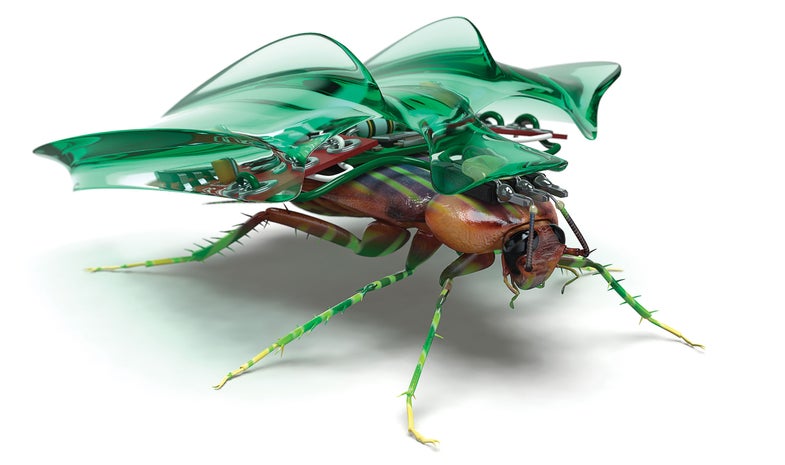
If cockroaches send you scrambling, use neuroscience to reverse the human-insect power balance. Carefully electrifying the nerves in a roach’s antennae makes the insect think it has met an obstacle—a sensation that can be manipulated to steer it. The trick could turn roaches into handy tools. Alper Bozkurt, an engineer at North Carolina State University, envisions a network of cyborg roaches assisting in search and rescue. Neuroscientists Greg Gage and Tim Marzullo, meanwhile, think hacking insects could inspire kids to research and improve electronic interfaces with the human nervous system. Gage and Marzullo developed a $100 RoboRoach kit that includes all the tech required for insect neurosurgery. But you can follow these steps to assemble a similar kit—and command your own troop of six-legged cyborgs—on the cheap.
Circuit Board
THE ROBO
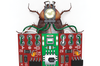
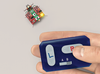
The RoboRoach kit contains a circuit board and controller, but you can hack the essential parts from a remote-controlled Hexbug toy.
CIRCUIT BOARD
Remove the Hexbug’s circuit board. The toy’s infrared remote control can start and stop current to the roach’s antennae from afar.
TIMER CHIP
Electricity needs to flow at 55 pulses per second to mimic the chatter of roach neurons (and hijack the insect’s senses). Computer chips called 555 timers can get the job done. Detach each motor on the Hexbug circuit board and solder on a timer.
BATTERY
Replace the Hexbug’s two batteries with a single 12-millimeter, three-volt lithium-ion battery.
CAPACITOR
To stimulate neurons, current must flow in each direction. Add a capacitor to the timer’s output pin.
ELECTRODE CONNECTORS
Snip a pair of three-electrode segments from a header. Wire one set to the circuit board and solder a one-inch strand of 41-gauge silver wire to each electrode on the other. The latter set will be superglued to the roach’s head as an electrode connector for the circuit board.
Roach Wiring
THE ROACH
Pet stores typically sell false death’s head cockroaches as reptile food. These big-and-slow roaches make great cyborgs, but pick an adult to avoid disrupting its maturation process (yes, roaches can enjoy their post-cyborg lives in lettuce-lined terrariums).
ICE BATH
Dunk the roach in ice water for a few minutes to anesthetize it. Dry the back of its head and sand off some of the wax. Superglue the electrode connector in place.
WIRING
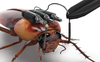
Poke the left silver wire about one millimeter into the roach’s thorax, under a wing just behind its head, and secure it with superglue. Cut each antenna to expose a neuron-lined tube. Insert the middle wire one millimeter into the left tube, and the right wire into the right tube. Superglue both wires into place.
CONNECT AND COMMAND
Hot-glue the circuit board onto the roach’s back and plug it into the head connector. After the roach wakes up, press the remote’s left button to urge it right, and the right button to move it left. The cyborg will ignore commands after a few minutes. Peel off the circuit board and clip all wires to ensure a long retirement.
Roach Remote
Time: 3 hours for circuit, 20 minutes for surgery
Cost: $50 for parts [or $100 for kit]
Difficulty: 4 out of 5
For full surgery instructions, download this PDF. Below are the materials you’ll need to create your own RoboRoach kit.
- R2/R5 (33k Ohm)
- R3/R6 (18k Ohm)
- R1/R4 (390 Ohm)
- IC1/IC2 (551 Timer)
- LED1/LED2 (Lights up for Stimulation)
- C1/C4 (0.01uF/10nF)
- C2/C5 (0.39uF/390nF)
- C3/C6 (0.033uF/33nF)
- C7/C8 (10uF)
- .100″ Male/Female Breakaway Headers
- BATT LITH 3V 35MAH 12MM