This article originally ran November 15, 2012. We’ve dusted it off to celebrate the four-year anniversary of Kepler’s lift off.–Eds
This week NASA announced its planet-hunter, the Kepler Space Telescope, just completed its primary mission. It’s far from retired–Kepler got a nice long extension back in April, so it will keep staring at distant stars for up to four more years–but it’s still a milestone for NASA and the planet-hunting community. To celebrate its next step, we’re taking a look at some of Kepler’s greatest hits so far.
_
Click to launch the photo gallery_
Since its launch in early 2009, the space telescope has found a treasure trove of new worlds orbiting distant stars, suggesting that planets are plentiful in our galaxy and maybe the universe. It has found so many planets, they’re practically garden variety–really a shocking thing when you sit and think about it. But it should not be this way. Exoplanets are awesome!
The space telescope is orbiting the sun, trailing behind Earth. It was designed to look for other Earths, and it hasn’t found one yet–but it has come very close, as you can see in our slideshow.
“The initial discoveries of the Kepler mission indicate at least a third of the stars have planets and the number of planets in our galaxy must number in the billions,” said William Borucki, Kepler’s principal investigator at NASA’s Ames Research Center in Moffett Field, Calif. “The planets of greatest interest are other Earths, and these could already be in the data awaiting analysis. Kepler’s most exciting results are yet to come.”
Click here to see some of the best we’ve seen so far.
Kepler’s Planets
Kepler has found 105 confirmed planets to date, and thousands of candidate planets that are still being studied.
Kepler Space Telescope
Kepler is designed to look for Earth-like planets orbiting Sun-like stars in a temperate “Goldilocks zone,” where temperatures are right for liquid water. It stares at a patch of around 156,000 stars in the constellations Cygnus and Lyra and notes teeny blips in their brightness, which could indicate planets passing in front of the stars’ faces.
Kepler-10b
Kepler-10b is a rocky, dense and hellish planet just 1.4 times the size of Earth. It’s not in the Goldilocks zone, orbiting much too close to its star for life to exist. It’s so hot (about 2,500 degrees F at the surface) that boiled iron and silicates are flowing into the stellar wind, much like a comet’s tail. Kepler-10b is more than 20 times closer to its star than Mercury is to the sun, and it whips around the star once every 0.84 days. Its average density is comparable to that of an iron dumbbell, says NASA — about 8.8 grams per cubic centimeter, or 0.32 pounds per cubic inch.
Kepler-11 System
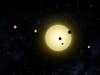
This system includes a sun-like star with six planets tightly orbiting it. At times, two or more planets pass in front of the star at once, as shown in this artist’s conception of a simultaneous transit of three planets. This event was observed by the Kepler spacecraft on Aug. 26, 2010. Kepler-11 is located 2,000 light years from Earth.
Sharing An Orbit
Kepler has found lots of strange planetary arrangements that suggest our solar system is not the only way to organize planets. These two co-orbiting planets, located in the four-planet system KOI-730, are always 120 degrees apart, permanent fixtures in each others’ night skies. Astronomers believe the moon formed from a collision between Earth and another planet that either shared or invaded its orbit. But until this finding, no one had found evidence of co-orbiting planets anywhere in the universe.
Kepler 16-b, Or The Real Tatooine
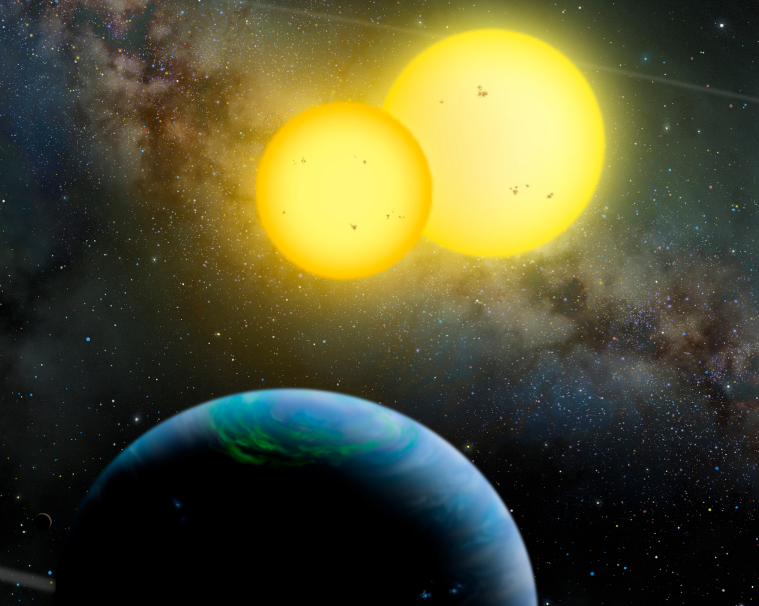
This discovery was one of Kepler’s most famous, if for no other reason than it made sci-fi into sci-reality. The planet, Kepler-16b, orbits a binary star system, just like Star Wars’ Tatooine. It resembles Saturn in its mass and gaseous makeup, and orbits at a distance analogous to Venus’ orbit in our solar system. The two stars in the system are 20% and 69% as massive as our sun, respectively. Since their combined mass is still less than our sun, Kepler’s Venusian orbit is likely chilly, placing it outside the habitable zone. This system was also special because of the way it was discovered–it was thrown on the trash heap, because eclipsing binaries fog up the data. Read more about the hunt for Kepler-16b in our interview with astronomer Laurance Doyle.
Kepler-22b
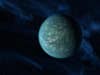
Kepler-22b, just 2.4 times the size of Earth, is the first planet known to comfortably circle in the habitable zone of a sun-like star. Scientists do not yet know if the planet has a rocky, gaseous, or liquid composition. It’s possible that the world would have clouds in its atmosphere, as depicted here. “This is a major milestone on the road to finding Earth’s twin,” Douglas Hudgins, Kepler program scientist at NASA Headquarters in Washington, said when the planet was found.
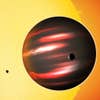
The Darkest Planet
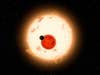
This planet, just 750 light years away, is very, very dark and hard to see. It’s so black that it reflects just one percent of the light that reaches it. TrES-2b is so black that it’s darker than coal, or any other planet or moon that we’ve yet discovered. It’s less reflective than black acrylic paint. It’s really black.
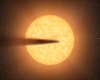
A Planet Evaporating Before Our Eyes
This nearby planet–just 1,500 light years from Earth– appears to be evaporating before our very eyes. Over the next 100 million years, the planet will completely disintegrate. The planet is orbiting a star cataloged as KIC 12557548 so closely that it makes a complete circuit in just 15 hours–one of the shortest orbital periods ever observed. That close proximity to its star generates temperatures of up to 3,600 degrees on the planet’s surface. This extreme heat is causing rocky material to evaporate straight from the surface, forming a wind that carries it into space as gas and dust.
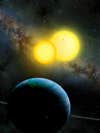
Kepler-35 System
As it turned out, Kepler-16b’s circumbinary system wasn’t all that unique. This rendition of Kepler-35 shows a Saturn-size planet orbiting a pair of Sun-size stars. The larger star is similar to the size of the Sun, while the smaller star is 79 percent of the Sun’s radius. The stars orbit and eclipse each other every 21 days, but the eclipses do not occur exactly periodically. This variation in the times of the eclipses motivated the search for the planet, which was discovered to transit the stars as it orbits the pair every 131 days. The discovery of Kepler-34 and Kepler-35 establishes a new class of circumbinary planets, suggesting many millions of such systems exist in the Milky Way.
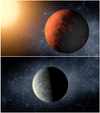
Kepler 20e and 20f
These planets are two of the smallest Kepler has found yet, and two of the most Earth-like. Kepler-20e, at the top, orbits its star every 6.1 days. At just 4.7 million miles from its star, its surface temperature reaches a searing 1,400 degrees F. Kepler-20f, at bottom, is 1.03 times the size of Earth, one of the closest to our own planet’s size of any exoplanet yet discovered. It has somewhere less than three times Earth’s mass. It’s just 10.3 million miles from its star (we’re 93 million from ours) and as such makes an orbit in just 19.6 days. Its surface temperature is about 800 degrees F, but astronomers believe it may have held on to a water-vapor atmosphere.