As with any good experiment, knowing your initial conditions is key.

Science of Roulette clry2 via Flickr

Sick of letting their mastery of calculus and classical mechanics go to waste, physicists in Australia and Hong Kong have figured out how to overcome the odds in roulette. You just have to know all the inputs -- preferably by tracking them with a digital camera -- and some differential equations.

The key is to know the ball's precise location, and the relative speed of the ball and the wheel, at the instant the croupier starts the game. If you know where the ball starts and how fast it and the wheel are rotating, you can make a much more educated guess about where it might land. Book your next trip to Vegas and read all about it in the AIP journal Chaos.

[Inside Science News Service]

4 Comments

Thats great but...you DONT know where it ball is released and you DONT know how fast the ball is going. I do like the fact that you can probably estimate the speed of the wheel and approximately where the ball is released, but the speed of the ball is gonna be a tough one considering its released manually by an employee, not a machine.

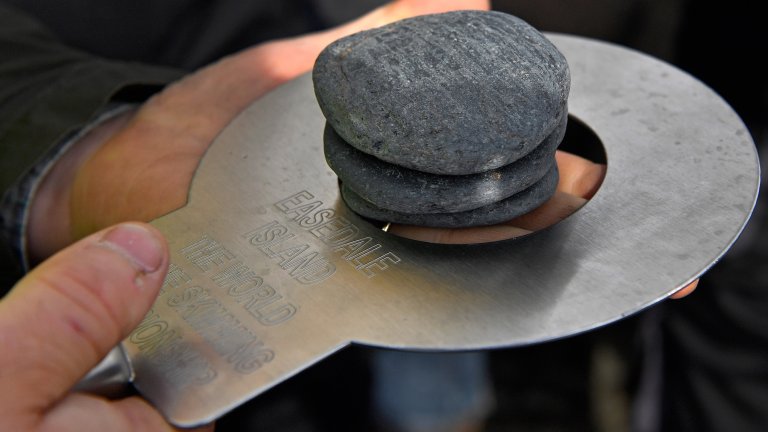
I used to work for TCS John Huxley who makes the wheel in the image and it is very easy to land the ball within 1 or 2 spaces where you desire. I could usually land the ball between 14 and 9 while aiming for 0. Most good dealers in Vegas can do this as well. Tip them good and they can take care of you.

In theory, one can pretty accurately predict anything in the future by knowing ALL of the inputs.

Using technology to minimize the Butterfly Effect is one of the major goals of science.

Live forever, know the future, infinite free energy. Done.

There's a (pretty bad) documentary about a few college kids who did this years ago and actually used it before casinos started catching on and the complexity outweighed the profit.

The brilliant thing is that it's about improving the odds. You don't need to know the exact spot it's going to land; even if you can narrow it down to which half, it helps. Which quarter? Even better! Without cheating you're hovering just under 50% win percentage, so it doesn't take much to nudge you over that house advantage. Just eyeing where the ball starts and estimating the speed it takes to make a revolution is sufficient in terms of data, so you really only need a computer to crunch the algorithms.

That being said, it's interesting to see how accurate we can get predictions in ideal laboratory settings.


June 2013: American Energy Independence

Five amazing, clean technologies that will set us free, in this month's energy-focused issue. Also: how to build a better bomb detector, the robotic toys that are raising your children, a human catapult, the world's smallest arcade, and much more.


Online Content Director: Suzanne LaBarre | Email
Senior Editor: Paul Adams | Email
Associate Editor: Dan Nosowitz | Email
Assistant Editor: Colin Lecher | Email
Assistant Editor: Rose Pastore | Email

Contributing Writers:
Rebecca Boyle | Email
Kelsey D. Atherton | Email
Francie Diep | Email
Shaunacy Ferro | Email

circ-top-header.gif
circ-cover.gif