An MIT grad student found the coolest possible way to veer an asteroid off course.
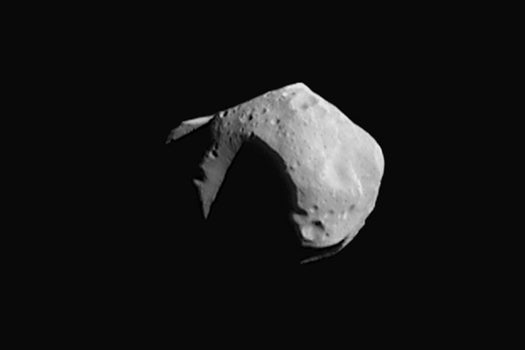
The Paler, The Better An image mosaic of Asteroid 253 Mathilde from June 1997. NASA

We can't do much to deflect a hurricane, but we may have a pretty good defense against asteroids. A particularly pale asteroid could reflect so much sunlight that the photons bouncing from it could create enough force to steer it away. All we'd need to do is ensure that any asteroids coming our way are bright white. MIT graduate student Sung Wook Paek's solution is to blast incoming offenders with pellets full of white paint.

Paek's strategy is fairly simple: Five tons of paintballs full of white powder would be launched towards an asteroid from a nearby space craft, 20 years in advance of a possible collision with Earth. The force of the pellets hitting the object will push it off course, but also the reflectivity--the albedo--of the white paint would increase, and over time the photons bouncing off the surface would also force the asteroid away from our planet. How has no one ever thought of this before?

This project, which would would've made a killing at any public school science fair, seems to be worth its weight in paint. It won the United Nations-sponsored 2012 Move An Asteroid Paper Competition, competing against ideas including nuclear detonation on the asteroid and launching a projectile to collide with it. Those scientists, undoubtedly, were just thinking too hard.

For his calculations, Paek used the asteroid Apophis as a theoretical test case. We might need his strategy really soon, because astronomical observations say that the asteroid will come close to Earth in 2029 and again in 2036. Paintball guns at the ready!

[MIT News]

15 Comments

I was under the assumption that photons were massless. How do they "collide" into things and cause it to move off course?

Wow! To be honest, with the headline I pictured a lot of kids holding paintball markers like the ones found on airsplat.com.

This is actually intriguing. Wonder how many paintballs it will take to get it to move, even with the photons, or how long it will take to see movement. Maybe due to restless mass it can be instant or it may be enough for it to just completely miss the earth?

Photons have no rest mass, which is why they travel at the speed of light. They are, however, units of energy. If enough of them hit the asteroid, they will add enough energy to it to deflect it from its previous path. Since it will take so many, it will take a long time to get that many hits.

Light, in other words, causes pressure. So little pressure that we can't feel it even in full sunlight, but it is nevertheless there.

Its about momentum. Even though photons have no mass they do have momentum that they can transfer:

http://www.physlink.com/education/askexperts/ae270.cfm

I took an into to astrobiology course 4 years ago and this was a one of the methods covered in the course material and textbook. I do not think that this proposal to steer away an asteroid deserves all of the attention that it is getting in science and mainstream news alike. Aside from the hilarious mental image one gets from thinking about kids shooting actual paintballs at an asteroid, this is a non story.

You know what else would be funny, putting a robot on the rock and have it take a paint roller to it.

- wise up

For this method to be relevant we'd have to get a LOT better at finding asteroids and predicting their orbits. It's an interesting idea, but far from viable, given both the uncertainties in orbit prediction, and the fact that many of the recent near misses were discovered not long before the pass-by or even slightly afterwards.

While we're at it lets just build massive Magnetic Accelerator Cannons and put them into orbit like in Halo and just launch 3000 ton projectiles at asteroids.

Just think its impossible to hit a comet or asteroid with any man made idea. Comet Shoemaker Levy 9 back in 1994 moving at 215000 km/hr gave the human eye a reference to what real extreme power is...when jupiter the inner solar system protector(liver) took a direct hit from the that huge comet SL9. They say its gravitational force directs ELE type entities into itself,therefore sparing Earth from a potential strike.The giant mass of certain meteors,asteroids or comets travelling at awesome velocities is unlikely to have its orbit adjusted by man in any way,sadly.

The Sumerians knew the earth revolved around the sun, and they knew about all the planets in our solar system, size and location. They knew of Uranus, Neptune, and Pluto, which discovered by modern day science until 1781, 1846, and 1930! They know about all the planets in the solar system, and they knew of one more planets beyond Pluto and in 1983, scientists announced their belief that there was a planet beyond Pluto. Even more astonishing is the fact that they even knew the nature of these planets- for example, they knew that Neptune was mostly water and they describe the color of Neptune and Uranus.

They describe clearly, when our solar system came into being and the young Earth had a collision with a rogue planet that come into our solar system, changing the structure of our solar system, created the asteroid belt and our moon. The most recent theory of how moon came into being is similar the Sumerians description.

The Sumerians clearly state their source of knowledge came from extraterrestrials from a 12th planet, which has an elliptical orbit of 3600 years.

There story of creation of man is more elaborately explain by the Sumerians and the same as the shorter story is written in genesis from the bible.

While many religions, myths and stories of an ancient culture can show an earlier source of where their story came from earlier, the Sumerians spontaneously show up as a civilization with no prior history. Ancient Samaria was a civilization, which appeared “full bloom” meaning they appeared without any precursor, or more primitive civilization. The Sumerians have a complicated law system (including juries), medicine (including invasive procedures), ships and navigation, but more remarkably, an amazingly advanced knowledge of astronomy, city planning and streets, farming techniques, writing, mathematics and so much more.

Our manner of keeping time come 60 seconds, 60 minutes, 12 hour for the day 12 for night and 24 hours in a day, and they calendar we owe to the Sumerians.

The Sumerian culture is 10,000 years old. Get to know the Sumerian culture and their history and you will learn about your human culture roots and how humans we humans were made from the God\Extraterrestrials. Did you know that the Neanderthal brain was larger than the modern human brain? The alien Gods change the local primates to created humans with the quality of who we are! The history of Sumerians even explain why humans were made.

The Sumerians clearly state their source of knowledge came from extraterrestrials from a 12th planet, which has an elliptical orbit of 3600 years, planet X.

This Sumerian information is not mythology. This knowledge and culture is archeology science of a record history.

The composition of Neptune is not mostly water. It has only a minute trace of water.

80% Hydrogen
19% Helium
1.5% Methane

thumbpick,
Thank you for the update.

Seriously, read up on the Sumerian history and be surprise about all they did know and was knowledge was given to them.

Besides, they wrote down, what was taught to them, so long ago. Least they got the idea right of many planets, approximate distance, color and round. They consider Earth to be the 7th planet as they counted from the outside planet, then inward towards the sun and Earth was not thought of as being FLAT.

Why would albedo affect the force of the light hitting the asteroid?

The same number of photos would strike the asteroid regardless of how much light it reflects back.

If anything, I would think a darker color, a color that would absorb the light, would capture more force than one that lets the photons zip away. Can anyone explain this?

This is all dependent upon early detection of an asteroid, so a tiny change in direction has a large effect from a long distance.

Perhaps if we detect the asteroid early enough, we could just launch a probe and unfold solar sails and then send it off in a different direction, adjusting the angle of the solar sails to better send it off a preferred direction.

The probe too, would need to be firmly fixed to the asteroid to force a change in direction as well.

It is interesting to note that a Crooks Radiometer works seemingly in reverse: The black panels absorb light, which has more push than the white panels, which reflect light, rotating the unit in a direction of the black panels

The best way to stop an asteroid from hitting the Earth?

Play the game of asteroids to the hilt and use other Asteroids to destroy incoming ones.

It's that's simple.

All you have to do is locate incoming asteroids that are the right size, shape, mass and speed desired--and then go out to meet it with a traditionally fueled (huge) spaceship and land on it while it's tens of millions of miles away.

Then you fasten that same engine to the asteroid and point the engine straight out to space.

Then you fire it to slow the asteroids speed and alter it's path so that it can be CAPTURED by the Moon's gravity and in a permanent orbit around the Moon.

Then go out with another ship and refuel the mounted engine and when the time comes that another asteroid up to about 10 to 20 times it's own size--is on a collision path--you fire the engine and push it out of orbit and SLINGSHOT the asteroid on a collision path with the incoming asteroid.

Two things can then be done.

You can either one use the DEFENDING asteroid as a 'tractor force' to pull the incoming asteroid and deflect it's path or sling it at 100,000+ mph difference in speed and literally pulverize it with more impacting energy than all the atomic bombs on Earth.

This can be done by putting it on a slingshot path around Earth and giving it massive speed.

We could, in affect, alter the path of dozens of smaller incoming asteroids into a path around the Moon to have them PERMANENTLY ready for use in stopping incoming asteroids from hitting the Earth. Not just one but many all in stable orbits.

And since it's close by it won't be that expensive to refuel the same engine which captured it and is mounted to push it out of the Moon's orbit.

It could work and leave future generations an easy way to stop much bigger asteroids.


June 2013: American Energy Independence

Five amazing, clean technologies that will set us free, in this month's energy-focused issue. Also: how to build a better bomb detector, the robotic toys that are raising your children, a human catapult, the world's smallest arcade, and much more.


Online Content Director: Suzanne LaBarre | Email
Senior Editor: Paul Adams | Email
Associate Editor: Dan Nosowitz | Email
Assistant Editor: Colin Lecher | Email
Assistant Editor: Rose Pastore | Email

Contributing Writers:
Rebecca Boyle | Email
Kelsey D. Atherton | Email
Francie Diep | Email
Shaunacy Ferro | Email

circ-top-header.gif
circ-cover.gif
bmxmag-ps