A battery of tests checking out the Mars rover Curiosity should wrap up today, and she's passing them all with flying colors. Very soon, the rover will start doing what it was sent to Mars to do: Swallowing some soil, baking it and X-raying it, with the goal of finding out whether life could ever have survived on the planet.
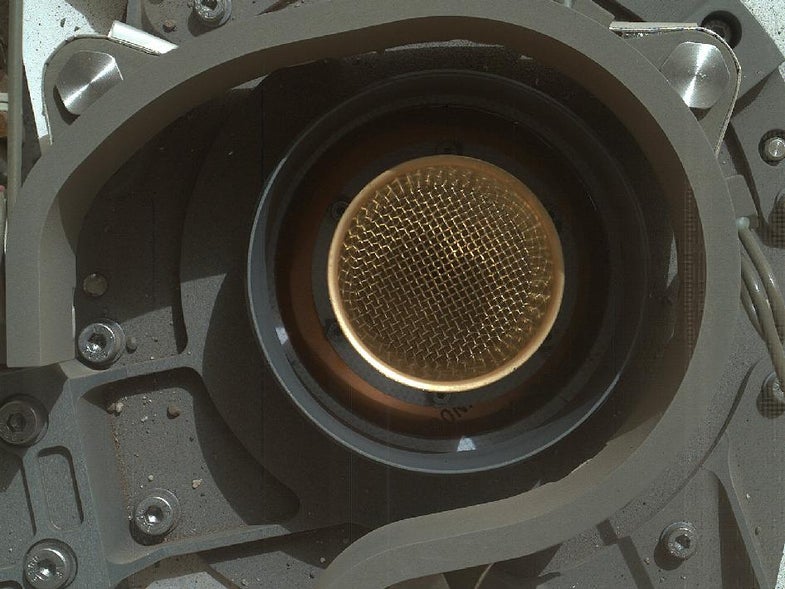
This image shows the entrance to the CheMin instrument (for Chemistry and Mineralogy), which will sift Martian dirt so it can be X-rayed. CheMin will identify minerals by examining the diffraction patterns of X-rays that pass through the spaces between atoms.
Curiosity will roll again by this weekend, driving until scientists see a rock they want the rover to touch, Curiosity mission manager Jennifer Trosper said in a news conference Wednesday.
NASA is using images like these to check out Curiosity's instruments, part of a series of tests to make sure everything works as expected — or if not, how it works differently than expected. During the tests, the rover's arm team also gained some confidence maneuvering the arm under Mars' freezing temperatures and lower-than-Earth gravity.
This particular picture is a composite of eight separate pictures from the Mars Hand Lens Imager, or MAHLI, which were merged on the instrument before being beamed back to Earth. This is the first time MAHLI performed that combo technique since arriving at Bradbury Landing — usually, engineers at the Jet Propulsion Laboratory have to stich images together.
You can also see some pebbles and sand — those were deposited on the rover deck during the sky crane landing.
Stay tuned for the next drive!
Five amazing, clean technologies that will set us free, in this month's energy-focused issue. Also: how to build a better bomb detector, the robotic toys that are raising your children, a human catapult, the world's smallest arcade, and much more.


Online Content Director: Suzanne LaBarre | Email
Senior Editor: Paul Adams | Email
Associate Editor: Dan Nosowitz | Email
Assistant Editor: Colin Lecher | Email
Assistant Editor: Rose Pastore | Email
Contributing Writers:
Kelsey D. Atherton | Email
Francie Diep | Email
Shaunacy Ferro | Email
Interesting, so this is Curiosity x-ray toilet, al ‘righty then; it is good, that Curiosity really understands what he eats. I wonder where they keep the roll of paper for Curiosity? What no self portrait pictures of the output?!
Did NASA desing Curiosity a sphincter too? I like to read that engineers resume!
Oh, I so do look forward to see pictures of MARS!;)
"...Interesting, so this is Curiosity x-ray mouth..."!
Dang it! Where is my editor, sheesh.
it is not a mouth nor a toilet, it's clearly a speaker, curiosity whistles while it works.
Here I though the Martian surface was pretty well baked already. Regarding this, isn't it more useful to just flip and scan the contents of an area than to attempt some nucleonic dispersal for the gauging of the contents of a single rock? These Martian rocks do roll around just like other rocks do. Their makeup is going to be typical for their area, same as other rocks. This rover ain't digging back to Martian antiquity depths anyway, so we'll get no truly functional knowledge of any life that might have been on Mars, and only incidental knowledge of any actual life progression such as expanding habitat of bacterium. Identifying rocks on sight has made far more people wealthy than if every prospector had broken every rock they saw.
I guess or imagine there is a finite amount of testing they can do, simply because you can not clean the gathering, sifting source. I mean, how do you keep microscopic debris from the previous gathering of material from contaminating the next gathering and testing of material? Still in any testing we learn. I am so glad we have robots on Mars!