The Mars rover Curiosity is chock full of the most advanced technology humans can build, from its miniaturized X-ray machine to its awesomely powerful laser. And then there are these knots.
Along with high-resolution color photos of its surroundings, Curiosity has been beaming home color photos of itself, including its wheels and deck, so its human managers at the Jet Propulsion Laboratory can make sure it’s safe and ready to go. The images have revealed some intricate knot work, as noticed by a poster by the name of David J. Fred or “dfred” on something called the International Guild of Knot Tyers Forum.
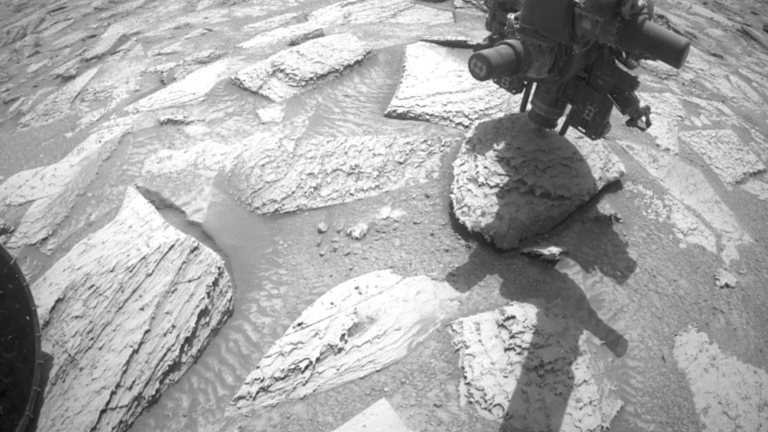
Knots may seem like a simple way to handle cables on the most advanced robot spacecraft ever built — but as dfred point out, they’re still reliable when done right. Good knots are better than zip ties for several reasons, and they’re cheaper than inventing some kind of interplanetary hyper-nano-epoxy. For this reason, they appear on most space missions.NASA actually has standards for the arrangement and tying of these knots, as dfred explains in more detail. Curiosity’s knots appear to include the “spot tie,” a combination of the classic clove hitch design and a reef knot, otherwise known as a square knot. “In addition to its pure binding role, it is also used to affix cable bundles to tie-down points,” dfred explains. The photo below shows several of them.
The clove hitch is a good choice because it applies even pressure on the object being tied down, and it doesn’t get overly tight, which can be a problem with other knots and zip ties. This same knot, except with just one square-knot topper, was first illustrated in 1917, but its first mentions date to the Greek physician Heraklas in the first century AD, who used them for orthopedic slings.

For further amazingly intricate knot lore, click through to the forum.
The incredible innovations, like drone swarms and perpetual flight, bringing aviation into the world of tomorrow. Plus: today's greatest sci-fi writers predict the future, the science behind the summer's biggest blockbusters, a Doctor Who-themed DIY 'bot, the organs you can do without, and much more.


Online Content Director: Suzanne LaBarre | Email
Senior Editor: Paul Adams | Email
Associate Editor: Dan Nosowitz | Email
Assistant Editor: Colin Lecher | Email
Assistant Editor: Rose Pastore | Email
Contributing Writers:
Kelsey D. Atherton | Email
Francie Diep | Email
Shaunacy Ferro | Email
The people from Nottingham and Robin Hood would be so proud!
Well that was knotty article.
That is SO COOL! It makes me want to take up knotology (or whatever is the prevailing term).
What's wrong with duct tape? It was used on the moon to repair the moon buggy's fender.Like they say,if should move,use WD40,and if it shouldn't move,use duct tape.
Oooo, we are all such a not-orious bunch, with our
wild ob-not-xious comments! Lol,..... snort.;)
I do say, I guess we've seen Curiosity's knotty bits.
I am happy to see that Curiosity still can tie one on, even in a remote planet as Mars. And with little kittens and children we entertain them with balls of string, but exactly how much did this mission cost again and how soon will we see COOL results from all the science gadgets on Curiosity?
What most people fail to appreciate is that there are very sound technical reasons for using string ties on spacecraft wire bundles. First, the string material used remains strong and flexible at the -200degF to +300degF temperatures experienced by spacecraft. Second, it is very lightweight. Third, a string tied with double knots provides multiple levels of fault tolerance, unlike something like the common nylon tie-wrap.
I almost always like Rebecca's articles, they are intelligent and have feeling.
Allot better than the stuff Clay tents to regurgitate.
We at www.sci-tie.com have been developing a completely new cable tie that comes on a roll. The new design and manufacturing technique allows us to use all sorts of materials to make them. They can be used in extremes of temperature and can also have antiseptic or antibacterial properties in them so that there would be no possibility of cross contamination. Our new cable tie would have been perfect for a project like this.
Finally, a legit reason to list Eagle scout on my resume.
Person 1 - Did you know about the binding on Curiosity that kept coming apart and splitting no matter how much they tried and seemed scared to go into space ?
Person 2 - Really ? Nope do you know ?
Person 1 - A Frayed Knot
Person 1 - Hey friend how are you ? Long time no see !
Person 2 - Doing good. Been working for NASA.
Person 1 - Doing what ?
Person 2 - I am a professional knot tier !
Person 1 - A professional knot tier ?
Person 2 - Yep. I tie knots in bindings that hold cables on spacecrafts. Infact my knots are so good they keep everything from moving no matter how the climate is.
Person 1 - I'll bet you used work in Washington.
Person 2 - Yeah how'd you know ?
sci-tie,
Does your cable material/process provide functional fault tolerance? Does the installation permit visual validation of the process for quality assurance? Are the materials serviceable over temperatures of +250degF to -200degF? Are the materials resistant to outgassing? Do the materials have long term resistance to UV radiation?
And most importantly, have the materials/process undergone a qualification test?
Today, while I was at work, my sister stole my iPad and tested to see if it can survive a twenty five foot drop, just so she can be a youtube sensation. My apple ipad is now destroyed and she has 83 views. I know this is totally off topic but I had to share it with someone!
ice maker