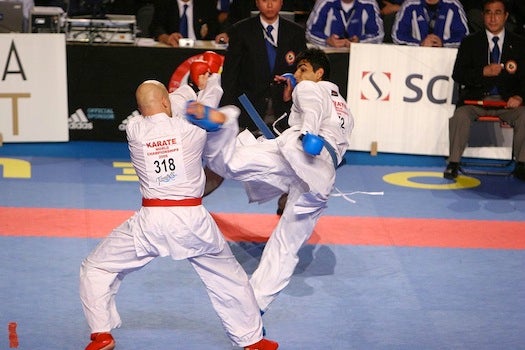
Karate WC Tampere 2006 Wikimedia Commons

If you've seen the board-breaking power of a professional martial artist and thought it looked superhuman, don't worry: for a while now science couldn't fully explain it, either. The punches delivered by a top-notch fighter are so tough that muscle strength alone can't account for them. But researchers from Imperial College London and University College London have discovered that a unique brain structure could be what gives experts fists of fury.

In a new study just published in the journal Cerebral Cortex, the researchers explain their process. They took 12 black belts with an average of 13.8 years' worth of karate experience, and also 12 control subjects who exercised regularly but who weren't trained in any martial art. After that, they hooked their arms and torsos up to infrared markers so their punching speed could be measured. The karate experts punched harder (obviously), but it was the timing of the punch, not just the brute strength, that mattered. Their wrists and shoulders were synchronized to give the most force.

Brain scans revealed what gave the experts that edge. Their brains' white matter--the bundles of fibres that send signals to other parts of the brain--was structurally different in the cerebellum and primary motor cortex, two parts responsible for movement. The difference also correlated with the age they started training and how long they'd studied karate, suggesting their unique brain structure and powerful punch are related.

[University College London]

12 Comments

And maybe the meditational and mental component of real martial arts is responsible for the change. We are what we think?

That's no surprise. Every martial arts student knows it's not muscle, it's speed and timing.

So the study found that you get better with practice?
What a useful discovery this is.

@killerT

No, the study found that practicing motor control at a young age actually induces changes in brain structure. Previously, it was thought that increased cortical activity was responsible for motor control abilities, but it turns out that the microstructure of the brain's white matter physically changes. This research helps explain the link between brain structure and motor control, which will be useful in answering many questions related to brain development and diseases that inhibit motor control.

KillerT isn't exactly wrong, it is the practice, but like suggestivesimon said, this study shows how all that practice affects the brain, not just the body.

It completely makes sense that the brain would change considering any task such playing music, a sport, or even doing math will cause a person to develop a better understanding and awareness of that subject. A person who plays basketball, not only is better at it physically, but they develop a better understanding of the game and how it relates to what they are doing. This shows that correlation.

i just love how popsci decides to not mention MMA in this entire article. since that is where the "superman" punch is usually utilized. but i see where this article is coming from. Lyoto machida a black belt in Shotokan Katare which he has been doing since early age is a perfect example. his punching accuracy and timing is just about the best in the entire UFC. and he always thanks that to his karate training.

"You take the blue pill – the story ends, you wake up in your bed and believe whatever you want to believe. You take the red pill – you stay in Wonderland and I show you how deep the rabbit-hole goes." -Morpheus

@JediMindset

MMA is mentionned in the link in the first sentence of the article. Why should it be, though? The punch used in the study wasn't a superman punch (at all); subjects were placed with their right hands 5cm away from a force plate and instructed to punch as hard as they could. If anything, PopSci should've linked to a video of B's punch training in Kill Bill:
www.youtube.com/watch?v=EEjI0A9iMow&t=1m35s

@suggestivesimon

yeah i know but its says " professional martial artist"... they are professional MIXED martial artist. theirs a big difference between traditional martial arts and mixed. the reason why it should have been mentioned is because, MMA has shown that training the most usually perfects the art of fighting. timing, skills accuracy etc all come into play when one wants to be the best. brute strength alone has never made a champion. and my bad i thought the article read, "Superman punch comes from a unique brain structure" haha. lol and yes kill bill is a great movie and all but most of it is highly fictional and not effective in real life....

"You take the blue pill – the story ends, you wake up in your bed and believe whatever you want to believe. You take the red pill – you stay in Wonderland and I show you how deep the rabbit-hole goes." -Morpheus

@ JediMindset

Ya, I know Kill Bill is highly fictional :-) It's what most closely resembles the punch used in this study, though.

@suggestivesimon
I may be reading texts from the future, but I already knew that the brain structure changes when you learn, especially at a young age.
I thought it was common knowledge already.

@KillerT

Every field of study is specialized now, so statements like "the brain structure changes when you learn" is akin to "gas engines work because of explosions". Both statements are basically true, and they would've been interesting when the concepts of neuroplasticity and internal combustion engines were first proposed, but now they're just generalities.

That's the reason why I chose to respond to your original comment: you dismissed this research based on "everyone knows you get better with practice", which fails to recognize the importance of understanding the intricacies of neuroplasticity when it comes to treating brain injuries, degenerative diseases, learning disabilities, chronic pain,...


June 2013: American Energy Independence

Five amazing, clean technologies that will set us free, in this month's energy-focused issue. Also: how to build a better bomb detector, the robotic toys that are raising your children, a human catapult, the world's smallest arcade, and much more.


Online Content Director: Suzanne LaBarre | Email
Senior Editor: Paul Adams | Email
Associate Editor: Dan Nosowitz | Email
Assistant Editor: Colin Lecher | Email
Assistant Editor: Rose Pastore | Email

Contributing Writers:
Rebecca Boyle | Email
Kelsey D. Atherton | Email
Francie Diep | Email
Shaunacy Ferro | Email

circ-top-header.gif
circ-cover.gif
bmxmag-ps