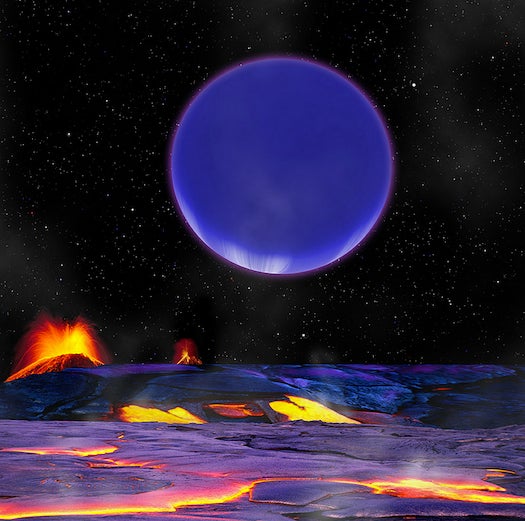
Imagine crawling out of bed and seeing a gigantic red Mars instead of the Sun. That's basically the situation for two newly discovered planets. Astronomers working with NASA's Kepler Mission recently found them 1,200 light years away, and they're 30 times closer than any pair of planets in our solar system. Actually, the scientists aren't totally sure how that happened--just another sign that our solar system is not the only way planets can be arranged.
One is a rocky planet 1.5 times the size of Earth and 4.5 times the mass; the other is a gaseous planet 3.7 times the size of Earth and eight times the mass. How two planets with disparate densities like that made their way into or stayed in such close orbit is a puzzle for right now. It's pretty odd behavior, at least compared to here in our solar system, where the rocky, warm planets like Mercury and Earth stay close to the sun while the icy ones keep their distance. There are still some knowledge gaps when it comes to planetary orbit and rearrangement, and researchers are hoping this sparks some discussion.
The incredible innovations, like drone swarms and perpetual flight, bringing aviation into the world of tomorrow. Plus: today's greatest sci-fi writers predict the future, the science behind the summer's biggest blockbusters, a Doctor Who-themed DIY 'bot, the organs you can do without, and much more.


Online Content Director: Suzanne LaBarre | Email
Senior Editor: Paul Adams | Email
Associate Editor: Dan Nosowitz | Email
Assistant Editor: Colin Lecher | Email
Assistant Editor: Rose Pastore | Email
Contributing Writers:
Kelsey D. Atherton | Email
Francie Diep | Email
Shaunacy Ferro | Email
COOL!
.............
Every day is a new day!
So are they in some kind of circumbinary orbit?
Ok, maybe a stupid question. I apologize if it is, but how can a gaseous plant 3.7 times the size of Earth have a mass 8 times that of Earth? My thinking is that rock, etc. is more dense than gas...
Denser core = more gravity = more mass
Think of it like cotton candy with a titanium core.
I'm relatively certain that when astronomers refer to a planet's size, they're referring to apparent diameter. So 3.7 times the size of earth would indicate a diameter 3.7 times that of Earth's.
The mass of the planet, however is dependent on its volume of material. Volume, if you remember from Geometry is equal to (4/3)*pi*r^3 or (4/3)*pi*((1/2)d)^3.
So: If we assume Earth has a radius of 1, then the planet in question would have a radius of 3.7.
Plugging in for Earth: V = (4/3)*pi*(1)^3 = 4.19 units
Plugging in for Planet2: v = (4/3)*pi*(3.7)^3 = 212.17 units
Therefore, the volume of the planet with respect to Earth is 212.17/4.19 or about 50 times greater.
If you then take into account what you said about gas being less dense, 8 times the mass doesn't seem so high compared to 50 times if they were both made of rock.
To add to my previous comment:
As "Bottle tap" alluded to, gravity also comes into play for objects on the planet-size scale, so the density of the planets is not uniform throughout their volumes, which further increases the mass of the gas planet as its volume gets larger. So, the 50 versus 8 comparison, while useful for small objects is not directly valid for planet-sized objects, but the general idea is still valid.
Is it possible these were planets thrown out of there original orbit and stuck together on there way, to where they are now? Like 2 galaxy's colliding or something similar?
Gotcha. That makes sense. Thanks.
so they like to cuddle, nothing wrong with a little planetary cuddling...
I know this is new for planets, but aren't there a couple of moons of I think Saturn (or maybe Jupiter) that do basically the same thing?