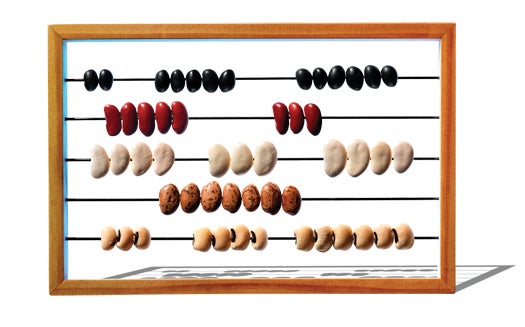
The calculus of human sustenance is simple: to feed the planet’s seven billion people, farmers must generate at least 12 trillion calories’ worth of food every day. And even as the world’s growing population demands ever more of those calories, climate change is making them harder to produce. How can science change the equation?
Farmers will need drought-resistant, flood-resistant, heat-resistant, frost-resistant and insect-resistant crops that they can grow in saltier soils and an atmosphere filled with more carbon dioxide and ozone. Researchers are developing seeds that can do all of those things, and genetic modification will play an important role in their work [see “. . . By Making Better Seeds”]. But no single company should have a corner on the world’s seeds, so countries must revisit their patent laws and enforce strict limits on transnational seed corporations that seek to monopolize the world’s genetic resources.
Climate change will alter farmland in a variety of ways. One recent study concluded that high-latitude regions in China, Russia and the U.S. may gain arable land while tropical and subtropical regions in South America, Africa, Europe and India lose out. Global trade agreements will become an increasingly important way to ensure the equitable distribution of the global food supply. No matter where the land, responsible stewardship will require greater use of cover crops, nitrogen-fixing crops and peripheral plantings that work to deter insects and rodents, and thereby lessen the need for pesticides and other man-made poisons.
The key to getting more food from less water will be to make that water do more work. Farmers will have to better harvest rainwater, reuse wastewater, trade trough and sprinkler irrigation for more-efficient underground drip lines, and use GPS monitoring to get precise crop-per-drop measurements.
A growing global middle class is demanding more meat, but it takes an extraordinary amount of fuel, fertilizer, pesticide and water to create the relatively few calories that meat delivers. At the same time, nearly half the corn produced in the U.S. enters the “biofuel cycle,” which also draws on many other food crops, from soybeans to coconuts. Biofuels are no more efficient at delivering energy to engines than cows are at delivering energy to stomachs. Humans must stop competing with their own animals and machines for calories.
Scarcity, or even the perception of scarcity, is increasing the price of the world’s food supplies. Among the greatest threats to future food security are the bubbles and spikes in the price of wheat and other globally traded commodities. The derivatives markets in food futures should be used in the way they were intended—as risk-management tools for those in the food business, not as a speculative shortcut to riches. The solution: transnational rules that limit the role banks can play in global food futures markets.
Frederick Kaufman is the author of Bet the Farm: How Food Stopped Being Food.
Five amazing, clean technologies that will set us free, in this month's energy-focused issue. Also: how to build a better bomb detector, the robotic toys that are raising your children, a human catapult, the world's smallest arcade, and much more.


Online Content Director: Suzanne LaBarre | Email
Senior Editor: Paul Adams | Email
Associate Editor: Dan Nosowitz | Email
Assistant Editor: Colin Lecher | Email
Assistant Editor: Rose Pastore | Email
Contributing Writers:
Kelsey D. Atherton | Email
Francie Diep | Email
Shaunacy Ferro | Email
After having read the print issue (I know, I can be such a Luddite sometimes), I felt compelled to comment on the GLARING absense of comment on the effect of population on the calculus of climate change, food shortfalls and resource management in general. Not a single one of the multiple articles in this months issue even touched on the subject.
My question to the editorial board is whether this was mere coincidence, or was this by direction?
Any serious discussion of global resource management MUST include population, and population control, as a variable in the equation.
Fact-humans developed on seeds, berries, meat, organ meat (fatty). Alaskan Native Americans (and other arctic people have seen flour and sugar until whites decided to “help” them.
While it would be more efficient to eliminate the carb to meat conversion, the fact is very few can eat that way. Studies have shown genetic differences between those who do better with veggie diets and those who do better metabolically with low carb diets (85% low carb vs 15% veggies). Regardless of how much we want to do away with animal protein, it would take years (as in millennia) to change our genetics to allow us to do it without killing ourselves. Good veggies are much more energy intensive than starchy veggies to grow. While growing potatoes, corn, wheat, and rice can produce lots of calories, the type of calories matters. Most experts are finally coming around to the dangers of refined carbs and simple carbs.
Not all meat requires "an extraordinary amount of fuel, fertilizer, pesticide and water". For instance, cattle grazing on an open range convert unusable cellulose into high-quality protein. We don't eat meat for the calories -- we eat it for the protein.
There are definitely going to be some interesting changes to deal with in the not-too-distant future. EngineerDad is correct: population control will be essential, but it has to remain a choice. The governments of the world can't say, "No more than this many children!" Incentives such as higher taxes for families with more children would be smart and fair, without taking away choice.
As far as meat goes, it's not essential. We don't need to change our genetics to live without it, jbairddo. I am proof of that. Food combinations such as rice+beans and pasta+lentils provide pretty much all the protein you need. Farms require more water than cattle ranches, true, and take just as long to yield food, true, but they can produce more calories per acre, and with a wider variety of food. Also, if these new carbon lattice water filters work out, the amount of water required wont be a problem. Besides, you can put a garden anywhere - rooftops, unused lots, back yard, etc.
@Ardent Ward - "We don't need to change our genetics to live without it, jbairddo. I am proof of that."
YOU are prrof of nothing. His or her point was thatdue to variations in genetics not everyone's bosy can tolerate the veggie only diet as well as others. The only thing that you prove is that you are one of the individuals whose genetics allow you to properly digest a veggie only diet.
The math isn't as hard as you might think. But the underlying moral questions are the tough part. What can or should we try to force people to do? For some, the answer is to completely control people's lives in order to save "society" as a whole. For others, no control over people should be maintained, and "society" will find a way to solve the problem itself through supply and demand. And most people are somewhere in between.
But really, if you're looking at an instant boost to food availability, there is one giant piece of low-hanging fruit that is extremely easy to get to: Ethanol. Let's see, just in the US alone last year (Aug 2010 to Aug 2011) we used 5.05 billion bushels of corn for ethanol. Take that number of bushels of corn, take its calorie content (88,480 kcal (which we commonly call calories) per bushel) and you see that we used almost 447 trillion calories worth of corn in the US last year to make ethanol. That comes out to about 1.2 trillion calories a day. Based on the 12 trillion number the author uses in the story, that's 10% of our daily food need. And that's just the corn used in the US for ethanol production. We use other crops too in the US (to a much lesser extent) for ethanol production, and the rest of the world produces almost as much ethanol as the US, almost all of it from food crops too (like sugar).
If we simply stopped producing ethanol right now, I'd guess we could feed 20% more people every day than we do right now. With just that one change. That alone is enough to take us to 2045 or so with current population growth estimates.
But to be honest, food shortages have a way of enticing people all on their own to curb population growth. I'm all for letting people make their own choices, and letting abundance and scarcity drive things.
@marcoreid:
Thats a very good analysis. The problem is that calories doesn't necessarily equate to the nutritional requirements of a person. We all know that a scoop of ice-cream carries a few hundred calories, but a human being cannot survive on ice cream alone. That said, corn has just about 0 nutritional value for us--we can't digest it which is why you see pieces of corn in the toilet. Sure, it has a little Vitamin A and protein but you have to be able to digest it to extract those nutrients.
That said, we shouldn't risk oversimplifying the problem. For all the expense to engineer new strains of crops, the cost to litigate the IP of those gmo strains, etc. we could/should just dump our money into VERTICAL FARMING. Yes, it will obsolete an industry, several industries actually. But do we care more about preserving the idealizing version of "capitalism" that has never existed and is, in fact, failing most of us? Or do we do what is right by OURSELVES?
How do we create VFs? The technology is all there. We just need the willpower and funding. I don't understand why a VF is so much more expensive than a typical building but it CAN be done!
@lawsonrw
I get your point about corn, and I should have been more clear. The point was that we can take the 36 million acres we used last year to grow corn for ethanol,and grow food instead, of whatever type we want. That is a lot more mouths you can feed.
Agriculture has been making huge gains over the decades in the countries advanced enough to deploy mechanized agriculture. For instance, average U.S. corn yields quadrupled over the past 60 years in bushels per acre, and biotech test plots are already getting another doubling beyond the current average: http://www.aleph.se/andart/archives/images/Biodesic_US_corn_yield-thumb.png
In bulk, corn now actually costs just $300 per ton, like $0.08 for a half pound, even though such seems alien to someone experiencing how small cans of corn at the grocery store cost $0.50+ each retail due to added costs from processing, packaging, distribution, middlemen, and profits.
Under a 300 ppm CO2 increase (like some would predict over a century although totally dependent on assumptions about the future), combined with appropriate fertilizer application meanwhile, typical yield increase from such a CO2 change in itself amounts to:
wheat = +33% growth
corn = +24% growth (despite being C4 which means less benefit than C3 but still net benefit as seen)
rice = +36% growth
soybeans = +46% growth
sugarcane = +34% growth
potatoes = +30% growth
http://www.co2science.org/data/plant_growth/dry/dry_subject.php
That helps, as unsurprising when the ancestors of modern plants evolved when atmospheric CO2 levels were thousands of ppm, far higher than the 400 ppm now.
For instance, as a random extra specific example, even for a 200 ppm CO2 increase instead of a 300 ppm increase:
“Increasing atmospheric CO2 is recognized as a major aspect of global climate change that would have a significant impact on the productivity of major agricultural crops. Two field experiments were done, with the objective of quantifying the response of a short-duration rice (Oryza sativa) variety (BG-300) to elevated atmospheric carbon dioxide, in the low elevation, subhumid zone of Sri Lanka. Grain yields of rice crops grown under elevated CO2 [570 ppm] were 24 % and 39 % greater than the respective ambient [370 ppm] treatments in the maha (January – March 2001) and yala (May – August, 2001) seasons. The results of this study demonstrate that elevated CO2 causes significant yield increases in rice, even when it is grown in warm, subhumid tropical climates.”
Response of Growth and Yield of Rice (Oryza sativa) to Elevated Atmospheric Carbon Dioxide in the Subhumid Zone of Sri Lanka
http://www3.interscience.wiley.com/journal/118887984/abstract?CRETRY=1&SRETRY=0
As under any other yield increase, when one is growing more biomass per unit area, fertilizer applied per unit area should be appropriately increased if needed to prevent a shortage of the elements used for protein production, to maintain the same nutritional levels. Yet total fertilizer needs are about the same per unit of food produced, just more concentrated into a smaller area of more efficient farming. (Production of the fertilizer dominant by mass, ammonia-based fertilizer, actually only utilizes about 5% of global natural gas production, while able to be produced from nitrogen in the atmosphere, hydrogen from any source whether natural gas or water, and energy from any source for the Haber process).
Some greenhouse owners today use artificial CO2 increase, of enough gain to plant growth to be profitable despite needing a nearly airtight structure and the cost of extra equipment.
Water usage efficiency rises still more, due to reduced stomatal conductance requirements for getting enough CO2 circulating into a leaf upon elevated CO2 (basically, fewer open pores needed so lesser water losses). For instance, for +300 ppm going from 400 ppm to 700 ppm CO2, even the C4 plant of corn has an enormous increase in water usage efficiency of about 50%: http://tinyurl.com/7fehzsu
Naturally we don't particularly bother to apply fertilizer to wild vegetation, making nutrients like nitrogen more often be limiting, while CO2 increase has been around 80 ppm per half century (past 50 years) instead of the example figures for +300 ppm, but, even so:
In major growth increase, estimated carbon in global terrestrial vegetation increased from approximately 740 billion tons in 1910 to 780 billion tons in 1990:
Post WM, King AW, Wullschleger SD, Hoffman FM (June 1997). "Historical Variations in Terrestrial Biospheric Carbon Storage". DOE Research Summary (CDIAC, U.S. Department of Energy) 34.
http://cdiac.esd.ornl.gov/pns/doers/doer34/doer34.htm
As http://www.agu.org/pubs/crossref/2005/2004JC002620.shtml shows, where chlorophyll concentration is an indicator of phytoplankton abundance (the basis of marine food chain):
“The analysis of decadal changes from the CZCS [1979-1986] to the SeaWiFS era [1998-2002] shows an overall increase of the world ocean average chlorophyll concentration by about 22%.” Such is influenced by more than CO2 alone and somewhat goes up and down including from fluctuations in nutrient upwelling, but overall it has increased.
Like other warm periods in the Holocene, the modern warm period has been predominately arctic and near-arctic warming. For instance, there was roughly on the order of 0.1 degrees Celsius meaningful temperature rise over the 1979-2012 period beyond the oscillations in the tropics, as can be seen looking at a chart ( http://tinyurl.com/6qbtwpt ), whereas there was 0.7 degrees rise in the 5-year-average of arctic temperatures 1979->2000 as seen at http://earthobservatory.nasa.gov/Features/ArcticIce/Images/arctic_temp_trends_rt.gif while the latter also shows temperatures were as high in the late 1930s as at the end of the 20th century. (For a longer-term perspective, see http://tinyurl.com/3d4mrbt for a graph of GISP 2 temperature data reconstructing the past 200 to 11000 years). As an example, when temperatures were warmer than now during the Holocene Climate Optimum 6000 years ago, vegetation phytomass was 20% higher in northern Europe-Asia due to less cold preventing growth, while during the Eem interglacial optimum (warmer still) vegetation was 55% more than now as implied at http://www.sciencedirect.com/science/article/pii/S0009254199000297
Regarding droughts:
Over the 1950-2000 period, the maximum area of droughts recorded was way back in the 1950s and 1960s in four of six continent-related areas:
http://www.worldclimatereport.com/wp-images/drought_2010_fig3.GIF
There was nil overall average increase in drought area for the world over the half-century period studied.
http://water.washington.edu/research/Articles/2008.global.continental.drought.pdf
But what climate change would be a real threat to agricultural yields is implied by Dr. Abdussamatov, head of the Russian segment of the International Space Station, who discusses how there is reason to suspect potentially onset of "the 19th Little Ice Age in the past 7500 years in 2055 [A.D.] ± 11 [years]": http://www.ccsenet.org/journal/index.php/apr/article/view/14754
Possibly it could become more often economically competitive to have greenhouse agriculture. By combining CO2 increase with multiple seasons per year not interrupted by the winter (in fact 4 crops per year instead of often just 1) and other optimization multiplicatively synergizing, http://settlement.arc.nasa.gov/75SummerStudy/5appendC.html estimated a factor of 40 increase in yields over conventional farming as being obtainable. The 24 hour sunlight does not occur on Earth, of course, but the other factors would require less to emulate. A factor of 10 or 20 in increased yield would be a big deal, as much food from a tenth or less the land usage, such as like the old ideas of nuclear-heated greenhouse agricultural complexes. The challenge, of course, is the cost per unit area for construction and maintenance, when the competition is very cheap per acre. In more limited applications and less optimized in yield terms, greenhouse agriculture is moderately expanding now, such as for tomatoes.
@HClark
^^^^Clearly an individual that has not seen what happens when an excess of CO2 is emitted in a greenhouse environment. After a certain point, particular plants cannot adjust to the abundance of CO2 and nutrient uptake is hindered; plants stunt, and eventually if no exhaust of the system is done majority of the greenhouse will die. Some will thrive, but most will die.
Likewise you are also implying that the lack of an entire season will be beneficial. This would be the case, save for the fact that this ''seasonal change'' is occurring at a rate far too quick for majority of the environment to adapt to. The phytoplankton decline worldwide has shown just what these drastic climate changes are capable -- displacing a major component of the food chain creating entire ''dead spots'' in the ocean.
This combined with the virulent way the weather has become worldwide is clearly indicative of what is to come. Read the National Assessment on Climate Change, or really any credible studies before making ludicrous claims and shilling the boards with your ignorance.
Space is not a real vacuum -- it does not ''suck'' out the emissions/CO2 exhaust of mankind. Unfortunately, it does not just ''disappear.''It says and traps heat, and this drastic temperature increase over a short period has dramatic implications for the species of earth. Have you ever even gardened in a greenhouse?
For not even seeing how the "multiple seasons per year not interrupted by the winter" in my prior comment was talking about an optimal artificial enclosed environment, not outdoors, I can't say I'm impressed with that level of reading comprehension. About every sentence in its particular paragraph implied it was talking about greenhouses for extra growing seasons a year, down to the remark on construction costs.
Greenhouse growers often use CO2 levels such as 1000 to 1500 ppm. (For example: http://homeharvest.com/carbondioxideenrichmentemitter.htm ).
Ambient atmospheric CO2 outdoors is 400 ppm and rose by around 80 ppm in the past half-century.
For example, growth increase for tomatoes at +600 ppm making 1000 ppm: http://www.co2science.org/data/plant_growth/dry/l/lycopersicone.php
Rice:
http://www.co2science.org/data/plant_growth/dry/o/oryzas.php
Corn: http://www.co2science.org/data/plant_growth/dry/o/oryzas.php
Et cetera. One could go on for plant after plant.
Regarding phytoplankton, for ocean plankton sampling over most of a century, there is a survey called CPR, the Continuous Plankton Recorder, which has operated in the North Sea and North Atlantic Ocean since way back near the World War II era. Such is referenced in the following study:
Raitsos, D., Reid, P.C., Lavender, S.J., Edwards, M. and Richardson, A.J. 2005. Extending the SeaWiFS chlorophyll data set back 50 years in the northeast Atlantic. Geophysical Research Letters
http://www.agu.org/pubs/crossref/2005/2005GL022484.shtml
Like http://www.co2science.org/articles/V8/N22/B3.php notes, Raitsos et al. observe "an increasing trend is apparent in mean Chl-a for the area of study over the period 1948-2002." What they are referencing by "Chl-a" is Chlorophyll-a, essentially a proxy for primary productivity in this case, showing how the plankton have been doing.
Antoine et al., a reference given below, looked at global ocean data from an initial mission starting in 1979, and, in that study's case, up to 2002. Again, while levels fluctuate up and down year to year, they saw an increase overall, not a decrease, over such a semi-lengthy time period.
Antoine, D., Morel, A., Gordon, H.R., Banzon, V.J. and Evans, R.H. 2005. Bridging ocean color observations of the 1980s and 2000s in search of long-term trends. Journal of Geophysical Research
http://www.agu.org/pubs/crossref/2005/2004JC002620.shtml
As for how the rate of temperature change in recent decades such as the late 20th century compares to the past, that can be seen from looking at http://earthobservatory.nasa.gov/Features/ArcticIce/Images/arctic_temp_trends_rt.gif and http://i46.tinypic.com/21oowag.jpg (where the latter is from http://www.uni-mainz.de/eng/15491.php ).
Though models are not as important as the prior observations, since models are dependent on programming and inputs, http://oceancolor.gsfc.nasa.gov/DOCS/ScienceTeam/OCRT_Apr2004/barber_ocrt04.pdf for an estimate out to the year 2050 A.D has model results of a 0.7% increase in total global productivity by 2050, including a 5.6% increase in phytoplankton biomass.
Finally, someone is posting decent sources!
Keep em coming (but perhaps more journal articles, and less .gov :P)
Actually artifical biospheres using hydroponics can grow food anywhere safe from weather,farm land is a waste of space as hydroponic bioshperes can grow more food per sqaure inch and vertically in same space via stacked bays,hydroponics recycles water and desaliation technology,which also currently exist,can turn sea water to fresh water at will...so get over the "lack of food/water vs Overpopulation" bs UN is now trying to get taxing/regulation powers after its fail with Kyoto and fail with Copenhagen to charge US a Carbon tax to redistribute to sufering nations via US Industrial hand and finally become a real "world government" (rollseyes)
As a "meatarian" I often tell PETA/vegitarian types that tell me the "Evils of eating meat" that wild game around here in Hawaii is Scarce which means without meat(blood) I can buy at Safeway I'll quickly need to turn to Vegitarians and PETA members..lol(I smack my lips while looking at thier neck and they scoot off quick)
As far as "food scarcity" you cannot sign the "biofuel initative"(US Nov 2007"cap and trade monstrosity) and not expect farmers to grow corn over other food thus making cost of food go up and make it where farmers get more selling thier corn for biofuel over food so price of food using corn goes up cause thier is less corn for food,feedstock or refined goods
Neither was taxing oil,gas,disel in that "biofuel initative" good for food prices as harvesters,process machines,manafacturing equipment,trucks,planes,ships and trains that move/produce the food uses gas,coal,oil,disel
Most hillarious thing about biofuel is that it takes about 5 gallons of oil running the machinery and in the fertiizer to grow the corn to make 1 gallon of biofuel (defeating the purpouse of using less/replacing oil)
This article displayed a disappointing ignorance of hydroponics. Hydroponics grows crops in any climate, with no need for herbicides or pesticides, because your food is growing *indoors*. It also uses a lot less water than soil farming (because each farm is a closed system). And finally, because it doesn't require large amounts of open land, it can be done right in the cities where the consumers are, reducing transportation costs (and emissions).
Virtually every problem mentioned in this article disappears once you consider hydroponics. The only remaining issues are: why aren't we using it more already? And how can we make it more economical in the future?
Can somebody explain the necessity of 6 billion "food processors" first. Then we can go on to address the problem on how to feed them.
Not hydroponics! That still uses chemical fertilizers.
Aquaponics is the key. Google it. Grow plants and fish together. Less water, no fertilizer. It is as natural and organic as you could possibly get. And you get to eat the fish if you want. I eat veggies every day grown in gravel with ZERO fertilizer. By Thanksgiving I will also have 75 pounds of fresh tilapia. All in an area smaller than a carport.