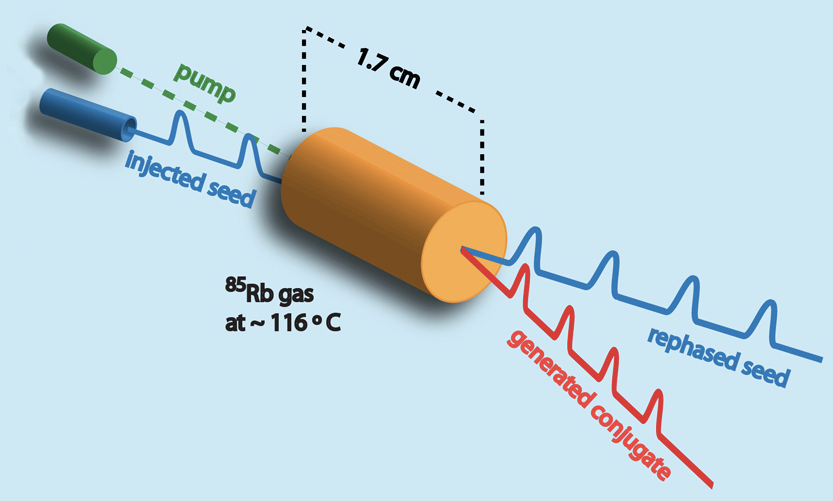
Four-Wave Mixing In four-wave mixing, researchers send "seed" pulses of laser light into a heated cell containing atomic rubidium vapor along with a separate "pump" beam at a different frequency. The vapor amplifies the seed pulse and shifts its peak forward, making it superluminal. NIST

Our nation’s official keepers of time and other standards are breaking one of the cardinal rules: They have figured out how to make superluminal light pulses. This paradoxical sentence — faster-than-light light — is from a new paper explaining how to make the sine wave of light hunch in on itself and arrive a few nanoseconds earlier than it would if it had moved at light speed.

Nothing can move faster than light, as neutrinos coldly reminded us earlier this year. Einstein’s constant C, for the speed of light in a vacuum, is a universal constant. But researchers at the National Institute of Standards and Technology are playing some tricks with physics.

A short burst of light can be expressed as a curvy wave, with the hump representing the peak of the burst. The whole wave cannot exceed the speed of light, but apparently you can do some physical manipulation to that hump and make it arrive earlier or later than it’s supposed to. Ryan T. Glasser, Ulrich Vogl, and Paul D. Lett at NIST and the Joint Quantum Institute manipulated the hump using a technique called four-wave mixing. It re-arranges the light waves that comprise the pulse of light and makes the hump move forward.

The researchers pulsed ultra-short (200 nanosecond) laser pulses into a cloud of rubidium vapor, according to NIST. Next to this seed pulse, they pumped in a second laser beam at a different frequency. The rubidium amplified the seed light, so its hump hunched forward. While this was happening, photons — because light is a wave and a particle — interacted with the vapor and formed a second pulse, which could also be tuned to travel faster or slower than it is supposed to. The peaks of these light waves arrived at their targets 50 nanoseconds earlier than they would have if they were traveling at the constant C.

Aside from proving that it’s possible to bend the rules, the NIST team could use this breakthrough to study some strange quantum effects of this fast light, which could be useful in quantum information processing.

The work appears in Physical Review Letters.

[via PhysOrg]

20 Comments

Doesn't that violate causality? It would mean that information could potentially be transported faster than light... Which whould have some interesting "time travel" consequences... I don't know, maybe I'm getting excited for nothing...

Does the "pumped up" light change color?

I hate to use qualifiers but information might travel faster than light already through quantum entanglement.

The jury is still out on whether or not this violates causality however

Quantum entanglement does not allow for faster than light information transfer as a parallel "conventional" canal is necessary to transfer info. The only use would be for security as this is the ultimate encryption solution : only the pair with the entangled objects can decipher the message. It therefore does not violate causality... Info faster than light necessarily violates causality.

E=MC2 = nadda

Well, causality seems to be a totally valid assumption, but there is of course nothing wrong with putting it to a test.
From what I read, the researchers don't make any claims on that.

Fifty nanoseconds faster? So what you're saying is, we have found warp 1.5! Sweet! Seriously though, this is very interesting. Perhaps we can use this new information to come up with improved methods for solar energy collection? Maybe the new wave form can knock more electrons loose? I'm not sure. What I am sure of is fiber internet. Give me some superluminal fiber internet connection. Now we are talking!

causality is a freaking joke! i'm a christian so my religion has already cornered the shoehorning market and even i believe in free-bloody-freaking-will. you, who you are, and what you make of yourself is not a constant that is dependent on time but is a variable that is based off of who you were born to, who you were, who you've decided to become, and most importantly what you decide to do. being born to a crappy family is no excuse to be a crappy parent as much as being born to a poor family is an excuse to be a poor person. my father was a blue collar worker for most of my childhood but i can promise you i have no idea what i will be but i have decided not to die from a blue collar noose.

at worst this just throws out our concept of a universal constant of the speed of light. c is the speed of light in a vacuum whereas this is the speed of light in rubidium gas. because the speed is amplified by the rubidium i think that we can keep all our favorite equations such as e=mc^2 and the C constant but i will imagine that continued experimentation will reveal more complex equations dealing with the movement of light through particles.

to mars or bust!

This sounds way more like changing the amplitude of a photon than making it go faster..

Since c is a constant and E cannot be created or destroyed, are these photons moving in waves within waves to create the illusion of created energy, when really the speed is the same but passing through space in a different way?if so this could suggest some sort of physical equilibrium. Perhaps even with degrees of freedom for distance and time

"Nothing can move faster than light" - I know it may be pedantic, but that of course is not true, nothing with a rest mass (which light does not have, although it can be calculated) can be accelerated to the speed of light due to Special Relativity - it would need an infinite amount of energy. In fact, Einstein himself proposed the possible existence of the faster-than-light particle called tachyons. Hence, that's not the rule which is being bent as stressed by this article, what's being bent is the postulate that the speed of light is the constant c in every frame of reference.

Try telling that to a black hole, and besides c is the speed limit in a vacuum. To go below it is normal,it's the faster part that is amazing & confusing to me.

so the top of the "hump" of the pulse is moved forward 50 nanoseconds? wouldn't that mean it comes out before the one going in goes in?

Okay, as I understand it, this doesn't seem to change the speed of the light itself; it seems like the beam is already established between points, but they use a few tricks to manipulate the light's amplitude in such a way that it propagates up the light beam. The front of the beam moves at light speed, but once it's established, this trick can come into play to move information faster than light speed. That's a neat trick indeed!

My opinion of causality is that because quantum entangled particles move at less than the speed of light to their respective positions, all the information that they will ever transmit is likewise also moving at less than the speed of light, thus causality there isn't violated. In the same way, because the front of the beam moves at light speed, causality isn't violated because the beam itself already contains, in a quantum sense, all the information that it will transmit. Come on, we have quantum physics, that totally makes sense.

Yesterday's "Common Knowledge" and "Irrefutable Facts" are tomorrow's "Funny Historic Beliefs".

The sooner we realize that we don't know as much as we think we do, the faster we can understand what we don't currently.

Playing Devil's Advocate since 1978

"The only constant in the universe is change"
-Heraclitus of Ephesus 535 BC - 475 BC

but thats a good thing. the more crazy ideas out there, the more likely that one of them will turn out to be correct.

They have not actually made "light travel faster than light", so to speak. They've used properties of light waves and interference to adjust the positions of amplitudes. They measured a particular peak being at a given position 50 ns before it should have been. It's very interesting, but not the sort of thing that is climate changing.
I'm not attempting to downplay the significance of this finding, only the significance that some people seem to be attaching to it.


June 2013: American Energy Independence

Five amazing, clean technologies that will set us free, in this month's energy-focused issue. Also: how to build a better bomb detector, the robotic toys that are raising your children, a human catapult, the world's smallest arcade, and much more.


Online Content Director: Suzanne LaBarre | Email
Senior Editor: Paul Adams | Email
Associate Editor: Dan Nosowitz | Email
Assistant Editor: Colin Lecher | Email
Assistant Editor: Rose Pastore | Email

Contributing Writers:

Kelsey D. Atherton | Email
Francie Diep | Email
Shaunacy Ferro | Email

circ-top-header.gif
circ-cover.gif