D-Dalus Graham Murdoch

Last year, the Austrian engineering firm IAT21 set out to construct a flying machine that floated like a hummingbird, traveled as fast as a jet, was as quiet as a hot-air balloon, and was simple enough that a car mechanic could repair it. The company’s working prototype, called D-Dalus, is roughly five feet by three feet square and can lift about 100 pounds. But the size and lift are not what’s most impressive. A flying machine with no airfoil, rotor or jet propulsion can travel where most cannot: in very tight spaces and through terrible weather.

ROTOR ASSEMBLIES

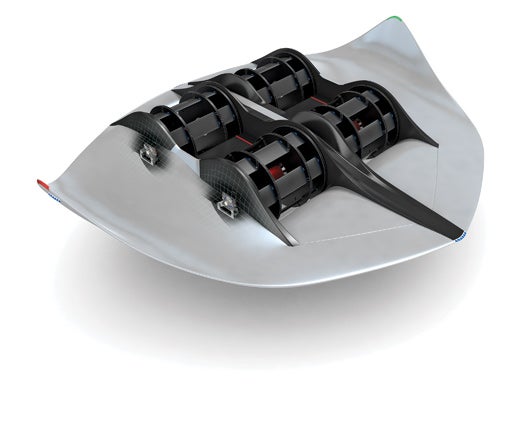
The craft’s four rotors spin at 2,200 rpm, and six blades attached to carbon-fiber disks create directional thrust. The blades act as mini airfoils, their angle of attack constantly shifting in relation to rotation. For vertical lift, a blade’s leading edge rises away from the center of the disk at the top of its rotation and toward the center of the disk at the bottom [pictured], creating a pressure differential.

FRICTIONLESS BEARINGS

Existing bearings were unable to withstand 1,000 Gs of force between the carbon-fiber disks and their blades and still deliver some degree of maneuverability. Engineers at IAT21 developed their own bearings, shaped like metal barrels, that hold up to the force better than spheres (think: arches) but can still roll enough for the blades to move.
D-Dalus Rotors:  Graham Murdoch

AUTOMATIC STABILIZATION

Servo motors communicate with the rotor assemblies to automatically correct the craft’s speed, position and balance by adjusting the blades’ angle. If the pilot jerks the radio controls too hard in one direction, the craft will keep itself from pitching or yawing by increasing opposing thrust. The system can adjust for turbulence and heavy winds, too.

ADVANCED NAVIGATION

Radar, GPS and three multispectral cameras (visible, EHF—extremely high frequency— and infrared) act as the D-Dalus’s eyes. Visual information is fed into the craft’s collision-avoidance algorithm. The system is so sensitive that D-Dalus can fly within inches of power lines, hover above moving platforms (a ship’s deck in rough seas, for example), or refuel another D-Dalus in flight.

22 Comments

A video would have been nice, one that demonstrates the vehicle's flight capabilities. Otherwise the D-Dalus sounds like a work of pure genuis.

You know this kind of technology is going strait to the military. Imagine a combat zone with these flying around.

Speaking of military uses:

I could see rapid deployment and extraction of troops. Think of a "theater entry vehicle (TEV)" with four hanging seats, all latched onto this thing. It powers up, makes a precision landing in a strategic location very quietly, the troops exit, as soon as they do this thing disappears back into the sky, hovering waiting for a "all clear" signal at the extraction point. The troops mount up at the EP and quietly disappear off into the night.

Basically, think of this very quietly and quickly dropping off and picking up Seal Team Six when they rescued those folks in Africa. No big heli, just this thing making rapid deployments from a nearby control center (which could be ground or sea based).

Best part is, TEV could be 100% automated and even take on drone or surveillance/relay duties while its waiting.

yes that is UFO technology. most likely alien tech. they give this to us now in 2012to prepare us for the long journey to other true mother planet in the constellation virgo.

"religion is like a prison for the seekers of wisdom"

-Killah Priest

This is one of the most innovative and interesting flying machines I have seen in a very long time. Depending on how efficient it is, it could mean a revolution in flight. Of course, if the claims are accurate, it most definitely is already a revolution in drone/UAV technology.

I look forward to seeing a video!

"One can resist the invasion of armies; one cannot resist the invasion of ideas."

--Victor Hugo

The concept behind the motor is not necessarily a new one. The application however is. Motors similar to this have been in use for quite a while in the form of voith schneider propellers.

dfabio's right. This seems to me to be based on four voith-schneider props. Good idea, because they can give thrust in any direction perpendicular to its axis, but I'd be interested to know whether they're any better than a conventional multicopter with regards to efficiency etc.

Cool, or as we would like to say in the old days "Far-out."

Ron Bennett

I wished to see a video as well, the inventors were at a Paris Airshow and in the background (behind the guy talking) you can see their promo-demo video here-
www.youtube.com/watch?v=c87wTW_3J2o

Very Fishy! I'm not sure it actually works, since this is actaully so simple that the first thing they'd have to have done is build a working scale model plane.
And the one in the video looks like it could barely 'drive'...

This interested me enough to actually create a login. I for one would love to see a video as well. Also, this is the type of tech I look forward to for flying cars it's definately a step in the right direction. Great Scott!

This craft just sent creators of '20 minutes into the future' sci-fi reeling, amazing work.

Here's a vid showing the concept.
http://youtu.be/uscW9RLcBpw

Very much doubt if there will ever be a manned flight application for this design because mechanical failure turns it into a rock. Planes and helicopters can descend safely without any power. This does not detract from the awesomeness though.

these won't be manned, IMOP...the era of manned attack planes is over, this will evolve into HK's, cheers

Could you use this to rescue people from tall buildings? I'm thinking of all the people that could of been saved from the fall of the twin towers.

I think everyone brought up great potential uses, so I won't go repeating them... I'm just surprised NO ONE brought up the obvious resemblance to the Green Goblin's glider!

He's kind of right.

The prop design was actually an aircraft design BEFORE it was a watercraft design.

Posted ironically in Popular Science. In something like the 30's or 50's IIRC.

early concept drawings had one barrel on each side of the aircraft bodies instead of standard wings.

They never worked terribly well. making one that worked required unreasonably strong materials and the efficiencies were never that great.

We do have stronger materials now though, and aircraft are getting very very specialized. There may finally be a place for one of these.

I am most worried that the makers apparently claim to have reinvented roller bearings in order to make this go. This implies a certain level of engineering myopia no condusive to making something that is actually useful.

What's this thing's power source? It doesn't look like it has an engine, so my guess is electric. I'd also think that all those rotors spinning at 2500 RPM would eat power pretty fast. For demo purposes they could plug it into the wall and it would go forever. On batteries it probably flies for minutes rather than hours. You could trade off weight for battery life, but this is probably this vehicle's Achilles' heel.

bluedm

Hung underneath in some earlier photos you will see a motorcycle engine. At Paris we had removed this so we could hang the D-DALUS prototype above the stand without fuel or oil dripping on us. In developing the next stage we have upgraded the control and flight software and have now attached a Rotax engine ready for extensive indoor trials, and may publish video of these trials in a few weeks time (althgough we are a bit shy of too much publicity at the moment as we are a tiny team flooded by emails and its too soon to start marketing this technology). The current prototype is pretty fuel efficient - one litre lasts around 15mins. We also have a small scale prototype that we will eventually drive with electric power and use for demonstrations.

I would say that once we perfect the technology, find a good energy source, and make it much bigger we could have ourselves something that acts similarly to a UFO. Fuck yea, let's do it. For Knowledge!

Here is a Link showing the first test flight that was broadcast on German/Austrian TV about a month ago.

http://www.youtube.com/watch?v=zujMZ-olu5I


July 2013: The Future Of Flight

The incredible innovations, like drone swarms and perpetual flight, bringing aviation into the world of tomorrow. Plus: today's greatest sci-fi writers predict the future, the science behind the summer's biggest blockbusters, a Doctor Who-themed DIY 'bot, the organs you can do without, and much more.


Online Content Director: Suzanne LaBarre | Email
Senior Editor: Paul Adams | Email
Associate Editor: Dan Nosowitz | Email
Assistant Editor: Colin Lecher | Email
Assistant Editor: Rose Pastore | Email

Contributing Writers:

Kelsey D. Atherton | Email
Francie Diep | Email
Shaunacy Ferro | Email

circ-top-header.gif
circ-cover.gif
bmxmag-ps