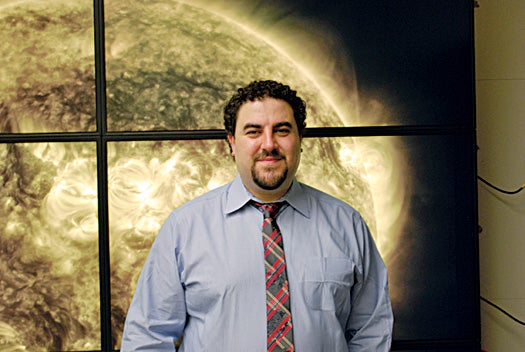
In July 2010, a colleague rushed into Justin Kasper’s office at the Harvard-Smithsonian Center for Astrophysics, in Cambridge, Massachusetts. He showed Kasper a telescope video of something they had never seen before: a comet crashing into the sun. The sight was amazing. But what grabbed Kasper’s attention was the moment before impact, when a surprising cloud puff indicated that the comet had hit unobserved material.
To answer, among other questions, what caused the cloud puff, Kasper is designing an instrument that will get closer to the sun than ever before. The Solar Probe Cup will scoop up bits of the sun’s corona and solar wind to continuously measure its speed, temperature and density. That information will help astrophysicists investigate why the corona’s plasma gets so hot—it can reach a million degrees—and how the plasma turns into a millionmile-per-hour solar wind, and what that mysterious puff might be. “Who knows what we can’t make out because we’re just too far away?” Kasper says.
The Solar Probe Cup will ride on NASA’s first solar mission, called Solar Probe Plus, in 2018. When it reaches the sun, it will have to withstand temperatures of up to 2,550°F. Kasper and his team have begun upgrading a conventional ion detector by shrinking the plasma-collection cup (so that it will absorb less heat) and etching sturdier grids out of melt-resistant tungsten and sapphire.
Once the Cup takes off, the data-crunching begins. Kasper has several theories about the plasma movements his detector could uncover, but sometimes even the best theories can’t anticipate what the actual conditions in the plasma will be. “We’re trying to build instruments as capable as we can,” Kasper says, “because very rarely do we find what we were expecting. That’s part of the fun.”

Read more about the molecular filmmaker, the butterfly pharmacist, and the rest of our Brilliant 10.
Five amazing, clean technologies that will set us free, in this month's energy-focused issue. Also: how to build a better bomb detector, the robotic toys that are raising your children, a human catapult, the world's smallest arcade, and much more.


Online Content Director: Suzanne LaBarre | Email
Senior Editor: Paul Adams | Email
Associate Editor: Dan Nosowitz | Email
Assistant Editor: Colin Lecher | Email
Assistant Editor: Rose Pastore | Email
Contributing Writers:
Rebecca Boyle | Email
Kelsey D. Atherton | Email
Francie Diep | Email
Shaunacy Ferro | Email
Radiation hardening of Computer chips will take on a whole new meaning here.
this reminds me of the movie "sunshine".
So essentially this multi-million dollar suicide instrument was designed because there was a puff when a comet got close to the sun and someone is curious why? I'll tell you why; as the comet got close to the sun, the internal ices melted and flash-boiled blowing a hole in the comet and escaped. There ya go, an answer. I'll take those millions of dollars please.
@ tertertert
dont be so assertive in your understanding of what you *think* you know, do you really think of the thousands of scientists, all of which are paid to be smarter than you, havnt thought about that?
i think he was joking; but then again alot of commenters on here think they are way smarter than the scientists, cheers
It was more or less a joke, but it was to make a point. I know that it's important to study space for our own advancement etc, but throwing millions of dollars into the sun because of a mystery puff just seems frivolous when we have so many bigger problems back on solid ground.
@tertertert
With that logic, we'll never colonize space. We'll just stay on solid ground trying to fix all our problems as new ones arise. Then all of the sudden something will happen that threatens our existence, yet it will be too late for us to do anything meaningful to secure the survival of our race.
Then our biggest problem will be how can people of all ages come to terms with the concept of death without legacy. Watch how fast civilization degrades when people are faced with mortality that doesn't produce any measure of existence beyond one's own life. Death is only bareable through the prospects of progeny.
What we do in science we do not just do to better our lives, but to preserve it. How long we survive in this universe will be determined by the things we judge (correctly or incorrectly) as important and trivial. Misconception will lead to our ultimate demise, however a correct assessment of importance may yet see one of a few sentient races (the only that we know of) in the universe endure everlasting.
yup, much more money is needed for space exploration, the future of humanity is at stake, cheers
I can understand the humor, but you have to acknowledge that humor. Speaking to that Idea, why are comets, which only recently were identified NOT as a rock with some ice, BUT rather ice with some rock? (Look up the history of comets) Sooo, with that in mind, why do comets circling the sun, much closer that Earth, does not simply melt? With my meager “thinking”, the puff made by the comet hitting the sun has to be something else than ice instantly evaporating.
They must be very cold? cheers
check out this video: www.youtube.com/watch?v=LIRM_59hqE4 woow!
Could you imagine what their R&D lab must be like to create a working probe in an environment withstanding temperatures of up to 2,550°F? So the lab must house an environment cooker test lab for their probe at 2,550°F from only one side of the probe, as it's facing the sun. The other side of the probe maybe at an extreme coldness of space, I guess, too.
The creation and testing of this probe cannot be an easy task.