Feature
Watching how insects use plants shows that self-medication isn’t just for complex animals
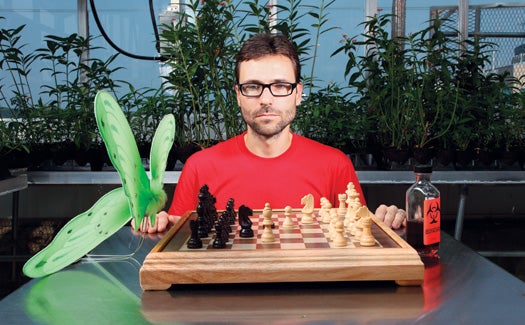
Checkmate Jaap de Roode studies how monarch butterflies use plant-based medicine to thwart parasites. John B. Carnett
“I didn’t start working with monarchs because I liked them,” says evolutionary biologist Jaap de Roode of Emory University. “I came to them because they have a really cool parasite.” That parasite, called Ophryocystis elektroscirrha, normally pokes holes in the butterflies’ skin, causing them to leak bodily fluids. But de Roode noticed that monarchs that ate the tropical milkweed plant did not suffer from parasitic infections as much as monarchs eating swamp milkweed did. This led him to suggest to his colleagues that the monarchs were self-medicating. “One of my reviewers said, ‘That’s completely ridiculous. There’s absolutely no way they could ever do that,’” de Roode recalls. Up until then, self-medication was seen as a complex cultural trait. Only a few animals, such as chimps and elephants, had been observed using medicine.

To test his hypothesis, first de Roode looked to see if infected larvae prefer to munch on the parasite-killing tropical milkweed species, rather than the swamp milkweed. They didn’t, so he concluded that the larvae do not use the tropical milkweed medicinally. But when he compared the behavior of healthy adult females with the behavior of infected adult females, a difference quickly became apparent. Infected females, which transmit the parasite to their offspring when they spawn, preferred to lay eggs on the tropical milkweed, showing that they can preemptively medicate their offspring. “Somehow, the mother knows what’s best,” de Roode says.

His findings challenge the view that only animals with cognitive complexity use medicine. If butterflies, which have a simple nervous system and no social structure, could preferentially use medicine, perhaps self-medication is pervasive in the animal kingdom and scientists just haven’t had the chance to find it yet.

Read more about the molecular filmmaker, the butterfly pharmacist, and the rest of our Brilliant 10.

5 Comments

I applaud the monarch, sovereign rule to pursue mathematical solutions for warping and twisting realities. These scientists persist with such tenacity that causes a great catalyst of development. During their studies at the peak of their own stress the smallest of things come into view. It is their never ending motion that achieves cures for illnesses.

Then, there are scientist that study microbial life and all its complexities for the restoration of our wetland ecosystems and a cleaner environment.

One scientist of medicine helps to illuminate disease organisms with biosensor detailed focus of light. And yet another scientist microscopic focus is in the neurons firing of the tiniest of insect brains, with the purpose of helping humans with mental disorders of autism and ADHD.

Another bright scientist with fun in his heart wishes to approach and probe our sun in as close cosmic detail for a cup of plasma soup of solar rays.

Scientist developing new tools, like a nanoparticle trap of precursor chemical markers for treatment of disease.

A scientist and programmer with an observation toward children’s mimicry learning ability wish to create a virtual humanoid thinking robot. Eventually our scientific develop robotic tools will be reinventing themselves and growing further beyond our own scientific dreams to further help mankind.

Perhaps in the future, we will have robots as scientist working side by human scientist, developing further, farther, faster in more detail or broad view than anyone could possibly imagine.

or they could just dissect us for fun to discover how the hell we came up with them, cheers :-(

I am happy for the Monarch butterfly, but they apparently, from de Roode's research, have pretty much solved their dilemma with the parasite. What is the application to humans? I find more hope in Sean Connery’s movie “MEDICINE MAN” that showed there is great knowledge to be found out in the unexplored area like the Amazon jungle. We need to think out of the box and literally out of our back yard, but not to ignore our back yard. Besides the Monarch butterfly did not lay ALL of her eggs on the “medicinal” milkweed, but only twice as many. Interesting, but I hope this is not the kind of research that wins a Nobel Peace prize. HEY, anything in tropical milkweed that might fight a parasite, bacteria or virus in humans?

Not my fave theory, but behaviorism might suffice to explain it. If the female experiences any relief from the discomfort caused by the parasite by being on or near the tropical plant, she would spend more time there, and lay more eggs there. No teleological planning a better future for her sweet unhatched caterpillars required.

Jack;
The Nobel Peace Prize is awarded for forwarding One World agendas, to the likes of Arafat, Waldheim, Kissinger, Bono, Gore etc., by the Norwegians. Nothing much to do with the Science prizes.


June 2013: American Energy Independence

Five amazing, clean technologies that will set us free, in this month's energy-focused issue. Also: how to build a better bomb detector, the robotic toys that are raising your children, a human catapult, the world's smallest arcade, and much more.


Online Content Director: Suzanne LaBarre | Email
Senior Editor: Paul Adams | Email
Associate Editor: Dan Nosowitz | Email
Assistant Editor: Colin Lecher | Email
Assistant Editor: Rose Pastore | Email

Contributing Writers:
Rebecca Boyle | Email
Kelsey D. Atherton | Email
Francie Diep | Email
Shaunacy Ferro | Email

circ-top-header.gif
circ-cover.gif