It's decision time

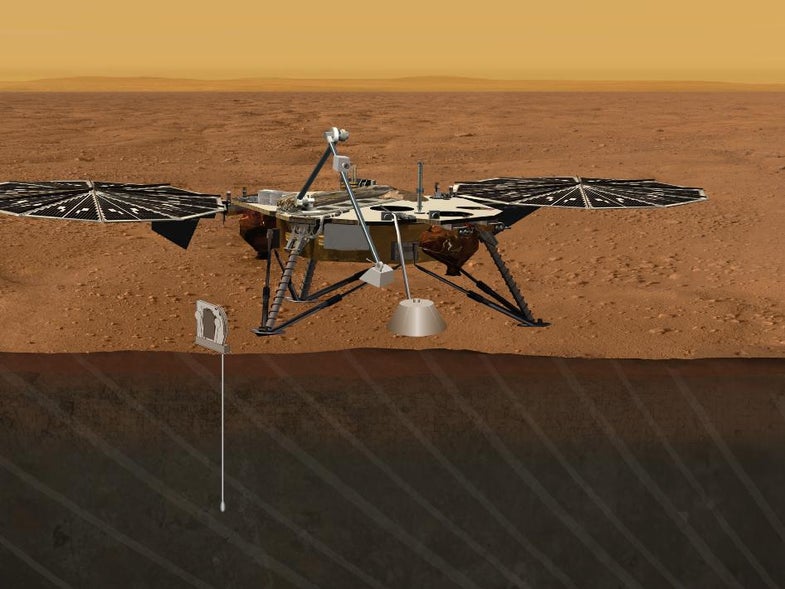
Mars Geophysical Monitoring Station NASA

If you could pick just one, would you A) send a new lander to Mars, B) send a robotic visitor to a comet, or C) send a ship to float in the hydrocarbon oceans of Titan?

NASA will pick one winner from these three projects, the space agency announced this week. The project will be capped at $425 million, not including the price of launch.

First on the table is the Mars Geophysical Monitoring Station, or GEMS, which will study the planet’s interior structure. It would carry three primary instruments, which would measure the planet’s wobble, marsquakes and geothermal heat flow. NASA says the mission could provide new information about the formation of rocky planets.

Next up is Comet Hopper, which will do just what it sounds like and alight briefly on a comet several times, observing how it changes as it interacts with the sun. Previous probes have already visited comets, smash wrecking balls into them and take their pictures, but this would study comets’ natural evolution.

And finally there’s the Titan Mare Explorer, TiME, which will float on one of the Saturnian moon’s massive oceans. It would be the second lander to alight on the moon after the Huygens probe, but the first to study an extraterrestrial body of water. It would study the methane-ethane oceans, possibly looking for any methane-eating inhabitants. It could also tell us whether Titan has a soggy interior, as some recently crunched Cassini data suggests.
Titan Mare Explorer: An artist's concept of a Titan ocean float.  NASA

All the missions will provide high returns at low cost, according to NASA.

Along with these missions, the space agency will choose among three technology demonstration projects designed to look for more comets, deep-space asteroids and near-Earth objects. NEOCam would be a space telescope positioned at a Lagrange point, where it would look for small bodies that cross Earth’s orbit, according to the Jet Propulsion Laboratory. The Primitive Material Explorer (PriME) would study comet compositions, exploring their role in delivering water and other compounds to Earth.

And Whipple - ROSS (Reaching into the Outer Solar System) would validate a new method to search for distant celestial objects.
Those are smaller missions still in the planning phase, while the probe proposals are already fairly advanced.

Each of the probe proposals will get $3 million to build preliminary designs and test them, and NASA will review all three again in 2012, choosing one for launch.

Here’s an idea — why not let the public vote, American Idol-style, for the best one? Nothing against any of the hardworking principal investigators, but I’m going with the Titan float. Mars is great and all, and comets seem like fun to visit, but a Titan ocean lander seems like a no-brainer.

[JPL]

18 Comments

Titan please.

NO MARS. They wouldn't even start to build it till 2012. So that means they finish by 2014 at the very earliest, then they launch it, and it'll probably take another 2 years to get there to save fuel. That means the soonest we get information from it is 2016.
Land humans and they'll be able to collect far more information.
Its not worth sending more probes there unless they're setting up bases.

Go to Titan and do something original.
Its way more sweet. No argument.

I am a Mars obssessed person.

But I want something on Titan a wee bit more. Personally, I would prefer a mission to Ganymede, Europa, or Io, but, you know, Titan would be cool too.

Yes, please oh please, pick Titan.

First of all, let me say that any future endeavors in space should have the ultimate goal of humans eventually going. Probes and landers have been great tools of discovery but we have inevitabilities here on Earth that tell us that we must at some point learn how to climb out of this cradle in a substantial way. Our space and resources are finite and we aren't going to stop multiplying anytime soon.

There was a time when I would have chosen Titan or perhaps Mars. However recently I've had to ask myself; With current technology we can get someone to Mars, but once we do then what? Our technology isn't robust enough to do anything but look around. And what of resources and support systems for our first Martians? We need a much heartier presence in space.

Seeing how stagnate human space flight has become over the decades I have to say that we must take a much more practical approach and entice as many companies as possible into future space ventures. Want to travel the stars? Get corporate greed involved. You convince them there is something valuable to be gained and they'll be onboard. And they'll build the most cost effective technology and infrastructure to maximize profit.

With that said it seems to me that we should be sending probes to asteroids and comets to look for abundant minerals and other resources. I think mankinds best hope for getting to the stars is to take those decisions away from people who are more concerned with the next election cycle than the future of the species. At least a company looking for profit (greedy or not) would have a goal that is in line with the necessities of mankind; getting to space cheaply, safely, and in a robust manner.

If we can get enough companies interested in mining these resource rich bodies in space (including the moon), we inherently develop heartier space craft and ultimately reduce the cost of going there. If done right, getting to space should be no more expensive than a transatlantic plane ticket in a few decades.

Then we can start talking about colonizing Mars and putting a human presence in the outer reaches of the solar system. If anyone is thinking that the governments of the world are going to get started on this soon I invite you all to look at the political environment of late as well as the past 30 years of space travel. We've done nothing but park ourselves in orbit. Time to do more, much much more.

Don't take life to seriously! You'll never get out of it alive.
-Elbert Hubbard

My line of thinking is very similar to cobaltblue1975's. I'd like to see more focus on mineral surveys of comets, asteroids and the moon.

If I had any say in this (and I obviously don't) I would push for a man tended robotic base at the lunar southern pole (where the H2O). Here would would start conducting detailed mineral surveys that look for useful things like H2O He-3 isotope (which could be very useful for fusion power), and anything else that is rare on Earth.

same as the two before me

while i really like the idea of titan cobalt blue is right in every respect expesialy the part about the extaterrestrial mining corporations.Because if there is anything that will motivate us humans it is greed,hence the fact people do crazy stunts and gamble for money.If we could share this info we can use the worlds most advance technologies(along with the money from a few billionaire investors)we could profit richly and also get LEAPS closer to space settlements and learning more about our solar system.

But of course we have to many hot-headed and close-minded countries, too busy warring with each other to care about coopretive peaceful goals to increase our intellegence.It is so sad that we have come so far from our caveman orgins,from prediciting silly theories like the earth is flat and we are at the center of the universe and yet with neucler missles and pollution everywhere we have a small chance to survive OURSELVES.If i had the money i would build a nuke-proof bunker with alot of our technology,history,philosifies,and books so that when WWIII comes we can begin anew teaching peace and striving to learn about the universe instead of learning how to kill our neighbors

Titan. We've never done it before.

It would really mean a lot if human beings made it to Mars.

Titan x 1000!

Most definitely (C). Ship to float in hydrocarbon oceans of titan.

@javor jav-you do realize that for the same reasons, plus travel time, the Titan mission wont land until after 2020, right? Having asked that, I do hope you get your wish!

The only realistic goal to further our species beyond this planet would be to set up a permanent colony on the moon. It is the easiest place to establish a settlement and would eventually become a viable setting stone to the rest of the universe... tho likely not in our lifetime.

All three of these mission seem to important to pass up, but if we have to choose one for NASA to attempt first, it should probably be the Titan mission. The frontrunners in the private space industry seem pretty enthusiastic about Mars already, so let them use their resources to develop more efficient means of transportation to the red planet. In the meantime, NASA could focus on projects like the Titan mission that are more focused on obtaining scientific data... If private space companies continue to focus on reducing costs and executing profitable missions while NASA continues to concentrate on increasing human understanding of the the universe, then both parties could benefit from the resulting technology/information. A symbiotic relationship between private and government space agencies is probably the only way i'll be able to make it to space before i croak so lets not mess this up people

i am pleased with all the excellent posts on here, not the usual case,
ddWilliams...you hit the nail on the head

Titan
Design it to last several years. The Mars probes have shown it is possible.

We've sent several spacecraft to Mars, comets and asteroids already. We've never landed anything in an alien ocean, so I say it should be Titan (if you hadn't already guessed that). The more missions we send to challenging destinations in the outer solar system, the better. Other countries will send probes to closer targets like comets and Mars in the coming years if we don't. That will likely not be the case for more distant destinations for quite a while. I hope NASA funds Uranus and Neptune orbiter missions this decade, as well. The only close-up data we have from them are 1986 and 1989 fly-bys from Voyager 2.

Titan.

Definitely Titan!!!


June 2013: American Energy Independence

Five amazing, clean technologies that will set us free, in this month's energy-focused issue. Also: how to build a better bomb detector, the robotic toys that are raising your children, a human catapult, the world's smallest arcade, and much more.


Online Content Director: Suzanne LaBarre | Email
Senior Editor: Paul Adams | Email
Associate Editor: Dan Nosowitz | Email
Assistant Editor: Colin Lecher | Email
Assistant Editor: Rose Pastore | Email

Contributing Writers:

Kelsey D. Atherton | Email
Francie Diep | Email
Shaunacy Ferro | Email

circ-top-header.gif
circ-cover.gif
bmxmag-ps