In a roundabout way, yes. But first we must heat that atmosphere, since the surface of Mars is about –58°F. “We know how to warm planets; we’re doing it right now,” says Robert Zubrin, the president of the nonprofit Mars Society, a group devoted to Martian exploration.
To make Mars more Earthlike, or “terraform” it, we just need to increase the greenhouse effect by adding fluorocarbons to the atmosphere, absorbing and trapping the sun’s rays. Tetrafluoromethane, or CF4, is a simple refrigerant that could work without destroying the ozone, as other fluorocarbons do.
As Mars warms, its frozen soil would thaw enough to release carbon dioxide, and more carbon in the atmosphere would further accelerate the greenhouse effect, bringing the average temperature up to 32°. Mars’s frozen underground water supply would melt and flow back into ancient riverbeds. And when the water reaches Martian soil, it would break down latent peroxides, releasing oxygen into the atmosphere—not yet enough to sustain human life, but enough to grow plants—which would further increase the supply.
Once the plants took root, we could just wait for oxygen to accumulate. At this point, Mars colonizers, who Zubrin imagines would work out of a research base camp and wear something akin to scuba gear to supplement their oxygen intake, would also grow algae and seaweed in ponds, which could anchor a growing food chain. “You could have fish farms on Mars,” he says. “Water would become the first environment that would be habitable by higher animals without any kind of artificial assistance.”
After bringing in fish, we could begin introducing land-dwellers to Mars, starting with insects and, as more and more oxygen became available, progressing to warm-blooded creatures. Using this process, Zubrin says, humans could walk around without supplemental oxygen within 1,000 years. But he also predicts that we’ll come up with other ways to speed up our settlement of Mars, such as genetically engineered plants that photosynthesize faster. “We can grapple with it and come up with a way to do it using 20th-century technology,” he says. “Yet these are solutions that people in the future will consider prophetic but quaint.”
Have a science question you've always wondered about? Email fyi@popsci.com
Five amazing, clean technologies that will set us free, in this month's energy-focused issue. Also: how to build a better bomb detector, the robotic toys that are raising your children, a human catapult, the world's smallest arcade, and much more.


Online Content Director: Suzanne LaBarre | Email
Senior Editor: Paul Adams | Email
Associate Editor: Dan Nosowitz | Email
Assistant Editor: Colin Lecher | Email
Assistant Editor: Rose Pastore | Email
Contributing Writers:
Kelsey D. Atherton | Email
Francie Diep | Email
Shaunacy Ferro | Email
What the author fails to mention is that without a magnetic field, the solar wind will quickly strip away all of the habitable atmosphere that cost trillions to create. until we can create an artificial magnetic field capable of covering the entire planet(way beyond our technological capabilities), all of this is just a fairy tale.
To add to what the other poster above said, even if we could heat the planets core, you'd have to also increase the mass of the planet. As it is now Mars cannot be terraformed.
First, you'd need to add mass to the planet. Second, you'd need to get the core hot enough to start convection process. This will turn the core into a little dynamo that in turn would create the necessary magnetic field similar to Earths(the Van Allen Belt). With out that magnetic shielding, the surface of Mars is bombarded by many harmful rays or more harmful rays than the Earth is.
Second: The reason you would need to add mass to the planet is to increase its gravitational hold on the atmosphere. Mars atmosphere is very thin due to the fact that it cannot hold onto what it has. As the poster above said, the solar wind helps draw off some of the atmosphere, but the biggest culprit is the lack of mass.
Third: Mars has two moons, Deimos and Phobos, each by itself is not enough to keep the dynamic tugging of the planets core necessary to create the dynamo effect. Earth's moon helps our planets core stay active. It helps it to create the magnetic field we presently have around our planet. Just as the moon effects our planets Ocean's tides, the moon also has an effect on the very core of our planet.
So you want to terraform Mars? It's not as simple as pumping oxygen into the atmosphere or even heating he atmosphere up.
@CeilingFan124
no matter how you look at it, this will be a fairy tale for a long time. Humans have not shown that they can work together on such a large scale. to build up an entire new planet would require the help of the entire human population. Its not going to happen any time soon unless we humans as a whole can stop fighting among ourselves and learn to move forward together. If every country shared there information and worked together from the begining of our time, we would be a much more advanced form of life and probably be testing intergalactic travel already or something so advanced we dont even know its possible yet.I trully hate how our planet is run
I am about to become a member of the Mars Society. Yippie!!
@Ceilingfan, AirshipGirl and anyone else who wants to argue planets and atmospheres, well you don't know enough about it to make a valid argument.
Simple reason is that moons smaller than Mars have atmospheres! Planets with less mass than Mars have atmospheres! Magnetic shielding, don't even bother with that argument.
As the Mars Society says, "The time is past for human societies to use war as a driving stress for technological progress."
That statement alone is worth the price of membership.
@ Airshipgirl
The dynamo theory of earth's magnetic field is just that, a theory. We're not even sure how our own magnetic field is created, we'll probably need to figure that out before we try to change the nature of something on the scale of a planet.
How much land is selling for on Mars? ;)
gotta get myself some 1Mil Acres of unused land :D Who knows, in 1000 years it might sell for $500 sqft :D
Couldnt you just put a huge rocket on the smaller moon, and push it into Mars?
That will make extra mass and heat, and whatever gasses were on the moon will then be transferred to Mars.
Killing two birds with one... moon so to speak.
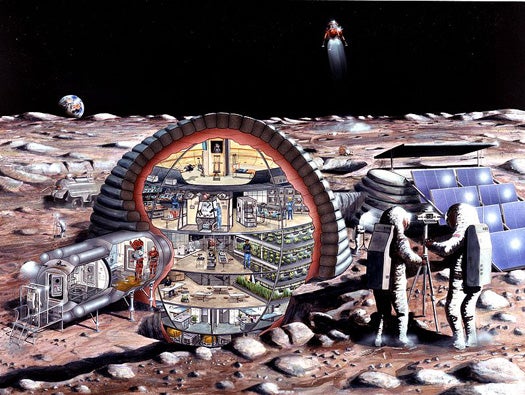
I don't think life on Mars is going to like that picture. It's a moonbase.
All4it, there are factors you do not seem to take into account - simply look at Earth and all the underlying factors as to why it even exist and can sustain life. It is actually a very complex mechanism that is finely balanced. It is folly to think you can simply add oxygen to Mars atmosphere and you could terraform it. That is just not going to happen.
For those interested in their directives, you can visit their website for more information.
http://www.marssociety.org/home/about/founding-declaration
already discussed on Michio Kaku's scifi science show (albeit in his typical 'scifi' way)
http://www.youtube.com/watch?v=izc95WRLlXM&feature=channel_video_title
But I do think it's achievable in the future, the thought of liquid water flowing an Mars and the ensuing teeming life that would spread fills me with excitement like christmas does to a kid.
@All4it You can't say that just because bodies with less mass than mars have atmospheres means you can easily terraform what appears to be a dead planet without an active core and a magnetic field in place. Granted, we still know little about the complexity of such things but without a magnetic field protecting the planet from the immense amounts of energy its being washed in by the sun making the entire planet livable just isn't feasible.
@Scotsman. It won't be easy.
My disclaimer: I don't have vast knowledge on astrophysics, Mars or anything outside the world of electronics. I don't have access to NASA's libraries to know where the current level of real understanding is at. I can only get my information from the same place everyone else does, Google.
From my limited spare time research, all arguments about how planets get atmosphere don't hold up when you start marking comparisons. There is another article about Titan and its atmosphere in Popsci that continues to tug at our understanding of why/how our solar systems works the way it does.
From my (limited) understanding, even if we terraformed Mars its atmosphere wouldn't last more then 500 or so years due to its distance from the sun as well as various other factors. At best, it would be a temporary stepping stone to explore outside our own solar system. I believe that our best bet to have any kind of settlement outside our planet should be in the form of free floating colonies. However, our current tech is no where near able to construct or maintain them. I doubt we'd even be able to get a small fraction of the materials needed out of our atmosphere.
Earth's dynamo has a lot to do with the churning and sloshing of its dense iron core. The friction speeds up the vibration of the atoms and unleashes hordes of magnetic discharge similar to what is seen on the surface of the Sun.
It clear that Mars has a hot core, but is it Iron? Also, if it is, does it already produce a weak field?
All bickering aside, before we can figure out how to terraform, we need to figure out what our plan for the now dead planet is going to be.
Are we tourists only looking around? or are we, as the article is written, going to take over the planet.
If the object is the latter, than we need to stop caring about any contaminants we might be bringing to the surface and start doing some quick and dirty recon/foundation operations.
Mars had a strong magnetic field at one point, and it still does have a weak field. Read about the current field, and the evidence of a stronger field in the 2 following articles.
http://www.spacedaily.com/mars/features/mgs-sci97a.html
http://forums.seds.org/viewtopic.php?f=25&t=2643
Right now all missions are scrubbed and sterilized to prevent contamination... If the main goal is to colonize, than we need to stop spending money on making sure we don't "pollute" the Martian enviroment and start working towards getting it up to a level of habitablity. Since it 1) does have a magnetic field
2) does have an atmosphere
3) has ice water
We can terraform.
But it needs to start now. Start, as stated in the article with heating up the planet, I also suggest we start loading up on microbes that we know can survive the climate (waterbears, bacteria, etc). If we are going to do this, we can't worry about what is or was there. We need to just act. I know that sounds callous and "American", but really people, if the plan is for Humans to live there, we need to walk in and take it. We don't have any evidence of intelligent life or even basic life in any form still living at this point. I say lets get cracking and make the move. Every journey begins with 1 step. Lets make that step.
@All4it I agree with you that we have a ways to go in our understanding of the mechanisms that drive planets. @codezero I concur, there are so many (relatively) cheap steps that could and should be taken now in order to start the process now
http://www.nasa.gov/mission_pages/mars/news/mgs_plates.html
About martian magnetic field(s)!
Easy stuff first.
CF's at .001% of Mars atmosphere would have enough warming effect to get things going. Easy to do with current tech.
While it's not clear a large moon is necessary, one can be provided with a modest investment. Some judicious orbital mechanics using nuclear rockets could move one of the larger asteroids into a 28 day orbit around Mars. This would cause tidal flexing of Mars crust heating it enough to release more CO2 and water. Pesky Phobos and Deimos can just be dumped into the new moon.
The magnetic field is more problematic but it's possible Mars just happens to be in the midst of a magnetic pole reversal. When Earth's field reverses, it will look like the one on Mars does now for a thousand years or so. In any event, human command of energy is advancing fast enough that in a thousand years, it may be trivial to add a protective planetary field using fusion reactors.
All planets lose atmosphere to the solar wind. The ones with a stable atmosphere just continually add enough gas to make up the deficit. The future terraformers of Mars could do the same.
Here are some more problems with Mars Society’s plan.
Humans can only tolerate trace amounts of carbon dioxide in the atmosphere we breath. Levels above 100 parts per million (ppm) are toxic. Levels above 1,600 ppm (0.16%) are fatal within 2 hours. Mars’ atmosphere is 95.32% carbon dioxide. If you plan to use the CO2 to keep the planet warm, then you will not be able to breathe the atmosphere. If you allow plants to turn almost all the CO2 to O2 then you will lose the green house effect that is keeping Mars as warm as it is today.
BTW if 95.32% CO2 isn’t enough to keep the planet warm, I don’t think an additional 2% or 3% is going to have the dramatic effect Mars Society is hoping for.
“At this point, Mars colonizers, who Zubrin imagines would work out of a research base camp and wear something akin to scuba gear to supplement their oxygen intake…”
Actually, they would need a pressure suit, and all the air they would need to breath (unless they have a way to efficiently remove significant levels of CO2 from the ambient air).
Even if you changed Mars’ atmospheric composition to that of earth’s, there is not enough pressure for human lungs to absorb the oxygen. At its lowest surface point, Mars has an atmospheric pressure of 1.2 millibars. Your lungs need a minimum of 300 millibars of pressure to breath (many people would pass out at this pressure). You are breathing air at around 1000 millibars right now.
Bottom line: you will need a lot of atmosphere (Nitrogen and Oxygen) for humans to be able to live on the surface without a pressure suit. When I say a lot, I mean more than 5×10^18 kg (5,000,000,000,000,000,000 Kg). Where is all that gas going to come from?
And as @CeilingFan124 mentioned, Mars will constantly losing atmosphere to solar wind.
The idea of terraforming mars is silly. If it is not impossible, then it is completely impractical. If we had the technology and the resources to do such a thing, I think that we would have more important things to do with it.
It’s called a DOME people.
@all4it - i know enough to get myself in trouble. it has nothing to do with mass. if we created an atmosphere on Mars, the Sun would blow the atmosphere away like a kid blowing out a birthday candle. the Magnetosphere is what stops this from happening on earth, it shields us from this solar wind. without a strong magnetosphere, building an atmosphere would be a wasted effort. everything we create will be blown into space. Until artificial magnetic fields strong enough to shield planets are realistic, domes are the only solution for human life on Mars.
@democedes...mars atmosphere is so thin even though the % of CO2 is high it has very little compared to earth...thickening the atmosphere with other gases (CO2, O2, N, ect) you could come up with an earth like atmosphere...however, this would be difficult and would obviously need future technology to overcome ALL the obstacles stated thus far in these posts...to consider it impossible is silly considering all the impossibilities we have overcome to date...starting ASAP seems ok, there isn't really much there to mess up
Mars lacks something more materially necessary to human life - sufficient gravety.
Even with gravetiy, why attempt to balance an entire planet when subterrainian life is so much simpler to build, maintain, and develop.
Finally, why bother sending humans at all until robots have set up an entire, self-sustaining, and functional colony base? There is no work on Mars that will be cheaper or easier to do with a person - the difference in cost between getting a person and getting a machine to the planet alone is incredible. No, the only reason to have people there is to diversify the number of habitated planets in the universe - a goal set in the vanity of man, and though laudable, it has more long term value than short.
We're not moving asteroids into orbit around any planet any time soon. Ceres is the largest asteroid, and it has 9.4×10 to the 20th power kilograms of mass (all hail Wikipedia). In US terms, that's 1.03x10 to the 18th power tons. In plain language, 1.03 quintillion tons. (As in: Million, Billion, Trillion, Quadrillion, Quintillion).
I won't even bother to compute the force needed to move that mass over a couple dozen million miles, because that's beyond even Star Trek type of dreaming.
@wylekyote
A theory is the highest level for an explanation of a phenomenon. What you're talking about is a hypothesis. A theory doesn't BECOME a law, it is a theory because it is the best explanation we currently have. Science always leaves room for future discoveries, but that doesn't mean we don't understand what's going on.
Remember a law generalizes an observation, while a theory explains it. A hypothesis doesn't become a theory until it's proven.
Once we are able to download ourselves into a computer there will be no need to terraform planets, we could live in virtual reality, or simply live as machines, no oxygen required. I think this will happen much sooner than making Mars habitable.
@Oakspar77777 Gravity shouldn't be an issue. If anything, life will have an easier time proliferating in slightly lower gravity environments. Life on Mars would evolve to be much larger than what we see on Earth. Trees would be roughly three to four times their normal size on earth. Flying insects would evolve to be much larger since there would be less of a physical limitation on flight. Plant life would thrive in a terraformed Mars environment, however you'd likely see the color of the plants be more of a red or yellow rather than green. Natural animal populations would likely evolve to get larger. Human populations would likely not evolve to be larger unless size played a factor in surviving the Mars environment. Lower intelligence species would naturally evolve at an increased rate.
It is not about being impossible, it is about being impractical. This is why I don’t own a jet pack, and I don’t use a flying car to get to work. Both exist, and 50 years ago there was no reason not to believe that they would be common place in the future.
Also, you assume that some technology will come along to make terraforming possible. It is equally possible that we have reached the pinnacle of our technology. Maybe we can make our tech smaller/cheaper/faster, but we have been using the same core technology for 50 years now.
My point is that there are things that we can do with our technology now. We can colonize asteroids or build domes on the moon or Mars if you prefer. We know how to do this now. It will just take the will and some exercises in engineering.
Spending billions to begin a terraforming process before you have the faintest clue how to complete it IS silly. I don’t think you realize the scope of what you are proposing. There is not enough Nitrogen or Oxygen in the crust to provide the atmospheric pressure humans need to survive. Terraforming Mars is on par with creating a dyson sphere or a death star.
If we really want to see humans set foot on Mars someday, we need to talk in practical terms. Mars Society talking about terraforming without first doing their homework really hurts their credibility in my eyes.
@All4it
Iv'e heard the reason smaller planets and moons have atmospheres is because they are further from the sun resulting in a colder atmosphere. Warm air is less dense than cold which causes it to rise. As a result you need more gravity to contain warmer air such as the Earth. Titan is far enough away from the sun so its lower gravity is enough to hold onto it's colder, denser atmosphere.
@democedes I think you are being a little bit hard on the fine scientists behind this idea. This is something that generates genuine public interest. If we can't feasibly conquer the universe by finding habitable planets and colonizing, then why not make one? When we have a purpose as humans, we are passionate about inventing technologies. One of the main drivers behind previous booms in technology were wars. The internet, modern aeronautics, advanced weaponry, and many more technologies were the product of the 20th century wars. We had a purpose and the money to push the boundaries. Think 1 million years into the future, if we terraformed Mars now, the future of our species would be truly thankful for being able to originate from two worlds instead of one.
@democedes One more note. The southern ice cap, if melted, contains enough water to engulf the entire surface of Mars in 11 meters of water. You truly think that this is beyond our reach? We're doing a pretty good job at warming up our own planet.
I am amazed that Popular Science would print this total trash.
It's long been known that Mars cannot be colonized as a 'twin Earth' simply because without a magnetic field to protect an atmosphere, any attempt to create one would be blown away by the solar wind as there is simply no way to reproduce Earth's dynamo magnetic field which is created by magma movement in the core.
If you invested trillions upon trillions of dollars importing Oxygen (and Nitrogen and Helium) you could never even get it to thick enough to breathe because the the gravity is 1/10 that of earth and the pressure would be too low akin to living on the top of Mount Everest.
You couldn't pressure it more simply because the gravity isn't high enough to hold the pressure in.
Jeeze you would think Popular Science writers knew a little about the equation PV-nRT !!
I simply cannot believe Popular Science produced this trash!
Qualifications and professional experience
Zubrin holds a B.A. in Mathematics from the University of Rochester (1974), and a masters degree in Aeronautics and Astronautics, a masters degree in Nuclear Engineering, and a Ph.D. in Nuclear Engineering — all from the University of Washington.[2] He has developed a number of concepts for space propulsion and exploration, and is the author of over 200 technical and non-technical papers and five books. He was a member of Lockheed Martin's scenario development team charged with developing strategies for space exploration. He was also "a senior engineer with the Martin Marietta Astronautics company, working as one of its leaders in development of advanced concepts for interplanetary missions" (The Case for Mars 1996). He is also President of both the Mars Society and Pioneer Astronautics, a private company that does research and development on innovative aerospace technologies. Zubrin is the co-inventor on a U.S. design patent and a U.S. utility patent on a hybrid rocket/airplane, and on a U.S. utility patent on an oxygen supply system (see links below). He was awarded his first patent at age 20 in 1972 for Three Player Chess. His inventions also include the nuclear salt-water rocket.
Now, I may be committing a logical fallacy via this submission but quite frankly I can think of a number of interesting articles that reveal the obnoxiously bold claims put forth by your collective arrogance to be lifted directly from ninth grade earth science, and I'm nobody! So, grow up and learn to debate with mutual respect and humility. I mean look at the way some of you end your little tirades, how rude. It is obvious that most of you are just trying to feel smart in any way you can. Here is an easy check for that kind of rhetoric: ask yourself if you are willing to bet your life on that statement and if the answer is no then say it with that in mind. Done!
They have been talking about terraforming mars for a long time, way before Zubrin suggested this and the process to do this has been well documented. One process left out in this article, fish need oxygen too, the algae would supply that.
The history of how the earth evolved is a good way to model how to terraform mars, eccept we would have to accelerator that process a bit to accomplish this in a relative short time. Also worth noting, because of the warmer mars the oxygen would escape the atmosphere at an accelerated pace, mars gravity is too week to hold onto O2 for a long time especially if the atmosphere has been warmed up.
Ron Bennett
The fact is, terraforming isn't about making a planet just like Earth, but making a planet to easily sustain life as we understand it. A thin atmosphere does not hinder terraformation.
Also @airshipgirl while we can't know for certain, scientists have judged that Mars' core is already spinning. Why would we need to start it? Just needs to go a little faster, that's all.
Nonetheless, our ultimate goal will be able to live there ourselves, anyway. Here the thiness is a problem, not because it's difficult to breathe, but because the air pressure is far too low for a human.
Find a way to raise the air pressure, and living on Mars is very much a possibility.
My question is this: So we have the technology, why do we just sit here and debate? Why not just go and start? If we mess up, we don't actually harm the environment at all.
@visualize,
"downloading yourself into a computer" is even more B.S. than colonizing Mars.
Most (if not all) of your identity and self-awareness comes from your experience of the world through your physical body.
If you took away that body and those perceptions, you wouldn't be yourself any more.
All of this "approaching the singularity" talk you hear about is just some old guy trying to deal with his impending death and dreaming up an eternal "heaven/afterlife" that his scientifically-oriented brain will permit him to accept as plausible.
@SolomonSinclair
Is that 11 meters above Olympus Mons or 11 meters above Hellas Impact Crater? There is a 29,429 meter (96,551 ft)difference between their elevations. If you are saying that water would cover the peak of Olympus Mons by 11 meters, I would really like to see your source.
What fools would we be investing resources in an impossible task when we can colonize our solar system through other means?
@skepticalofyouall
You are a total hypocrite. I see neither mutual respect nor humility in YOUR tirade. You have nothing to add to the discussion. No relevant facts or new ideas. Only that Robert Zubrin is really smart and should not be questioned by people of such low intellect.
If you know of articles that address our concerns, please share. Otherwise you are just another troll.
I see no mention of atmospheric pressure in this article. This is the primary concern in any endeavor to terraform. Even if you can make Mars warmer, earth plants and animals cannot survive without significantly increasing the atmospheric pressure. If this problem has been solved, I think it would be much more interesting that what is currently in this article.
You know, any one of you would go on all day about how people need to work together and how disappointed you are by humanity but you can't even recognize that respectful and humble communication/debate is something we can all do right now. Try this equation on for size: normal person + anonymity + audience = democedes! What you are not getting is that you are acting like atoms in the gun that shot Gabby Giffords. You see this stuff on tv and think that acting like an intolerant ass equates to a higher iq, but you are not John Nash, you're just a dick!
I came onto this site to read an article that I thought was interesting and happened to scroll down to find nothing short of arrogant self flattery. This is exactly why I usually don't read comment sections on online science sites. Everyone is out to prove their superiority, people like democedes aren't here to learn and question, they are here to get-off! What a waste this has been for me.
@skepticalofyouall
What have you added to the dabate? Insults are not evidence of truth. Where is your respectful and humble communication?
You are just trolling.
hmm, if we had robots 500 years ago, then Columbus would have never sailed the ocean blue. Louis and Clark wouldn't have to chart the west. Why send robots to do a humans job? Maybe it's cheaper, maybe they would do a better job...but they won't have as much fun, fear, or adventure. Mars exploration is better left to humans.
Terra-forming would be ideal....but for now why not send a colony that can live underground? Supply them regularly and watch them flourish...humans have a way not only surviving but flourishing. As long as the infrastructure is taken care of (heat exchangers, mining equiptment, 3D printers, food supply etc. etc etc)
But first things first...design a vehicle that can get the colony there safely. As of right now manned flight in space, beyond the van allen belts (for periods over 2 weeks) is impossible due to the same solar winds that would ravage earth if not for our magnetic shields.
@ Airshipgirl and everyone arguing over anything on this comment thread, related or unrelated:
The problem with this article is the mass and solar winds, true. But the real problem is that you're arguing. If you want to "win the arguement, stop angrily commenting for one minute and consider the other user's perspective, and try and figure out where their thinking is coming from. Maybe you're both right, maybe you're both wrong, maybe you're both partially right. Who knows?
@visualize
yes i say make a body from scratch with all this new homegrown factory skin and human tissue technology to make a body suitable to mars environment and put our minds into them. sort of like Avatar. like in dreams, we don't necessarily need our physical body's in them to remember how to walk, breath and so forth. either that or take the Surrogates route.
well it is true that humans cannot at this moment work together at such a large scale,first of all we need to clean the mess in our home,meaning that we have to minimize poverty and conflicts,and also repair the damage we did to the environment.That requires a new means of creating energy other than burning hydrocarbons
I am no scientist. I don't have the time to study into all this and I don't really have interest in a future that's about 100 generations away, at least, but when I read this I thought all the obvious issues. That's a lot of oxygen. Where do you get it all from? Can't take it from earth.
I made an account just to say one thing: Neptune.
Nawh, nevermind. Hydrogen isn't quite the same as water.
Maybe we could jump start the warming process if we smashed a few medium size asteroids into it. It's an interesting what-if article, but I am guessing that things on earth would have to change dramatically for us to put resources toward it. It's not like our planet couldn't use some help first.
Another missing ingredients that doesn't come up that is just as important for terraforming as oxygen and that is where will they get the nitrogen? Nitrogen currently makes up about 5 percent of the Martian atmosphere and 80 percent of earth atmosphere. In other words oxygen is a much either gas to introduce into the Martian atmosphere than nitrogen. There is hardly any nitrogen in the soil, humans can't breath a high concentration of CO2 and O2???
Ron Bennett
What say we spend a few thousand trillion or so - cleaning up our own planet before we piss money down a rat hole on Mars.
How could we keep industrialists from poluting Mars faster than it's being teraformed, if we can't stop them here.
Clean up the 200 million gallons of oil in the Gulf of Mexico.
Clean up the Exon Valdeze mess.
Clean up the Chesapeake Bay.
Hell, right about now, I bet that Japan would like a little help with that Fukushima thing.
If we can figure out the tiny stuff, then we'll be ready for diddling with other planets.
I believe mankind can make Mars habitable, but firstly, we need to develop an economically and technologically feasible means to take us there.
www.youtube.com/watch?v=ysTMByWXphQ
@rlb2
You are correct. Breathing air at 1,600 ppm (0.16%) CO2 is fatal within 2 hours, regardless of O2 concentration.
Breathing elevated levels of O2 is also dangerous for prolonged periods (days). The condition is called oxygen toxicity. Although symptoms and tolerance varies widely from person to person, recovery is very quick. Also, regular exposure does not have any long term effects, as long as spend some time at “normal” O2 concentrations regularly.
Consequently, I don’t think there will be many smokers on Mars when the O2 level rises to 90%.
Is the atmosphere really that thin on Mars? I saw pictures of what looks like entire forests and streams on Mars. Of course, there's also a lot of airbrushing going on and the more anomalous NASA pics get taken down right away. This might be the same type of red herring as bombing the moon to "explore underground aquifers."
@NASAWFF
I agree with you in that it is premature to spend money on Mars terraforming. But I think we need to spend more on manned space exploration.
There will never be a shortage of problems here on Earth. We need to take care of our environment, true; but not at the expense of our collective future. Earth is due for another mass extinction, and we are totally unprepared.
If we had spent all our resources fixing problems here on earth, we would have never gone into space at all, let alone to the moon. These are some of the greatest achievements of mankind. They inspire us to do more than simply survive / consume / make war. They give a noble purpose to our existence. And our survival as a species depends on us learning to do more than just survive for short durations outside Earth’s atmosphere. We need to thrive and expand in space.
@ Caitlin Kearney (and everybody else):
Is it just me or does this mars base look suspiciously like a moon base?
Maybe a reverse of the "Mars is gonna hit us!" legend where the martians freak out about "Earth is gonna hit us!"
@HealingMindN, I'm guessing you must be a troll or one of those sad cases of people being led astray by nutjobs that believe mars has stuff such as life and buildings but it's constantly being hidden by the government. There's no forests or streams on mars. There were once streams, but no evidence whatsoever of forests considering the extreme amount of time since any forest could even remotely exist in the wildest fantasy.
I admit it, I've been led astray, but I want to hear anyone try to explain away all the evidence including http://www.youtube.com/watch?v=iNRTeVcd1KA.
I'm no more of a troll than you are a girly man with feelings that are easily hurt. No one likes flamers.
Possible? Yes.
Probable? No.
Worthwhile? Depends.
Might be more worth our while to re-terraform the planet we already live on.
By the way, Healing: The US Government can't keep a secret for more than 30 military minutes. A secret lasts from 16:30 hours to 17:00 hours, which is how long it takes for someone with a TS clearance to get into town, go to the local bar, have three beers and begin trying to impress some sweet little babe by letting her know what he does for a living.
democedes, I' glad someone is paying attention and knows their chemistry. Even with 90 percent oxygen can you imagine how much of an explosive world that would be. Scuba divers don't use 90 percent oxygen it is more like atmospheric gas for a reason. A reason why NASA don't use 90 percent oxygen is because in "1967: Gus Grissom, Ed White and Roger Chaffee were killed on the launch pad when a flash fire engulfs their command module during testing for the first Apollo/Saturn mission. They are the first U.S. astronauts to die in the line of duty." They used mostly pure oxygen, they changed that afterwards.
That accident was because they used pure oxygen they stopped using it after that. An asteroid blazing across a oxygen enriched atmosphere would be 10 to several hundred times more destructive. So terraformers say that they can terraform mars but they never talk about the nitrogen deficit. Terraformers will have to find a lot of comets that has a lot of nitrogen in it then direct it to Mars. However any comet with frozen nitrogen in it would lose most of its gas way before it gets that close to Mars.
The best that we can terraform Mars is as other suggest before Zubrin, and that is to increase the CO2 level to a good distance above the tripple point of water which will allows water to pool on the surface, any explorers will have to wear an oxygen tank roaming on the surface similar to a scuba diver uses in the sea. However a CO2 environment will make any pooling water very acidict.
Until we develop a life form similar to soybeans that puts much more nitrogen into the soil then it takes out will we be able to start a long process to terraform Mars.
After thousands of years we may have developed more genetically productive terraforming microbes that balance the nitrogen / oxygen level out in the atmosphere to where we may walk on the planet without using a respiring gas tank.
As said before the biggest terraforning challenge to terraform Mars is where are you going to get the nitrogen???
Ron Bennett
Wouldn't you also need a moon large enough to control the weather and heat up the core to protect the people and life on mars.
all the theoriesare fine...but...we're missing the REAL prob folks....in todays world....truth =perception....fact=opinion...and logic has been changed to appropiate and the king of them all...politically correct...the biggest oxymoron ever created by man...until we can stop goverments(politicians)...the press...and yes...even our so called academics(including researchers and scientists) from drawing conclusions based on ONLY PART of the info(normally the part that is mst convienient or profitable to either themselves...or they're overlings...i.e those who pay for the research or sign their paycheck)i'm afraid we're all pretty much spitting in the wind waitting for the REAL cuase of most of our probs....overpopulation and lack of recoures...to help mother nature remove another over-successful inneficient species from her surface
Excuse me for being overly simple but, you are all focused on surface habitation of Mars. It cannot happen. Most of you have proved it in this discussion. So, think out of the box. Subterranean habitation is the answer. Hmmm, simple.
@hickory
yes that seems the fastest and most logical option for the time being. we could have an underground community in 50 years on mars. good call.
JediMindset, Mars has all the elements needed underneath it's surface to support almost any endeavor. The huge underground water deposits could allow us to establish a forward base for other planet flybys or visits very easily.
How about some kind of atmospheric shield, kinda like that highlander movie.Artificial o-zone layer.
@hickory
yes but we should first make an underground base on the moon. its way closer. than mars shortly after.
JediMindset, I agree. If you remember, a huge cavern was discovered on the moon that would work fine for a base. I am a retired engineer that worked on Apollo and other space projects. I would love to be able to visit the remains of the lander and the SIV-B stages that crashed on the moon. I designed several circuits on all of them. But, we have been sidetracked by people who are more interested in wasting the money than furthering exploration by mankind. Chris Columbus faced the same problem.
@hickory
an underground base could be accomplished in 10 years or less and wouldn't be that expensive. i wonder why this hasn't been done yet.........
JediMindset, the answer to your question is simple: We have too many politicians monkeying around with NASA planning. People who don't know a rocket from a potato are forcing NASA to change plans to meet political agendas. Engineers are usually non-political and results oriented. We first establish a need, then a set of goals and then accomplish with function. No politics there. Just good old hard work and wonderful discovery. We had a very good space station with Skylab but the politicians dumped it in the ocean. There were enough SIV stages left to add several large chambers to it. We also had a very good vehicle to get crews up there and back. Did you know that Pete Conrad used to run laps in Skylab? It had a circular track around the wall where you could run and create micro gravity. Oh well, what we wound up with was a compromised Shuttle design that was more expensive and more dangerous. The original design was a "stack" configuration with the shuttle on the top.
@hickory
wow i didnt know any of that. Skylab was never mentioned in school along with other important things in human history. lol. If we would have stuck with Skylab than we would have been farther in space by now. i wonder why space stations are only meant to last for short periods of time. NASA could in theory make them indestructible and make them last for 100s of years. I personally think that the space Shuttle was NASA worst accomplishment. they could have come up with a better design. think about it two have disintegrated in earths atmosphere. maybe thats why they are scrapping the whole project. they could have used a better and more durable material.
JediMindset, the original concept with the shuttle on the top of the stack had a reusable booster stage that had 2 pilots to return it to earth. There were no solid fuel boosters strapped on it. The design was much safer and after all this dancing around with politicians, it would have been cheaper. Back to Skylab: We had a huge telescope mount on it that would have been usable for a telescope almost as large as Hubble. There were plans to build a space tug that went along with it to dock supply ships. I was part of the team that did a lot of the electronics designs on the Skylab. We were looking into some fantastic appliances to go into the living quarters that make the ISS look like a camper. The team members had special shoes that allowed them to stand and walk on a grid type floor. It was very advanced. But.......... the politicians dumped it into the ocean.
hickory,
man thats crazy. imagine a world were the politicians didnt make the decisions for the good of the people but the actual people themselves making the decisions. we would advance in technology and life dramatically. yeah the original concept was better. skylab was a greatly planed station. at least we still have the ISS.
JediMindset, I don't have a problem with the politicians making most decisions but, in the case of NASA, you have some politicians that worry about us turning an island over making decisions that require thousands of smart minds to decipher. Don't be surprised if we abandon the ISS and leave it for the other nations. Our political leaders don't have a clue. What do you think about the bigelow modules? I can see these things working in space or on a planet surface.
hickory,
yeah but i think politicians should at least stick with politics, and leave science to the scientists. maybe we will end up selling the ISS lol since money seems to be more important to this nation then science. bigelow modules seem like a great idea. they can be used on the surface of a planet and i think also underground. plus they can be attached to a space station. another one of the most logical ideas for living on a uninhabitable planet.
@AirshipGirl
I agree
Without a magnetic field it would be completely worthless to try warming the atmosphere of mars and I'm pretty sure we don't even know how to do this with current technology. Its atmosphere is already mostly carbon dioxide. Even with an oxygenated atmosphere no-one could go outside without a suit anyway and any plant-life could not survive because of the radiation.
Oh, and the thicker atmosphere would just blow away eventually
@B.V.
Sorry for this reply being so late, I forget to ever check back to see if anyone else commented.
You say that, "Most (if not all) of your identity and self-awareness comes from your experience of the world through your physical body." and that, "downloading yourself into a computer is even more B.S. than colonizing Mars."
Since all of your experience of the world is actually created in the brain regardless of what you perceive to be causing the stimulus, I believe recreating this will actually be fairly easy in the future. It's not your hand scratching your ass that makes the sensation...it appears to be so, but really it all boils down to a brain function. You don't really need a hand and an ass to have that sensation, all you need is the right things firing in your brain. Think of people with phantom limbs. Figure out the code for what every signal of the senses are and be able to transfer that to a digital world and a physical reality is no longer required.
So if Venus has no magnetic field how does it keep its' atmosphere?
Jump starting a planet's magnetic field seems unlikely.
We could condition the atmosphere, but it is futile without that crucial magnetic field.
I'm not even sure if it wise to mount a mission to Mars.
The cost is one thing. The risk is huge. We all have lost probes to Mars. What makes one think that a manned mission will be any different?
It makes more sense to send more unmanned rovers. To send people is foolhardy at best.
I watched the first moon landing before i was three yrs old.
Dad built the tv. We took way too many chances.
I don't know how to say it more strongly, but don't go. The chance for tragedy is too great.
Who of us wants to watch worldwide as a crew to Mars dies.
We should create better propulsion before we attempt such a mission.
At least then, we might get them back.
I would never vote to leave a crew in space.
I hope you would feel the same.
There's things i don't understand and it's okay.
To put such funds and lives on the line, we must be sure.
Or at least reasonably sure.
At this point, we must not mount this mission.
I'd rather see us going back to the moon.
It's closer and more easily reached.
-akaterr
Those that believe that the solar wind will blow the atmosphere away, or that the mass of the planet is too small to support an atmosphere are ignoring empirical evidence to the contrary. Titan (Saturn's largest moon) has no appreciable magnetic field, and has a much smaller mass than Mars, but it has an atmosphere that is denser than Earth's.
Considering the post of "putting a small rocket onto one of the moons and flying it into mars"
there would be a slight chance that doing that might desimate the planet completely, and if not, the materials released into space from the explosion would minimize the chances of teraforming mars as it would lessen the materials that would be at our disposal. also, any frozen water that is lost due to the explosion would be lost forever. it should be our best of interests to keep as much water on the planet as possible.
putting a rocket onto the moon to speed up its orbit might be a better posiblity, as it would increase the tidal forces within the core of mars, causing it to heat up from the inside-out. This would also melt the underground water supply. while this is happening, it would be an ideal time for scientists to be working on the atmosphere and leave nature to take its course in giving us a water supply.