In a cosmic first, the Kepler telescope has discovered two planets sharing the same orbit. There is a theory that says our moon was created when a body sharing our orbit crashed into Earth, but up until now no one had found evidence of co-orbiting planets elsewhere in the universe.
It is possible that such a phenomenon could occur when matter around a newborn star forms into planets. In a planet’s orbit around a star, there are two places where a third body can safely orbit. These spots, known as Lagrange points, are 120 degrees in front of and behind whichever body is smaller. The discovered co-orbiting planets, located in the four-planet system KOI-730, are always 120 degrees apart, permanent fixtures in each others’ night skies.
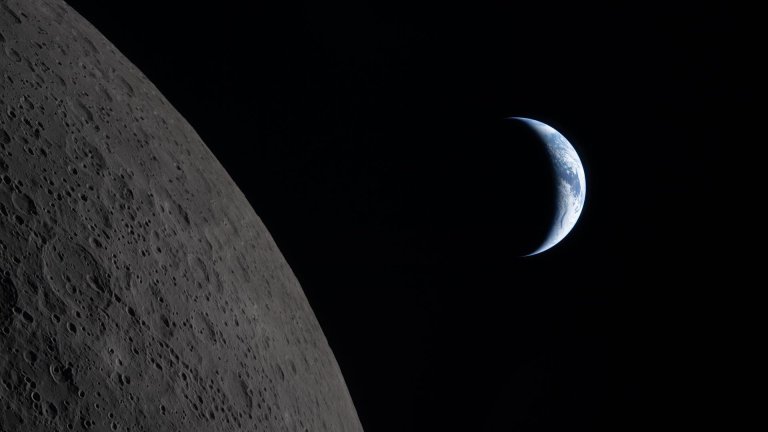
Fifty million years after the birth of our solar system, the moon may have formed from the debris of a collision between Earth and a Mars-sized body named Theia. For this to be true, Theia would have to have hit earth at a relatively low speed. Richard Gott and Edward Belbruno of Princeton University say that this could only have happened if Theia had originated in a Lagrange point. The discovery of the KOI-730 planets shows that it is possible.
Maybe someday these co-orbiters will collide and form another moon. But it won’t happen for some time, as simulations show that the planets will continue to share their orbit for at least 2.22 million more years.
Five amazing, clean technologies that will set us free, in this month's energy-focused issue. Also: how to build a better bomb detector, the robotic toys that are raising your children, a human catapult, the world's smallest arcade, and much more.


Online Content Director: Suzanne LaBarre | Email
Senior Editor: Paul Adams | Email
Associate Editor: Dan Nosowitz | Email
Assistant Editor: Colin Lecher | Email
Assistant Editor: Rose Pastore | Email
Contributing Writers:
Kelsey D. Atherton | Email
Francie Diep | Email
Shaunacy Ferro | Email
i like this
Don't forget that these planets were discovered by looking at a single dot of light and just noticing that it changes color and intensity jjuusstt so that it means that there are 2 bodies orbiting at the same distance, and from that little dot we can extrapolate what will be happening to those planets for the next few million years. Science is incredible, eh?
does anybody have anymore info regarding the size of these planets and the distance that they are from here
that's the great thing about theoretical physics. You just need a flicker of light and you can come up with an awesome story that no one will ever contradict unless he has a super-light speed spaceship or a time machine.
Well you all know what the definition of science is:
Making vast theories based on half vast data.
I've always wondered if that's possible. Now we have an answer :)
@enevo What is theoretical about measuring the angles between two celestial bodies observed via telescope? We don't have to physically travel to many places in order to observe them. If science followed your logic, we wouldn't know anything about any place other than the earth and its moon. Much of what we know about astronomy was discovered hundreds of years before we even figured out how to achieve flight here on earth.
It's ok sorandom, he still believes that the Earth is the center of the universe. So we can't get too mad at him. Haha
interesting, can som1 please explain this simulation
Fom the article:
"These spots, known as Lagrange points, are 120 degrees in front of and behind whichever body is smaller. The discovered co-orbiting planets, located in the four-planet system KOI-730, are always 120 degrees apart"
From the New Scientist article:
"They circle their sun-like parent star every 9.8 days at exactly the same orbital distance, one permanently about 60 degrees ahead of the other."
and
"there are two Lagrange points along the planet's orbit where a third body can orbit stably. These lie 60 degrees ahead of and 60 degrees behind the smaller object."
How did 60 degrees suddenly become 120 degrees? Please cut and paste properly when you copy an article. Or at least read and understand.
@dontcallmechief "Well you all know what the definition of science is:
Making vast theories based on half vast data." wow??? really? why do you even come to this website at all??? I think FML.com would be more suited (f#ck my life.com)
While this may be the first time two planets have been discovered that share the same orbit, we know of THREE moons that share the same orbit. It actually happens TWICE around Saturn. Tethys has two Trojan moons, Telesto and Calypso, at its L4 and L5 Lagrange points. Dione also has two, Helene and Polydeuces, at its L4 and L5 points with Saturn. Also, Saturn moons Janus and Epimetheus have orbits that are so close together it would appear they would collide, but they actually swap orbits about every 4 years when they approach instead of crashing together.