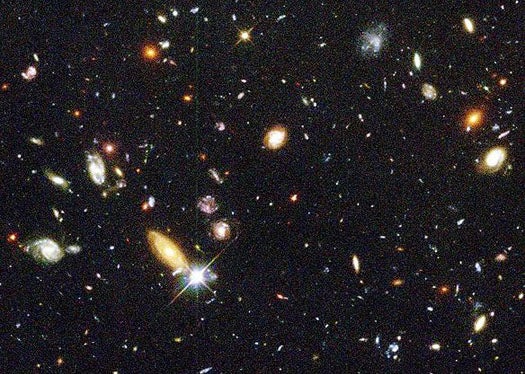
How big is the universe anyhow? We know the universe is roughly 4 billion years old and we know how far light travels in a year, so ostensibly it would seem the visible universe is contained to a radius of 14 billion light years. But we know that photons in the cosmic microwave background have traveled some 45 billion light years to reach earth (because the universe is also expanding the most distant visible objects are actually further than 14 billion light years), giving the universe an apparent diameter of at least 90 billion light years.
So how big is it really? A new mathematical analysis says its at least 250 times larger than the visible universe. Which is really, really big.
But it’s not actually the biggest proposed size of the universe. When cosmologists crunch their data, they use different models to give values to the universe’s curvature and therefore it’s size. Since we don’t know the shape of the universe, or whether it’s flat or open or closed or infinite, so we use different benchmarks to make our best guesses. This leads to a huge range of values assigned to the size of the universe, each as un-provable as the last.So Mihran Vardanyan at Oxford and a few of his colleagues did what outwardly seems obvious but is actually quite difficult: they averaged the results of all this data in the easiest way they could. Using a complex mathematical technique called Bayesian model averaging they found a way to constrain the complexity of the individual models themselves in a way that is much stricter than the constraints on the models themselves. In other words, Bayesian model averaging itself is complex, but it produces a simplified solution from complex models.
What is that simple solution? They found that the curvature of the universe is strictly constrained near a zero value, meaning the universe is likely flat. It’s also at least 250 times bigger than the Hubble volume, which is roughly the size of the visible universe.
Elegance in simplicity; what’s not to like? If you require more complexity, Vardanyan and company’s paper can be found at arXiv.
Five amazing, clean technologies that will set us free, in this month's energy-focused issue. Also: how to build a better bomb detector, the robotic toys that are raising your children, a human catapult, the world's smallest arcade, and much more.


Online Content Director: Suzanne LaBarre | Email
Senior Editor: Paul Adams | Email
Associate Editor: Dan Nosowitz | Email
Assistant Editor: Colin Lecher | Email
Assistant Editor: Rose Pastore | Email
Contributing Writers:
Rebecca Boyle | Email
Kelsey D. Atherton | Email
Francie Diep | Email
Shaunacy Ferro | Email
''How big is the universe anyhow? We know the universe is roughly 4 billion years old and we know how far light travels in a year, so ostensibly it would seem the visible''
Right... Maybe more like 14 billion years old?
No proof reader available I guess. If I remember right, the universe is a bit older than 4 billion years.
I'm amazed to see things like Bayesian statistics and the whole "Galton's ox" thing not being overused more often. As the article says, each number is more unprovable than the last, and while organised, thinking crowds certainly have a history of coming up with things that aren't completely stupid, that doesn't necessarily make using it good science.
Think of a number......................
Now justify it.
WOW! This is very elegant statistical technique. With ever increasing amount of data cosmologists have to work very very hard to understand the data. This techniques shows how much underlying theory changes the results, thus they have to come up with new methods to perform the analysis. Also there is a typo it should be 14 instead of 4, just checked it on www.icosmos.co.uk/index.html (you can play with the parameters to see how the age changes).
Good idea. However, i believe that the numbers come from the analysis, then when they have the numbers they have to justify it. There are many studies that estimated the size of the universe, and this is more about the statistical technique then the final result. As the result will soon change after they have more data from Planck satellite.
I think you mean 13.6 billion years old. =P
I have always wondered, why do people think there should be a size, or end to the universe? Are we going to bump into a wall? Or do we expect it reach the end, and then it will be empty, going on forever? People used to think the earth was flat, and the center of the universe.
I guess the same type of question applies to the Big Bang. What was there before that?
@56Kruiser i think when people say end, they really just mean an end to physical matter, an end to energy, then an end to any particles whatsoever. It is just an term so that we can try to visualize in our minds the existence of everything. if you trully try to understand that there is no end of the universe that it actually wraps in back on itself. Your mind cant comprehend that. We can experience it, so mathematically it makes sense, but can you sit there and try to figure out what EXACTLY this means: there is no true end to the universe you cant leave it, it litterly fold back into itself. its much easier for humans to try to think of a point where nothing more can be measure, what ever it is that you are trying to measure. that can be stars, or microwave energy which goes much further than stars.
Oh please. 250 times the size of the visible universe is "really, really big"?
c'mon popsci. Until we're talken something like 300 times the size of the visible universe, lets not get so dramatic. Now that would be pretty big.
inaka_rob: That model isn't difficult to understand for anyone who's ever played Asteroids. Don't exaggerate incomprehensibility. = )
The cosmos is infinite. No if and or butts.
@gizmowiz
The cosmos is not infinite. If everyone is sure everything began about 13.6 billion years ago, that is a finite amount of time.
If you believe Einstein, Hawking, and almost every physicist out there who say time and space are one in the same, then that would have to mean there is a finite amount of space as well.
Whether or not they will both go on forever is a different story..