On the bright side, that's sooner than others suggest
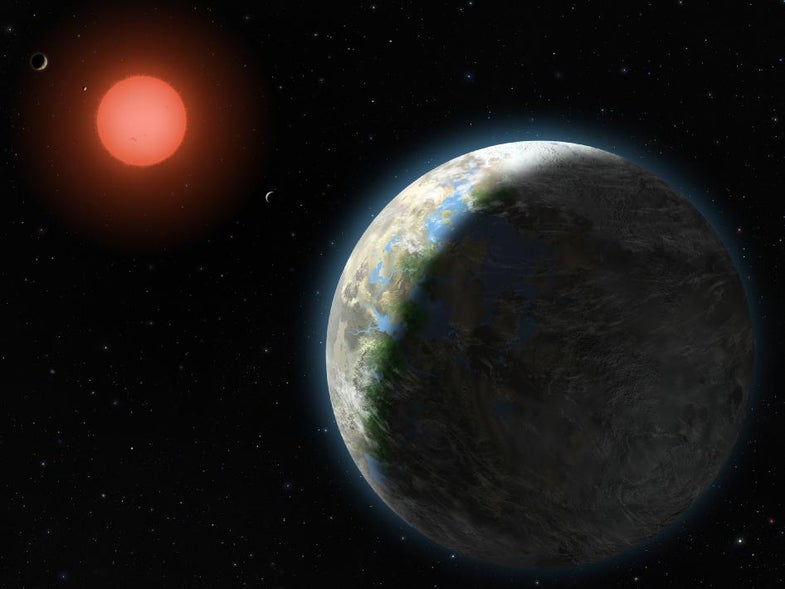
Gliese 581 System This artist's concept shows the inner planets of the Gliese 581 system. Planet G, shown in foreground, is thought to be in its star's habitable zone. Unfortunately, we won't be able to visit other solar systems for a very, very long time, according to a new study. Lynette Cook/via NASA

Interstellar travel won’t be possible for at least 200 years, according to a former NASA propulsion scientist who has some new calculations. And by then, the spaceships we would design for the trip will be obsolete.

Forget cost, political will and all the other variables — simply obtaining enough energy will take until 2196, according to Marc Millis, former head of NASA's Breakthrough Propulsion Physics Project and founder of the Tau Zero Foundation, which supports interstellar travel research.

Millis did plenty of extrapolating to reach this conclusion, which he presented at an astronomy meeting in Prague last fall and posted to the physics archive this week. He crunched 27 years of data on energy trends, mission energy requirements, individual energy use and even societal priorities, and chose two possible trips: An aimless interstellar colony ship, and a 75-year-long mission to Alpha Centauri.

Millis examined the energy required to launch the space shuttle during the past 30 years, which is a fraction of the nation’s total available energy. He assumes the same ratio will hold for interstellar flight, as Technology Review’s arXiv blog explains.

For a 500-person ship on a one-way journey, Millis figures you would need at least an exajoule — that’s 1018 joules — which is just a little bit less than all the energy consumed by the entire world in one year. For an unmanned ship destined for Alpha Centauri, you would actually need more energy, because you’d want to slow it down upon arrival at our nearest neighboring star. This would require 1019 joules. Even without accounting for fuel, the 500-passenger ship wouldn’t be able to launch until around 2200 at the earliest, and the A. Centauri probe won’t be ready until around 2500.

Millis’ math is actually more optimistic than other studies, which have suggested you would need 100 times the world’s total energy output to cover that distance.

Still, it means we all have to live vicariously through Voyager for at least the next few generations.

[Technology Review]

74 Comments

@brublr
So you're saying we shouldn't turn ourselves into computers?

that's without new propulsion.

Word Up nicolasjh1, wasting time doing math like this is complete rubbish. All this does is let politicians and the money people underscore the year 2211, realize they'll be dead by then and not further research into it. Studies like this do not help the cause, they crush it. Obviously with the crap we have now, we can't undertake something like this. We'll need new and smarter technologies and a better source of power. Besides that, who the heck decided to send a 500 person ship? We'd have a lot more worries then power consumption on a ship of that size... Interesting, but pointless.

Actually,i've read a concept of a 50 000 person ship(an "intestellar arch").This "arch" was propulsed by a plenty of fusion reactors-propulsors that also produce the energy needed for the ship(the propulsion is,i think,created by the exhaust of high velocity fusion products).It took into accout the mass of the fuel(a large corolla placed at the front of the diabolo-shaped ship,and also serving as a front metorites and radiations shield)for the acceleration and decceleration phase.When I think about it,the conceptor thought it would take around 500 years to "build" the ship(in fact,it is made of space-growing-vegetable-type structure,so you just have to let it grow,and it would take aproximatively 2-300 years,i think).All of that for saying that yes,we do not have YET the energy for such travel,but I think that with the fusion energy,or who know other sources,we can get it.Anyway,i hope he did not think we would do an interstellar travel with chimical propulsion,right?If he did,well his calculation is worthless.

i think thats all well and good...but that's assuming we still use the SAME energy means in 200 years. we dont still use horse-drawn carriages so i think Innovation should play a larger part.

Hmmm... On one hand I look at the advances taking place today and I don't think it shouldn't take so long for humans to be capable of interstellar travel. On the other hand I look at the fact that it has been far too long since the first moon mission to get a long term mission there and we have yet to get serious about going to Mars so maybe we won't get out of our own back yard until 2400 or longer.

The obvious conclusion to take is that it will be much sooner.

If you want to ask how long will a computer take to crack the hardest NSA encryption, you don't say a million years based on todays computers. You say computing doubles every so many years, in maybe 100 years a computer will be powerful enough to do so.

If you want to ask when will interstellar travel be possible. Answering 200 years based on todays technology is kind of ridiculous.

Not if we discovered payloads of fossil fuels on other planets like mars which I bet there is. My guess is life could've existed on mars before on earth. Lets get those automated mars factories up and running. Make it $60 billion project... I know if NASA, Darpa, Honda, and Pentagon all work together they could succeed at a much faster paste.

Even Have Bill Gates help out!

We'll never go to the stars on chemical reactions...

although that sounds like a lot of energy requirement;
in popsci article; about solar wind replacing solar & wind;
10:1:2010. a Dyson-Harrop satellite could supply a billion times the power consumed on earth or generating 1 billion billion gigawatts of electricity;
which i would suggest be sufficient enough for interstellar travel.
maybe a spacecraft fitted with dyson-harrop satellite & electric engines, or maybe a series of dyson-harrop satellites in our solar system supplying power for interstellar craft to utilize,
according to article "The system would be cheaper than installing solar panels in space, because copper is cheaper than photovoltaic cells"
so our current technologies are sufficient for interstellar spaceflight, it's just a matter of convincing people to see the lite; & with mathematicians making comments like this,it does not help.

I am not a physicist. I cannot say any of this with authority; only report the declarations of those with such authority.

Project Orion. Not the personel capsel cacnled recently, but an old alternative Earth-space propulsion idea that was not executed due to political reasons (And a healthy, but potentially unsubstantial fear for public health).

[Previously the following paragraph began with "In Short" but that would be a lie given the length of this post. There is a TL;DR paragraph at the bottom, but in general, brevity shouldn't trump clairity of information. If you don't mind reading but want to save time, ignore my post, go to the wikipedia article, (or search the interenet for other reliable sources of info on it) and form your opinion from there.]

The idea is to create a bullet-esqe ship that rests on top of a hemispher dome, attatched by compression springs. It is a nuclear pulse drive. You simply detonate bombs, one after another, at the center of the hemisphere. The explosion propels the hemisphere in jolts while the hemisphere uniformly accelerates the ship due to the springs.

The wikipedia article does a good job of explaining it; both the theory and politics surrounding it.
http://en.wikipedia.org/wiki/Project_Orion_(nuclear_propulsion)

The main points however, are that the energy provided is cheep and massive, allowing us to lift payloads in the thousands of tons. The largest theoretical ship (calculated with 60's tech in mind) was on the order of 8,800,000 tons. A city-sized ship!

On to the relavence, not only does this provide a cheep way with known technology to get massive payloads into space, but it also allows for an efficent propulsion method through space.

With Fission Bombs, the estimated max speed was 3~5% speed of light. With Thermonuclear bombs (which, again, is known and well developed technology) the theoretical limit is 8~10%.

With matter/anti-matter bombs, the theorietical limit is 50~80% speed of light. This is not known technology,(or at least developed) but its nice to know there is something faster to shoot for.

TL;DR:
Yeah, my posts like this are always long. Sorry.
Project Orion: Nuclear Pulse ship, driven by nuclear bomb explosions propelling ships both into orbit, and throughout space. Massive payloads possible, in the thousands and theoretically millions of tons, with technology known since the 60's. Potential speed of ships 8~10% speed of light with known technology developed since the 60's (Thermonuclear/Fusion bombs). All this with known technology.

I would suggest everyone read the wikipedia article. Most of its facts correlate with other reports on the Project. Pay attention to the numbers, and also the reasons it wasn't implamented, before you start shouting "Great idea, lets just blow up nukes in the atmosphere, and leave the planet a radioactive wastedump as we leave." I am rather pro-non-radiactive-planet.

Although we obviously couldn't have something as massive as a city-ship in the trial stages within a decade or two, the concept is based off of known technology, and after the conglomeration of technology is applied to and developed with space travel, such an engineering feat would be conceivable.

The cool thing is we should never run out of "gas" because you could always put a piece of anything in the engine to split atoms and make it go, like space dust, poop, or a dead astronaut. Right?

The third word in the captcha was "bombard" WOW I just hope it doesn't take three captchas to start the accelerator.catch

Hey folks just get used to spaceship earth. We ain't going anywhere ever so get used to it. Intergalactic travel is for science fictions fans and that's all it will ever be.

For want of another world to colonize we could terraform Venus and make is a sister planet (nearly equal gravity) simply by adjusting the sunlight that falls on it.

That calculation is totally wrong!!! It assumes humans will be using today's technology 200 years from today!
You never know, what if we learn Cold Fusion in 50 years!!

It's hard to say how good his calculations are not being able to see what all assumptions he made. I would think we would launch interstellar missions from a lunar base, rather than from earth, to avoid the need for so much fuel spent on launch. Establishing a lunar base would also let us first understand and develop the means for astronauts to live in a weightless environment for extended periods of time. I think that is presently the more difficult matter ... right now it looks like we could send astronauts to Mars and their bodies would practically fall apart from muscle atrophy and the space version of osteoporosis.

This is the biggest load of bs i have ever heard from nasa, they are foolish for thinking that there will be absolutely no advancement in propulsion for 200 years, this article just makes me rage at nasa as well as makes me suspect they are just releasing crap like this so our crappy politicians dont have to be useful and concentrate on space exploration

I'm sure Millis is intelligent enough to extrapolate some advancement in technology and propulsion in his calculations, though I feel it's flawed. The key advancement necessary for interstellar travel is propulsion. I don't think propulsion technology is going to advance slowly and uniformly Moore's Law style; there will most likely be a Eureka! moment where physicists discover an altogether new form of propulsion. I hope it's gravity manipulation since it would solve the propulsion problem, as well as the living in micro-gravity problem. Plus, with so much fun stuff going on at Cern, is it really hard to believe a discovery like that could happen within our lifetimes?

Most of our civilian nuclear power plant designs have been topped out at about 1 giga-watt since the 70’s. The limit is more of a practical reactor core and single turbine size limit. Perhaps with superheat steam, the power production of a low enrichment core could be raised (Carnot efficiency).

Our high enrichment Naval cores have a higher power density than the civilian reactors. Maybe with the required high impulse electrical demand of rail weapons systems, we will finally develop a better means of energy production and storage that will exceed our current production limitations.

The ultimate energy density beyond fusion / fission would be antimatter. Some would argue that antimatter is more of an energy well that an energy source. It is the same logic of using water (ash) to make hydrogen (fuel) and oxygen.

Well the point of antimatter as interstellar propulsion would be weight. It would probably be more efficient to send an antimatter ship to orbit than a nuclear fission or fussion ship, or even hydrogen oxygen rockets.

An antimatter ship would get more bang for the weight, accelerating better and getting there faster. To send a human operated ship, that means less weight in food an resources and a shorter trip in human lifespan. It would be worth it to dump 5 years of energy into antimatter production. I mean by then it would be a global effort and a one way colonization tip.

A better idea would be put that energy to orbit a giant telescope beyond any today. Or even to send that telescope as a probe. If the goal is to send humans, an unmanned scout would be ideal. Don't want to get to interstellar Venus or Mars that happens to be in the habitable zone.

Assuming we never achieve hydrogen fusion, let alone more-sci-fi energy sources. Assuming we can't collect energy along the way, or at the final destination. And I believe, assuming you can't just freeze 99% of the passengers and have them sleep it out. Let alone do something like, oh, send only genetic info in a ship, grow colonists there, and have a good enough bank of videos and nanny-bots to raise people there.

Like many, when I read the title of this article, I said to myself "no way it will take that long". Now after reading both sites and their comments, I'm pretty sure it will take longer!

One fellow on the other site suggested that we could already build factory ships that could replicate themselves and also build solar power plants! Regarding that Orion Project ... well, it's nuttier than the factory idea and that is saying a lot. I'm a Wikipedia fan but that page is a joke.

No, the scientist's calculation is probably optimistic. There are far too many other issues. Seriously ask yourself how long it would take to send a COLONY ship to Mars ... then multiply by five.

To contemplate an interstellar colony ship without first having gone back to the Moon, gone to Mars, colonized a few places in the Solar System, sent out experimental interstellar probes to visit any exoplanet, etc. etc. ... sorry it's not going to happen in decades.

The most damning thing is that we likely won't find a habitable planet for centuries. Finding a habitable planet is VASTLY different to finding near-Earths (we'll find thousands of those). When we do find one that can sustain humans (not other lifeforms), it will probably be hundreds if not thousands of light years away. You have to be certain too ... or will you send a colony ship on a "maybe"? There is no point in building a ship that has no place to go!

Imagine that, a former NASA employee who has no vision.
The biggest problem we have is one of getting us off the planet cheaply. Thanks to NASA we are still lighting a match under a bomb to get us into space.
If they had put money towards electromagnetic launch twenty years ago, we would have a working system now.
Instead it took the Navy to push the technology forward (see electromagnetic catapult and gun), and now they are talking about it.
What NASA lacks is not technology, but vision.

Someone invent a wormhole generator. Pronto. I want to be able to go to Gilese 581 g before I die.

designlancer.webs.com

What a bunch of BS from commenters on this article. Most of you don't have any idea what your talking about. Probably a bunch of trekkies!

Interstellar travel requires prodigious amounts of energy in order to accelerate a 'home sized' vehicle to near the speed of light to make a trip practical in a human lifetime.

That's why it's not going to happen period for thousands if not millions of years or ever.

And probably not ever unless a 'wormhole' can be created on spaceship earth like the 'stargate' thing of science fiction.

Get real earthlings and understand your orders of magnitudes!

I think this calculation could be way off. This is not taking into account new energies and the possibility of a paradigm shift in technology. Too many people measure the future with todays yard stick. What about the probability of super advanced AI that could solve problems like this in moments that would take humans centuries. Will have to wait and see if this prediction is true but if you ask me we could have interstellar starships within the century. It will most likely not be of human invention though but that of an AI. I've become a believer in the Technological Singularity which is due to happen within the 20 to 30 years. After that point, if it does happen no human today can predict what we will see in this century or centuries to come. If you don't know what the technological singularity theory is than I suggest reading "The Age of Spiritual Machines" by Ray Kurzweil.

I think your a little close minded on the subject. What sounds impossible today might be common place in the near future. What would a person say in the early 1900s if I told him in less than a hundred years we would land on the moon, or make bombs that can turn entire cities to ash. He would say your crazy and unrealistic. To say something is impossible is to halt thought. Every generation there are nah sayers, and almost every time they are the ones who are proven wrong.So have hope in your fellow "earthlings" we might just surprise you.

Try to keep a sliver of reality while engaging in flights of fancy.

It took thousands of years to get to the moon. Having a concept of a propulsion system is not good enough. It only seems to us that it happened fast because finally the technology caught up with the concept. The 'yeasayers' back then (there must have been some) were very very wrong.

@DennisBuller
Don't hold your breath waiting for a rail space launch. We don't have the technology for that either and that is just a tiny step.

@quantumwarrior
Why do you want to go there? There is very little chance that it can support human life. I'd like to see it too, but from an advanced optical telescope that we also won't have for decades because we don't have that technology either.

@opplock2
Scientists can not base their plans and calculations on fantasy. I'm glad you brought up A.I. Even the experts 30 years ago thought it was only a few years away. Now we know that the complexity is far beyond anything we could imagine. Even a simpleton form of true A.I. is likely decades away. A.I. doesn't require vast amounts of power, money and difficult manufacturing. It is mostly an intellectual problem with plenty of resources but very few answers so far.

.....................

I suppose many decades later still, when we perhaps finally have a vastly superior A.I. intellect to instruct us, it will tell us that only it can go to the stars. Of course someone will then call the A.I. a naysayer, say it lacks 'vision' and use it as reaction mass in an ill-fated Orion experiment attempting to colonize the dark side of the Sun.

I have to disagree, the game has changed. Yes in the past they may have been overly optimistic on the time frame of AI but things are truly different now. We are approaching a "elbow curve" in the exponential growth of technology. With Moore's law coming to an end in the very near future (roughly 2020), we will move on to quantum computing. This will vastly catapult our computing power by going to a 3d architecture. Also what about the advancements in genetics and the possibility to extend a humans life span to survive long space voyages. I think once again you are not taking the exponential growth into account. Maybe I'm crazy, or maybe its just wishful thinking but I do believe theres a chance I will see these things in my lifetime. If I'm wrong, well just that I'm wrong but only time will tell you cannot disprove the possibility.

over 200 years ago, they told us that air travel was impossible. We did it in 1903, around 100 years ago. Then we had enough power to break sound barrier in 1947. So watch those strides in aviation and then watch us humans when we take yet another great leap into space within 25 to 50 years when we send first interstellar probe. (Because government'll always be a wuss about sending humans.) Using nuclear fusion ,maybe brand new fuel that'll be discovered later, or a new method of maximizing nuclear energy output. We will never know until time comes and we humans can never be underestimated, not even by ourselves.

1) Energy is a major issue in interstellar travel - since the farther you get from a solar body, the less "free" energy is speeding toward you. A 75 year voyage (rather short - barely to Alpha P) is a long time for sufficient heating, lighting, agriculture, water reclimation, fabrication and repairs, etc. This would require a copius amount of nuclear power to maintain in the emptiness of open space.

2) You have to figure in a return flight. Conditions might not be as they seem upon arrival. There has to be a way to turn around and return the ship and its resources to Earth. Sure it is easy to load a ship with young people willing to live and die in space. It is another issue alltogether to doom their children to the same.

3) Travel in space becomes more exspensive (energy wise) the faster you go. Pushing the limits will reduce the "time" cost of the journey, but greatly increase the energy cost of the trip. Since we are such frail and short lived creatures, that acceloration has to be pushed to ridiculous levels to have any hope of feasible travel.

4) Let's assume we have mastered in-space solar orbit cosed system human life around our own star, that we have saved up sufficient energy for a journey to the nearest star (the nature of the ship making a habitable planet non-necessary, only the presence of a star to draw power from). Assume we have an efficient means to not only power the ship on solar, but to battery up enough energy for a centry long voyage. Also assume that we have the means to harvest mass from planets/asteroids/etc, and sufficient energy for their refinement into propulsion fuel and new raw materials and minerals for repair and expansion. Assume that such a ship is capable of harvesting and refining enough material to eventually replicate itself. Then will we happy little mytochondria be content to live our lives achieving little more than propagating our celestial protozoan ships? 2500AD is not just ambitious, it is ludacris. How can you imagine mankind creating a utopia in the sky before it finds the panaceas for the problems within the mind of man (call it sin, evil, deviance, or whatever else you wish).

Dr. A. Cannara
650-400-3071

And when the 500 folks got wherever? The writer seems unaware that the Space Shuttle is a culmination of inefficient payload delivery to near space -- the Space elevator is the future for that. And, he seems unaware of the "grand tour" approach to using celestial bodies' gravity to slingshot some trips along.

But, the bottom line is time and ignorance of destination. The nearest stars are several light years away -- about 50 trillion miles -- with no evidence of habitable worlds.

As we go farther out, the unreality of the idea becomes ever more apparent. We don't know within years = light-year distances what's going on wherever we think we're going. And when we get there? Then too, who here will know or care? Energy isn't the problem. Time is.

Star Wars, Spaceballs & Startrek were great fun, but huge ships emitting loud noises as they cruise by in vacuum? Or, tipping and falling when hit by photon torpedos? Or, switching to hyperspace? Really?

No shows ever illustrated the huge radiation dangers, even in going the baby step to the Moon -- we now have several solar orbiters watching for solar storms & ejections so Space Station folks & others don't get mutated, and we're ready when the next Carrington Event occurs (ready to lose our cell phones & power grids). Just going to Mars (a few months in space followed by landing on what almost is space) requires radiation shielding equivalent to a 15ft thick, spherical wall of water. Figure how that gets made, orbited (easier from the Moon) and accelerated to a sufficient fraction of light speed to get somewhere nearby, starwise, within some 'reasonable' time.

Keep in mind that any useful interstellar cruising needs to get to a fraction of light speed. At 10% light speed, encountering a teeny, teeny piece of interstellar dust will cause a shock sufficient to ignite fusion and immediate destruction of any vessel.

We all need to gain real appreciation for our planet, despite it effectively being a small impurity within our own solar system.

Wow, reading the comments have been the best part of this whole article - lot's of great ideas and some well thought-out answers.

I agree that perhaps the problem would be best solved with a more advanced AI - but the best solutions come from creativity IMO.

Here's a thought; let's say advances in Quantum Entanglement Tech allows for the creation of a Quantum Power Generator, where one half of the power plant sits in orbit around our sun and the other half rests on the interstellar ship. In connection with that, advances could be made to where one could communicate in real-time and there would be little need to even send people... after all, why go all that way and then try to figure out how to get back?

The basics of this concept was imagined by Asimov 40 years ago. Everytime I read about these 'new visions' they always forget the fundamentals. We might have much more information now than back then, but we don't have more holistic thinking. Asimov states that to travel to the stars we have to colonize the moon. After establishing a lunar base, we will have to build the starship there. The fuel cost of the starship escaping the Moon's orbit vs. the Earth's orbit will be a huge difference (less for the Moon departure). And yes, we will have a completely different fuel source if we are harvesting it from the moon.

One of my favorite books is "The Physics of Star Trek" by Lawrence Krauss. Around the time of its writing, consistent solutions to Einstein's General Relativity equations were found by Miguel Alcubierre that seems to suggest that, in principle, GR does not preclude the possibility of warp travel.

However, Dr. Krauss goes on to explain why the solutions do not necessarily mean that warp travel is actually attainable. One of the biggest problems is that the matter/energy side of the equations require exotic matter that may not, or cannot, actually exist in nature. Other work has shown that Alcubierre's equations has other serious issues. Like, information about what is outside the warp "field" can never reach inside the field. The travelers can never know where (or when) they are. (At least that was the result I recalled from one scientist's analysis a few years ago. I regret that I don't recall his name. If I'm in error, please correct me.)

The fact that warp drive is taken seriously at all by physicists is hopeful. As successful as Einstein's Theory of General Relativity has been, there has been a sense that GR is either incomplete, or could be replaced by another, deeper theory. Who knows? Maybe warp travel is possible. If so, the whole Universe is open to us for exploration. Otherwise, we'll forever be stranded on this island Earth.

According to Andy Basiago, the US military already has a teleportation device which teleported him from New Jersey to New Mexico. Using a wormhole generator and an elevator, one here on earth and the other on Mars, he was transported to the surface of Mars where our MEPI underground base is located. Looking at the Meier videos of the Pleiadian spacecraft known as the Beamship, the hovering spacecraft creates a field of green light before blinking out and teleporting to another location. The distance between hyperspace and our dimension is the frequency of green light. Teleportation has already been achieved outside the military using a pulsed wormhole-propagating gravitational wave. The person is enfolded in a space-time curvature and teleported to another location depending on the length of the pulse. According to the Pleiadian Federation, teleportation across the galaxy takes less time than walking across a street. So there are other means of traversing the galaxy other than obsolete rockets.

Scientist needs to junk the idea of using the nuclear power as a source of energy for propulsion. Nuclear energy is an old technology they need to think outside the box. I’m not a science guy but come to think of it to go to one place to another place we need to displace a matter this displacement cause a friction. But light travel so fast because it does not displace anything.

To prove this try to put a light on the water you can see that the light pass thru the water without disturbing the water and without adding weight or displacement on the water. But the light travel to the water.

This is only my observation correct me if I’m wrong.

Most of these comments are from mental retards. Excuding my own of course.

I am glad brian144 pointed out Project Orion.
The real headline for this article should be "We COULD have had enough power for intersteller travel in 1970."

Ha ha ha ha ha oh my god, most of these comments are just hilariously misguided and woefully ignorant of scientific reality.

What a bunch of lunatics! Maybe some of you are young kids, and I can expect this from young kids, but those of you over the age of 12 shouldn't be spouting nonsense.

The amount of energy needed to send even a probe to the closest star is enormous. There are a million problems to overcome before we can think of interstellar travel, and for many, we have no idea how they can be overcome. For example, high speed itself is suicidal in space because hitting even a tiny particle at high speeds would destroy the whole ship unless it is ENORMOUSLY shielded, making it ENORMOUSLY harder to accelerate through space. That ratchets up the energy requirements even more, beyond our current ability to imagine creating. Calculating the energy requirements is one thing, but doing it is quite another. As someone else here mentioned, you all need to learn something about orders of magnitude.

In reality, it will take thousands of years to get to the point where we could even think about it, and even then, it will probably never happen unless there is some unimagined new discovery and physics as we know it now is quite wrong.

I must say, the level of readership of this publication is just awful! Only a couple of those who commented have any clue what they're talking about. The rest of you should be riding the short bus. Get some education before spouting your stupid conspiracy theories and wishful thinking.

The scientific integrity of this (PopSci) article is in some question (perhaps why it's call "Popular Science?"):
"For a 500-person ship on a one-way journey, Millis figures you would need at least an exajoule — that’s 10^18 joules — which is just a little bit less than all the energy consumed by the entire world in one year."
The second clause is simply false, and suggests a rather casual relationship with orders-of-magnitude.
Actually, the U.S. alone consumes about 100 exajoules per year. The world, almost 5 times as much.
So this statement is off by about 2.5 orders of magnitude.

If one wonders, a simple Google search will confirm:
"global energy consumption in exajoules"

@FarOutMan: "Seriously ask yourself how long it would take to send a COLONY ship to Mars ... then multiply by five."
The technology exists right now to send a colony ship to Mars. We could sustain colonies on the moon and Mars, but lack the motivation to support the costs in dollars and human life.

"The most damning thing is that we likely won't find a habitable planet for centuries. Finding a habitable planet is VASTLY different to finding near-Earths (we'll find thousands of those). When we do find one that can sustain humans (not other lifeforms), it will probably be hundreds if not thousands of light years away. You have to be certain too ... or will you send a colony ship on a "maybe"? There is no point in building a ship that has no place to go!"
Depends on the capabilities of the "colony ship". If the ship is self-sustaining and the participants are willing, then no destination is necessary. The goal would be a livable planet, but the chance to explore other solar systems up close would be a fantastic achievement in lieu. Besides finding a habitable planet is not "VASTLY different" than finding near Earths, it's just less likely. Same technology and procedures are used. It's a matter of application of resources. This all comes down to how much humans are willing to spend (and therefore sacrifice in other areas) to accomplish it.

All i know is that if i were rich billionaire that i would invest every dollar and have investors sign on a project to devize a plan to go to mars. strap 6 200kw vasimr plasma rockets and get a crew to mars or somewhere. i mean seriously where is the will...? where is the money....? why doesnt this go into the private sector?? lets explore!!

The first order error in predicting the future is to assume that tomorrow will be the same as today.

The second order error in predicting the future is to assume that tomorrow will be a linear progression from today.

The third order error in predicting the future is to assume that tomorrow will be a geometric progression from today.

True enlightenment comes when you reach for a coin to flip.

The Earth is flat and still center of the universe to some people. We know all we need to know. Our knowledge is complete. We know it all.
Knowledge will increase until the time of man is over.
The paradigm will contiuously change and make all but the actual truth about what we think we know actually lies that we quote as facts.
How arrogant and proud we are until we are humbled by something greater than ourselves. There are universal truths to our existence we have yet to discover and these will make for greater paradigm shifts than we have ever imagined since the beginning of the human race.
This is why God made us a courious creature. To always search for real truth and not be satisfied until it is found.
Signed
Guru Gobbly gook
This blog has as much credibility as this article.

@waynemckz
I don't think we can do it with out present technology and even if somehow we could, it would take decades to prepare. I suppose it also comes down to what we consider 'colony' to mean. I see it as a minimum population of 500 humans and many thousands of animals. It must be completely self-sufficient recognizing little or no chance for rescue or extraction (even a Mars colony). As for near Earth planets, I believe we will find so many that are close but not good enough for humans to survive. We could find hundreds that look good but have to be rejected for one reason or another. That very quickly pushes the distance traveled for the 'right one' to impractical distances. That is VASTLY different to spotting a glimpse of a shadow of a rock passing across a star that seems to be in the habitable zone. As for a colony ship without a target planet, that makes the problem at least an order of magnitude more difficult (e.g. size, power, gravity, resources, objective etc. etc.).

@opplock2
The so called Technological Singularity seems flawed to me. First of all, there can not be just one despite the name. There must be others that follow and possibly one final one where time is eliminated (therefore no other ones in the sequence :-). Also, I think the discussed acceleration is only an illusion as we are actually losing ground when the ratio of learning is compared to what could have been learned. In a way, we prune what will be learned and miss a lot along the way ... perhaps something very important. Finally, to believe in such a thing we must either believe we are alone in the Universe ... or perhaps that we are the oldest. The latter not logical considering how many Snowball Earths and major meteorite strikes we've had. In that scenario, one must accept that many other civilizations have beaten us to this Singularity. One need not give up on dreams and instead realize that no one is capable of accurately guessing our future. Have you noticed that every concept of the future (say 2010) was more optimistic than the reality?

I just thought I’d have a little fun with some of the comments to Rebecca Boyle’s article. My take on the whole debate lays somewhere in the middle of all these comments. Yes I believe we will enter into interstellar travel. No I don’t think it will be using today’s technology. Where will we go? Who knows, because as of yet, we have no place to go. Will we discover another habitable planet within the next 200 years? Again, who knows, the universe as we know it is an awfully big place to search, and with the less than handful of fulltime researchers, well; you be the judges.

The following are my thoughts on a few of the comments that were made.

1. “That calculation is totally wrong!!! It assumes humans will be using today's technology 200 years from today!” You are so right; assuming that we will be using today’s technology 200 years from now would be no different than thinking that we used the Wright Brothers technology to get to the moon.

2. “It’s hard to say how good his calculations are not being able to see what all assumptions he made.” I couldn’t agree more.

3, “Hey folks just get used to spaceship earth. We ain't going anywhere ever so get used to it. Intergalactic travel is for science fictions fans and that's all it will ever be.” Wow, like we didn’t go to the moon.

4. “For want of another world to colonize we could terraform Venus and make is a sister planet (nearly equal gravity) simply by adjusting the sunlight that falls on it.” You might want to think about terraforming Mars, it’s a little friendlier environment to start with.

5. “We'll never go to the stars on chemical reactions.” Ion propulsion, and warp drives, who knows what the future holds. Gene Roddenberry seemed to have the answers; however I’m still totally convinced he was one of the survivors from the 1947 Roswell crash.

6. “This is the biggest load of bull I have ever heard from NASA, they are foolish for thinking that there will be absolutely no advancement in propulsion for 200 years.

To this I reply; I’m not picking on you dude, but you should have read the article a little closer. NASA didn’t release the information; it was released by a former NASA employee, and I quote the first sentence in the article. “Interstellar travel won’t be possible for at least 200 years, according to a former NASA propulsion scientist who has some new calculations.” However I do agree with. “There will be absolutely no advancement in propulsion for 200 years.” Fore I don’t think that even NASA hasn’t foresight enough to plan an interstellar journey based on today’s technology.

One final thought. The article mentions. “A 500 person ship.” Give me a break. A vehicle large enough to house 500 people, for who knows how long, is in itself the stuff of science fiction. Think for a moment what the daily requirements are to sustain 500 people for just one day. Now multiply that by; what? The whole thought reminds me of a Sci-fi film from 1972 titled; Silent Running, written by, Deric Washburn, Michael Cimino, and Steven Bochco. Add to that list, Roddenberry, Spielberg, Lucas, and a few others, and at least for now let’s sit back and watch another good Sci-Fi movie, because folks none; of us will be here to debate this 200 years from now. Although if science has it’s was that too will soon be possible.

I don't see what y'all are so concerned with.
The study is statisically flawed.
The sample size to too small.
The surveyor limited his study to Shuttle flights.
40 years?
1500 is the magic number in stats.
So if he didn't go back 1500 years, he's just looking for his 15 minutes of fame.

What if we accept that we will not move quick enough to another system in one lifetime and figure out how to try to do it where we can support generational travel.

Large asteroids with a diameter of a few miles might have enough internal heat to power geothermal power plants. Could this power also power drives? If we dont core out the asteroid but maybe build large habitable caverns a distance into the asteroid, we can shield the habitations from radiation and debris strikes.

Maybe thousands could live in these asteroids or more on larger ones. We could shoot them in a particular direction and hope for the best. Maybe spin them for some form of artificial gravity and somehow attach propulsion systems to give them the ability to change course.

With their own telescopes and sensors they could continue to explore the local neighborhood and pass data back to earth as well as judge if they should alter course for another system.

If they find another habitable planet they can either colonize it or scout it out and report back to earth then move on - if they enjoy their asteroid home.

If we send out a bunch of these we increase our odds and of finding another habitable planet but also ensure the survival of our species.

I've done a bit of math on this and the only choice close to economical would a fusion-driven engine. THe problem with all this space travel, of course, is finding fuel that is plentiful enough to provide the energy for such a long flight. If anyone could acquire unbelievably large amounts of Uranium, then nuclear transportation through the vacuum could be an option. So, on that note, I have calculated an extremely precise number close to how much we would actually need. According to the mass-energy equation developed by Einstein, it should take roughly 1111.111111 Grams of U-238 to produce the energy required. (10^19 J or 10,000,000,000,000,000 Kilojoules)

It is quite surprising to read a statement like that from Marc Millis! This is CONVENTIONAL Propulsion Physics, not BREAKTHROUGH Propulsion Physics! Is that really what the Tau Zero Foundation is all about now, interstellar travel by mere conventional propulsion? This is neither breakthrough propulsion, nor breakthrough physics!

We should be focusing all that scientific talent on new physics, what I call "third generation physics", and use the knowhow to develop entirely new kinds of "propellantless propulsion" as the BPP program originally proposed.

Those who have the "right stuff" should consider these articles as starting points for new technology:

scripturalphysics.org/4v4a/ADVPROP.html#MotionCancellers
scripturalphysics.org/qm/issues.html#PappEngine
scripturalphysics.org/qm/issues.html#ExcessHydrogen

And some overlooked properties about gravity and space should be re-examined:

fqxi.org/data/essay-contest-files/Fraser_NatureOfTime.pdf (paper)
fqxi.org/community/forum/topic/294 (discussion)

Related comments: (wait for them to load) :

cosmiclog.msnbc.msn.com/_news/2010/09/16/5118339-visualize-future-spaceflight?threadId=1076574&commentId=17598040#c17598040

cosmiclog.msnbc.msn.com/_news/2010/10/01/5215017-scrunched-up-dimensions-untangled?threadId=1092183&commentId=18117687#c18117687

technology-science.newsvine.com/_news/2010/10/21/5330993-the-best-options-for-flying-to-faraway-stars?threadId=1110755&commentId=18682551#c18682551

cosmiclog.msnbc.msn.com/_news/2010/08/20/4939982-going-to-mars-itll-be-one-wild-trip
(comment #13)

cosmiclog.msnbc.msn.com/_news/2010/12/03/5575877-could-x-particle-solve-two-puzzles?threadId=1147914&commentId=19902222#c19902222

@wltstab1
I think you are mixing up fission, fusion and matter/antimatter reactions. The latter being the only reaction that would convert mass entirely to energy. The other two produce a tiny fraction of that amount of energy. Even if you had weapons-grade uranium, you would need something like a kilotonne (1000 metric tons). That is just to produce the energy needed without getting into how that energy will be applied and how much will be lost to inefficiencies.

@hro_jim
I like that idea. It does add tremendous mass to the "ship" but solves many problems. Then at the destination, it can be put into orbit as a new moon ... a momento from the Solar System which the new planet's future generations can later visit. Now we just need the technology to do it!

However, I don't think anyone will be "enjoying their asteroid home" too much ... it will be quite a sacrifice for many million of people to ensure our survival.

@Far Out Man

Uranium-235, or more commonly know as "weapons-grade" as you have realized, has one, sole purpose. Atomic warfare. The only safely usable uranium would be U-238. And right now, i dont know of many matter/antimatter reactions that would be able to take place on a spacecraft, but you are right in the fact that THEN, maybe, it would be possible.

And thank you for realizing my error with fusion and fission. Just messed up.

@wltstab1
I think we can stay with U-235 in this discussion (especially because we talking advanced technology). That allows for needing only 2 or 3 metric tons of fuel whereas using U-238 would require 1000 metric tons. This becomes problematic depending on the ship size that was proposed for this energy consumption model. Weapons-grade does not mean "too dangerous to handle". It's not that easy to make a fission bomb! Obviously for weight-saving purposes, you can go beyond weapons-grade (90%) to pure U-235 fuel. If we were going to use our weapon stockpiles for fuel, it still would make sense to refine it further to bring the weight down. Your calculation suggested full energy conversion that would perhaps require a matter/antimatter reaction. That is obviously the ideal scenario and should possibly be the true target even if we are not quite there yet.

Ok. So you have obviously misread what i said about the amount of fuel. We need 1111.111111 GRAMS. Not metric tons! And You have the idea of a fission bomb's creation backwards. Its easy to make a bomb, but extremely hard to get the materials. And for the time being, we could think about both fission and matter conversion. Because, if all the calculations by these physicists is wrong, probably isnt but its an if statement, we COULD create the energy needed much faster than they predict. The extreme part of this whole scenario is the craft itself. You and I both know it. In that case, your argument and most others here are just barely too, i dont know, unrealistic. Because you're all assuming we will have to wait for this great stuff, but most of it, if not all, is possible with what we have now.

@wltstab1
You'll have to recheck your numbers. The bomb used on Hiroshima had 64kg of uranium. Apparently slightly less than 1kg actually reacted. You would need the energy of about 2 million of these for the proposed energy demands (10E+19 Joules). Also, achieving critical mass in a controlled way is more complex than the name suggests. A specific density must be reached, usually carried out by a explosive force. This process is difficult to get right as you can see by the Hiroshima example. I strongly disagree that we have the technology now. I hope you are not counting on that Orion Project stuff. I think we may need fission/fusion/antimatter power but not for bomb propulsion!

@far out man
ITS NOT BOMB PROPULSION!!! It is a controlled reaction. And please show me how you came up with freaking KILOTONS! i have no clue how you got about 2 kiloGRAMS. you must underestimate the power of fission. And we cant sustain fusion at this point because of 2 things 1.) we cant get the high-enough temperatures. 2.) we cant contain the plasma, which would melt through anything we brought into contact with.
A question, what is your profession?

*not about. above.

Although I derived my total via a different method, you can just go to the Wikipedia page for the Hiroshima bomb. That near 1kg of uranium liberated approximately 60 Tera-joules of energy which is in the same ballpark with my original calculation.

Regarding fusion (and antimatter), I'll just point out that you seem to be discussing today's technology while I am discussing near-future technology (next few decades). I've already stated that I disagree strongly with your belief that we currently have the technology to go to another star.

I'm confused about your statement "its not bomb propulsion". What is not? What method of applied force are you considering as the method to move a starship? My characterization was specifically aimed at the Orion Project which is about exploding bombs under a vehicle to produce thrust. This is not 'controlled' as no run-away nuclear reaction is ever considered to be controlled. The functioning of a nuclear power reactor involves the controlled reaction of fissile material (no explosion).

If you can give some basics about how you arrived at the slightly over 1 kg amount, that would be helpful. You don't have to get into details. Are you suggesting that one Hiroshima bomb equivalent is enough to power a starship? That is approximately the energy that 500 automobiles will use in a year.

Keep in mind that the whole point of this fellow's study was to show that the power we would need is far beyond what we can spare now. He is saying that it will be 200 years before we can produce such quantities easily, above and beyond what we need for everyday use. Contrary to many of the posters suggestions, he is not looking at today's technology. He is assuming that we will have advanced technology in two centuries that can produce 10E+19 joules for single purpose applications.

I may just forget this, because this is no-win situation already. you do realize no one of us is gonna gain any ground arguing with different technologies in mind?

And i reached my answer by working the equation over and over in a calculator. (you may not be familiar with the fact that certain Texas Instrument calculators enable you to make programs, at which i am relatively good at and made one for this equation a while back) I programmed it to use kilograms for the mass and stored the speed of light in so that there was no room for error. I used trial and error until i ended up with 1 and a whole bunch of one's after the decimal, but then multiplied that number by 1000 and got my answer.

p.s. Wikipedia can be changed, and those that change info on there play around with numbers (specifically dates) but love to edit and type in random numbers. If you could give me another source with the same info I'd wouldn't mind forgetting my equation for more-reputable info.

It's not about winning or losing. Much more important to just arrive at a consensus. Here is an link to Britannica:

http://www.britannica.com/EBchecked/topic/421827/nuclear-weapon/275645/The-weapons-are-used?anchor=ref521132

That page indicates the yield was equivalent to 15 kilotons of TNT.

1 Ton TNT = 4.184E+9 joules (4.184 Gigajoules)
therefore:
yield = 15 * 1000 * 4.184E+9
= 62760000000000 joules
= 62.7E+12 joules
= 62.7 Terajoules (agreeing with the Wikipedia page)

I think we've been getting our wires crossed just a bit. In your post where you first mentioned the 1111 grams, you also state that it would take a lot of fuel. You use the term "unbelievably large amounts of uranium". This leads me to think we've been taking about the same thing all along. Your calculation may have concluded that 1111 grams of the original uranium is converted to energy. That requires at least a couple of metric tons of uranium. During the trip that huge pile of uranium will be converted to its fissile products (Technetium, Tin, Selenium, Zirconium, Caesium, Palladium and Iodine). The original fuel weight and the weight of those fissile products will be almost the same. The fissile products will only be a tiny bit lighter and that missing weight was what was converted to energy ... the 10^19 joules needed for the trip.

If you did a calculation where you figured out what atomic mass would be equivalent to that amount of energy, that might explain our difficulty. One can not take a kg of anything and covert it to pure energy unless you have perfected matter/antimatter annihilation (where you would need a half kilogram of each).

(by the way, I erred when indicating the article's energy total as 10E+19 ... that should have been 10E+18 or 10 * 10^18, sorry)

Damn your good. I completely forgot about that part of the equation of how not much is converted. I think we can agree that this a good point in our argument. I think we can agree that you realized how much we need to begin with, but i realized how much would be converted. Can we agree on that, at least?

wit that in mind, it would require splitting the atoms of no less than 1111111.111 grams of Uranium. Thank you Far Out Man for not forgetting that about .1 percent is converted.

Can't argue with that. :-D

Assuming we did have all the other technology ready today and just required the will to do it, I think it would be twenty years just to get ready. Who knows what we'll have discovered by then. Matter/antimatter energy may be just around the corner ... perhaps long before cold fusion.

Yeah. I still think there is some good fortunes for cold fusion in the near future, but oh well.

i think you are all to smart for your own good. a big chamber filled with tiny quartz rods spaced so close together air will barely move around them maximize surface area (quartz when put under preasure generates electricity) then you fill this chamber with compressed air. then you move the ship closer to the sun and calculate the polarization of the sun duplicate it and broadcast it tword the sun like polls repel. you would only need to turn the magnet on for a split second. target another sun and use it to slow you down the same way. get in sit down shut up and hold on. the only thing is how do you survive the acceleration

Oh, I a child of the Apollo days and before, where truly exciting space science was accomplished in a decade instead of centuries become so miffed when I hear it will be one hundred to a thousand years before we will have the technology to go to the stars, we have the technology TODAY. Actually we have had the tech for over fifty years! We just don't have the will or the money or the political clout (to remove the silly anti weaponizing of space mantras). Lastly I feel that we are afraid of anything fission or fusion when it comes in the form of bombs. NOW you know where I am going!

We have the ability to build large heavy structures in space, look no farther than the international space station. So why not build Orion the spacecraft that is powered by pulse nuclear propulsion which uses an A bomb or in some cases similar devices that employ specially materials such as tungsten and boron etc to maximize performance. In reality the bombs are just nuclear shaped charges. For interstellar travel the use of fission bombs is not practical and the use of one megaton deuterium fusion explosions should instead be considered. This is getting long so say that a craft using this technology was practical (feasible to build!) in the late 50’s and early to late 60’s. Estimated velocity was predicted to be about three percent the speed of light for crude fission types. However later estimates raised this to a little over ten percent the speed of light using the deuterium fusion propulsion ! 10% c ! And that was in 1968! Now we are cooking with gas…er fusion!

Sory I posted the unedited peice! (above).

Sorry I posted the unedited version! (above).

It is true Humanity has reach some amazing milestones especially in the past 200 years. However Interstellar Travel is Orders of Magnitude higher then anything we have achieved to date. In all reality for reasons mentioned in this thread, meaningful physical Interstellar travel is not possible and never will be. Well at least in the way we imagine it. For one simple reason you can only approach the speed of light and anything with mass would require almost a infinite amount of energy. This is because mass increases the faster you go As you approach the limit of the speed of light you have almost infinite mass. Of course if you could reach that speed then Time Dilation would be so great that the traveler could travel to the end of the Universe and the end of time in their lifetime if not in seconds. Really there is no technology that will EVER be able to do that. Sorry we live in a Physical universe.

So I think the future lies in understanding how the Universe really works. If theories like String/M-Theory are true. If the Universe is really a multiverse that contains a universe for every possibility. If you think it about it makes complete sense.

Something to consider. Think of one of those Old Football games from the early 80's. You know the ones that really were just a 2d array of lights. The light lit up in patterns to progress the game. Now consider the Game as a Universe when the lights are all off it is in a Superposition that represents every possibility in this Game Universe. Every time you run a play it collapses the superposition. Since the game has physics and rules and can only collapse in certain ways. That is one universe. Now say you hack the game to display random patterns and you let it run through all of the possible cycles. By the rules of that Football and physics of the game every possible outcome has played out. Now what if each Planck Length of Time and Space are fixed and work like the lights on that video game. Every Possibility is played out. I can go on and on about it. Of course its not Science a cool thought experiment.

I believe AI and Quantum Computers will make our dreams a reality. Consider an Intelligent species reaches this milestone. Then it might be possible to create a bridge between Quantum computers in other Universes controlled by AI. Then it could transfer information between universes. This wouldn't break any laws of physics. Now if we could create a bridge with a Alien race that is in another universe identical to ours but is on the other side of their universe in respect to ours. In a sense we could send information across the universe.

Now consider we extend this Technology to Virtual Reality and the Ability to download Conscience, 3d Printers that can create an exact physical copies of ourselves. Then since its just information. We could transfer our conscience to another universe, download it to a Surrogate on the other side. Then we could travel to the other side of the universe in a instant.

This is what the singularity is. Its not that far away. So Think outside of the box.

Who knows maybe we could communicate with a species that has been around for much longer and has map the universe and created an exact Virtual construct that lets us fly around the Universe and see all its wonders.

BTW Maybe they have reach such a high level of technology that they can control the subatomic and control the forces. Maybe even disrupt the Higgs field and seem as if our spaceship has no mass and change the Electromagnetic force so our spaceship does not interact with normal matter. That would change everything.

I know I said Meaningful Interstellar travel will never be possible with that one exception. I believe the ability to control the forces would be the greatest achievement in all of Science.

We are just scratching the surface, the next 20 years will answer most of our questions and will spawn new questions we don't even know exist or even how to ask.

I have invented a novel engine for interstellar propulsion. Check it out on here: www.hosseinnabipour.ca

It's controversial, I know but it works.

The above link has now changed to: www.hosseinnabipoor.com

Check out the 3-D CAD model of the prototype.


June 2013: American Energy Independence

Five amazing, clean technologies that will set us free, in this month's energy-focused issue. Also: how to build a better bomb detector, the robotic toys that are raising your children, a human catapult, the world's smallest arcade, and much more.


Online Content Director: Suzanne LaBarre | Email
Senior Editor: Paul Adams | Email
Associate Editor: Dan Nosowitz | Email
Assistant Editor: Colin Lecher | Email
Assistant Editor: Rose Pastore | Email

Contributing Writers:

Kelsey D. Atherton | Email
Francie Diep | Email
Shaunacy Ferro | Email

circ-top-header.gif
circ-cover.gif