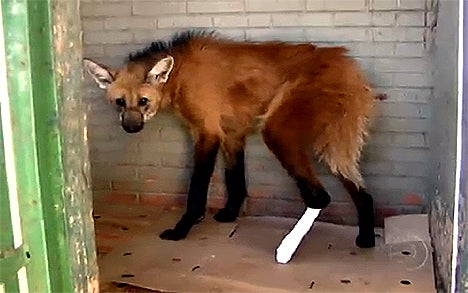
A maned wolf that had been left for dead after being hit by a truck was released back into the Brazilian wild this month, granted a speedy recovery through the use of stem cells. The female wolf is reportedly the first wild animal treated with stem-cell therapy, according to the Brazilian National Journal.
The wolf was in a pre-coma state when a passerby brought her to the Brazilian National Zoo in September, the National Journal said. She had broken bones and various other injuries.
Veterinarian Rafael Bonorino implanted stem cells near the site of the wolf’s broken bones, and the animal was back on its feet within hours, Brazilian media reported. After a few days, she no longer needed pain meds, and just eight days after her surgery, the wolf pried open her enclosure and escaped. Veterinarians found her about two miles away and brought her back for further treatment and monitoring.Her broken leg had completely healed after three weeks, the National Journal said. After four months of rehabilitation, the wolf was released back to the wild. That’s half the time it would normally take to treat a wild animal with her level of injuries, veterinarians said.
“Making use of stem cells, we will have faster healing of the bone,” Bonorino said (translated with Google). “This animal is now less prone to re-fracture and the healing is more complete.”
Plenty of other animals have been treated with stem cells, but normally it’s to test stem cell therapy's efficacy and safety for eventual use in humans. Human stem cell therapy is still brand-new — the first regulated clinical trial using stem cells for stroke treatment started in November, for instance. Experimental treatments have shown stem cells can grow teeth, restore sight to eyes damaged by burns and even cure HIV (by accident).
Now they've been shown to help wild creatures hurt by interactions with humans.
[National Journal via Treehugger]
Five amazing, clean technologies that will set us free, in this month's energy-focused issue. Also: how to build a better bomb detector, the robotic toys that are raising your children, a human catapult, the world's smallest arcade, and much more.


Online Content Director: Suzanne LaBarre | Email
Senior Editor: Paul Adams | Email
Associate Editor: Dan Nosowitz | Email
Assistant Editor: Colin Lecher | Email
Assistant Editor: Rose Pastore | Email
Contributing Writers:
Rebecca Boyle | Email
Kelsey D. Atherton | Email
Francie Diep | Email
Shaunacy Ferro | Email
Wow, that looks like a really bad photoshop job on the leg there.
seriously, i look and look at it and it has to be photoshop. maybe this is some kind of joke... but if this is a joke then that means... time for blue pill
We will have Bonorino to thank when las chupacabras take over the bread-basket of South America.
Better figure out a way to fix habitat loss and reduce mankind's damage. There won't be any wild animals left to test medicine with soon.
Why does the article not state whether the wolf was treated with adult stem cells or embryonic stem cells?
Given that the most promising stem cell scenarios involve adult stem cells, but that the general public probably isn't even aware that adult stem cells exist because embryonic stem cell research has been so propagandized by the left-wing, pro-abortion media, it is very interesting that this article does not tell whether the stem cells in question are adult or embryonic. This is good reason to suspect biased reporting.
dually: well said
Jesus christ guys, its either a cast or a bandage and its white. and that part of the photo is overexposed.
Once stem cell is perfected, we could cure all diseases, we could rebuild our bodies to live almost forever. It will require incineration of the body to stop one from living forever. I for one would love to live forever. Cant wait.
it doesn't even look like a fox, it looks more like a hyena they died red.
*wolf*
I thought hyena as well. Has there been a formal genetic comparison study of the specie that would tell us whether it's closer to the hyena or the wolf? Knowing Latino machismo well; I'm sure they'd rather have us call it a wolf, but I know that a lot of Brazilians have to wonder about this critter too.
I can imagine professional sports wanting to get ahold of the technology to use on their players.
Imagine a player injured in preseason and designated for IR then coming back from a devastating ACL injury in about 3 or 4 weeks! Or from a torn pectoral muscle in 2 weeks!
It's possible with stem cell technology.
We can build him better, stronger, faster.
Sad it won't happen in our lifetimes due to politics/ethics.
@ gizmowiz: Yeah, imagine if pitchers and quarterbacks weren't forced to retire in their prime nearly so often from Tommy Johns surgery. Now let's get really out there and imagine normal humans getting some benefits out of this too. I say this because I remember the speed and forcefulness of the two techs that came running into my wife's delivery room and damm near ripped the umbilical cord loose before I could cut it at my youngest child's birth. They way they ran back out of there without even a single peep of censure or caution from her doctor or any of the nurses once they got their embryonic stem cells that are supposedly illegal to use. I suspect that rare blood type and rarer Rh factor just might have had something to do with it; but do you think I may just be paranoid?
why does its left leg look like it was made with MSPaint?
dually: both adult and embryonic stem cell research are and have been covered in a wide variety of reporting outlets. It is you who are attempting to spread misinformation by claiming otherwise. You imagining biased reporting is just your own bias coming out. Your claim that adult stem cell research is the most promising as a given becomes itself suspect in the process. Just claiming something doesn't make it so. And trying to say that you know so much that the general public doesn't know just makes you sound pompous and presumptuous. By lacking respect, you lose respect.
By following the link to that article, one can see the bandage in a video and how the lighting source sometimes overexposed the bandaged area. That may be why the photo in the popsci article looks bleached out or Photoshopped.
I am wondering whether the stem cells are autologous or exogenous??