
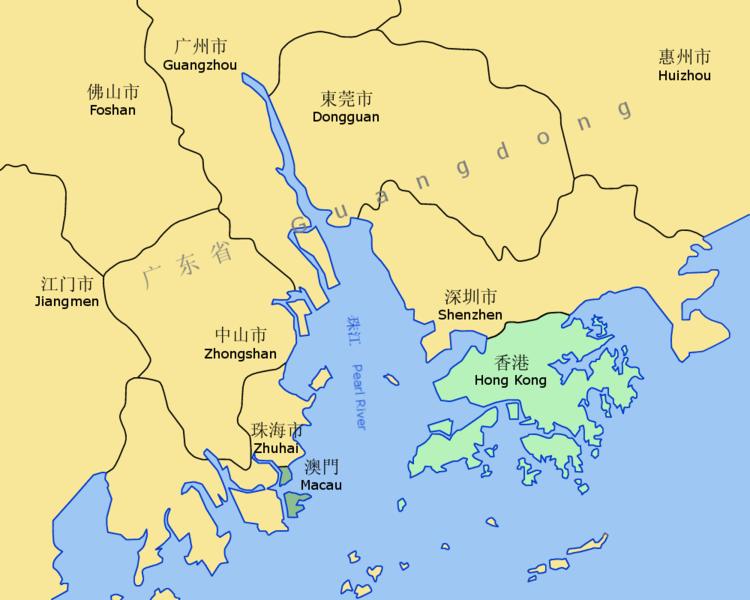
The Pearl River Delta The new super-city will take in all the cities above (excepting Macau and Hong Kong), as well as Zhaoqing (due West of Foshan but out of frame. Croquant via Wikimedia

If you’re going to build the world’s biggest megatropolis in the world’s most populous country, you don’t start from scratch. You take nine existing population centers and merge them. At least, that’s the thinking behind the “Turn the Pearl River Delta Into One” initiative, which aims to do exactly that. Merging nine cities, China plans to create a 16,000-square-mile urban swath populated by 42 million people in the southeast near Hong Kong.

In terms of geography, the new mega-city will be roughly twice as big as New Jersey. More than 150 infrastructure projects costing some $300 billion will link the nine cities together over the next six years, reducing redundancies and bringing nearly ten percent of China’s economy under a single umbrella.

The idea isn’t just to create another superlative for the People’s Republic, but to make things more efficient for people living in China’s manufacturing heartland. Stretching from Guangzhou to Shenzhen, the as-yet unnamed megasprawl will also include Zhongshan, Zhuhai, Huizhou, Jiangmen, Zhaoqing, Dongguan, and Foshan. The cities, all cultural and industrial neighbors, share little common infrastructure or regulation, and merging them will simplify both governing the region and the lives of its inhabitants.

For instance, the project aims to add 29 rail lines (31,000 miles of track) linking the cities on which riders can use a single fare card. Hospitals and schools will be improved and, according to planners, residents will have more choice in where they receive public services like medical care. It will also drive living costs down by merging water, energy, and telecommunications in the region. Moreover, as industry and jobs spread more evenly across the region its leaders can institute more uniform environmental regulations, which are currently piecemeal.

Of course, an ambitious Chinese infrastructure plan would be nothing without staggering high-speed rail investments; the Pearl River Plan will link the region such that each current city center can reach any other in an hour (an express line will also link the mega-city to the nearby financial and commercial hub of Hong Kong).

However, all that rail (and distance) between city centers makes it seem like this is less a single mega-city and more like highly controlled urban sprawl. Then again, perhaps the super-city of the future has no “downtown” as we’ve come to know it, but rather is a more uniform dispersal of people and commerce connected by high-speed transit and higher-speed communications networks.

If that’s the case, China has yet another head start on the U.S., as it is sprawling like crazy; China’s cities are adding people by the tens of millions, swelling into urban zones that could host up to a quarter billion people each in coming decades. You can’t get all those people into one Manhattan, but you can certainly fit them into two New Jerseys.

[Telegraph]

13 Comments

Did they ask the Sierra Club for permission first?

This makes sense from a port authority standpoint. Merging all manufacturing and import of material with the product export is efficiency squared comparatively to here, where each city on a harbor has a different tax and fee structure, different zoning rules, and services that typically overlap to a far greater degree than is cost effective. We have places where invoices, manifests, bills of lading, and end user certifications are carried around to many people who then all look at it, and give the same signoff that 5 or 6 others who do their same job do. No change in scope at all except some demarcation line that was crossed by a truck tire.

While being 3.3 times larger the Northeast megalopolis (Boston to Washington D.C) has about 49.6 million people. Imagine high speed rail in that region. This Chinese mega-city might be like the Russian space program for US city efficiency.

www.wikipedia.org/wiki/Northeast_megalopolis

TOO MANY PEOPLE ON THIS PLANET!

People freaking out about over-population always make me laugh. if it's so terrible, why not alleviate the problem by killing yourself? One less person, right? Look at a map of the U.S, there's MASSIVE amounts of wide open space with very low population density. Plenty of space for all of us. I lived in LA for ten years and heard a whole lot of people griping about how over-crowded the city is. of course, the people doing the complaning aren't about to leave, it's always somebody ELSE that should get out.

As for China, they've already got population controls in place, hence why it's such a sausage-fest over there.

New Chinese Political group established "Train-fare is too dam high"

@jeff17

while i don't dissagree that people sometimes over-state the problem of overpopulation, I do take issue with a couple of your points. namely that all that open space in the USA that isn't urban is mostly being used to feed, cloth, and fuel those urban sectors. the midwest may be a drop in the bucket populationwise, but if you paved over the fields and packed in a billion more people the nation would be hard pressed to feed itself.

over population isn't about space, we have plenty of that. it is about resources, and while we currently have enough resources, they could very easily become a problem in the long term.

time to start looking to the stars! :D

@jeff,

"Look at a map of the U.S, there's MASSIVE amounts of wide open space with very low population density."

Over-population isn't a problem because people on Earth are running out of space to stand--that's stupid.

The problem is that every human being who is alive needs far more space to sustain their life than just the 2'x2'x7' block in which they could stand.

We need shelter--which requires vast uninhabited spaces of forests to cut to produce building materials.

We need food--which requires "wide open spaces" to produce grain, even wider open spaces to produce meats, and not to mention clean water in rivers, lakes, and oceans to produce fish.

We need clean water--which requires "wide open spaces" around water reservoirs and rivers, huge facilities to treat the water, and massive delivery systems.

We need clothing--which requires "wide open spaces" of cotton/hemp/etc.

We need places to make all of that stuff, which requires useless-for-other-things land to build factories.

Then, there's all of the stuff we just "want" like iPhones, and flatscreen TV's, cars, motorcycles, computers, cellphones, etc.

All of these consumer goods require "wide open spaces" for mining raw materials from the earth, and converting them into stuff we (temporarily) use.

Finally, we need plenty of "wide open spaces" for throwing out last year's iPhone, computers, magazines, juice bottles, individual wrappers from our dried plums, etc.

If it weren't for the oil-based products used every day to subsidize our unsustainable population and living standards, we'd already experience a population crash. In fact, go look at the 3rd world for a preview of what's to come when 1st world countries are unable to continue "securing" sources of oil...

The catastrophe of population growth outpacing agricultural output famously predicted by Thomas Malthus a couple of centuries back has not happened in the developed world, and it's argued need not happen in the "undeveloped" world either.

If population levels determine agricultural methods, rather than agricultural methods determining population (via food supply), then whether through GM crops science or other farming technologies, necessity will be the mother of invention.

@Americano

I'm not terribly concerned about food production, as long as there is a a demand (read: profit to be had) for higher yield crops, companies like Monsanto will continue to improve them. I was raised on a corn and soybean farm in Iowa and I can tell you the shift in the work to yield ratio even in the last 15 or so years is staggering. Farmers get more and more efficient every year, they work just as hard as ever, but they continue to produce larger and larger crops with the same space.

I always laugh at the steriotype a lot of "city folk" have of farmers as backward technological ludites who don't know a computer from a gopher hole. The science behind the modern farmer is really interesting stuff.

No, food won't be the thing that limits our population growth. even if we hit the wall on what a field can produce, there are people dreaming up ways to build massive "farmscrapers", multi-level structures with a field on every floor. float a few of those out in the ocean and space is never an issue again.

our population is far more likely to be limited by non-renewable resources like oil or rare earth minerals.

The largest factor in improved crop yealds per acer is the fact that in resent years if land does not produce the ratio needed it is released from farm use. The reported ratios of crop yeald is like the life expec increases that are calculated from birth which is not good math because the largest increases are from zero to 1 year and does not make any difference from 25 years on.

@Abremms, B.V

Abremms, your points are well-taken. My point was not that all human beings require is a place to stand and that's all. Obviously large amounts of land area are required to sustain the population. I'm not saying that over-population couldn't be a problem in the future, only that it doesn't rise to the level of catastrophe at present. Certainly given enough time over-crowding can become an issue if there is a lack of technological development. But that's certainly not the case, as we are developing at a very rapid pace technologically-speaking. Your experiences in Iowa with farmers is an excellent example of this. We have made astonishing progress in just the last 100 years.

BTW, I currently reside in Tennessee and I too have to laugh at the city-folk's view of us.

@jeff17,

Most of the agricultural efficiencies we enjoy now are unsustainable.

The genetic engineering of crops places the US food production at high risk for susceptibility to disease and pests.

Remember the Irish Potato Famine? Remember why it happened?

(Hint hint: they only planted one kind of potato)

If we only plant "Monsanto super soybeans" and depend on the yields they produce we are putting ourselves at GREAT risk for another disease/pest wiping out that particular strain of soybean and plunging us into famine.

For this reason bio-diversity is incredibly important--it's an insurance policy against famine caused by disease/pests.

Additionally, non-GMO agricultural "advancements" largely depend on the availability of CHEAP oil to produce the fertilizers and pesticides.

In case you haven't noticed, we're kinda running out of cheap oil... and quickly.


June 2013: American Energy Independence

Five amazing, clean technologies that will set us free, in this month's energy-focused issue. Also: how to build a better bomb detector, the robotic toys that are raising your children, a human catapult, the world's smallest arcade, and much more.


Online Content Director: Suzanne LaBarre | Email
Senior Editor: Paul Adams | Email
Associate Editor: Dan Nosowitz | Email
Assistant Editor: Colin Lecher | Email
Assistant Editor: Rose Pastore | Email

Contributing Writers:
Rebecca Boyle | Email
Kelsey D. Atherton | Email
Francie Diep | Email
Shaunacy Ferro | Email

circ-top-header.gif
circ-cover.gif
bmxmag-ps