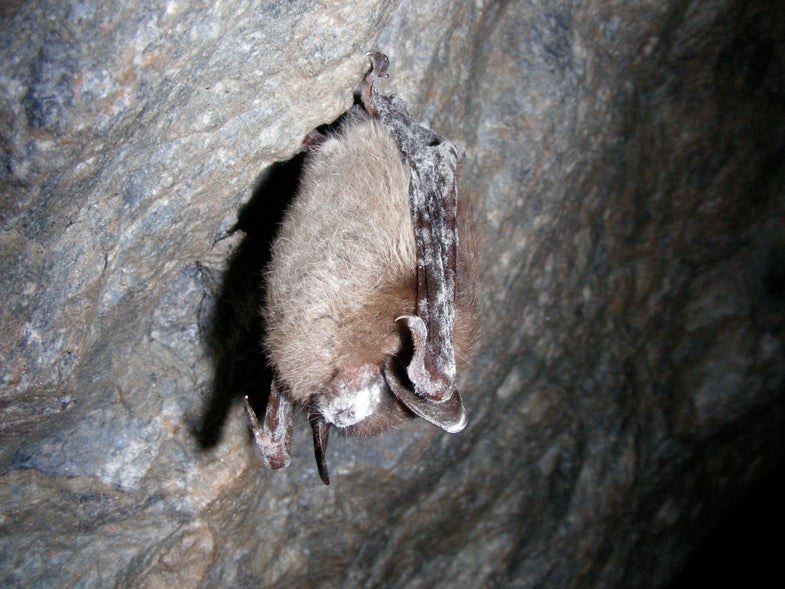
Little Brown Bat This little brown bat was photographed in Vermont's Greeley Mine March 26, 2009. White-nose fungus is evident on its face and wings. Marvin Moriarty/USFWS

Biologists are asking the U.S. Fish and Wildlife Service to determine whether the little brown bat — formerly one of the most common mammals in North America — should be added to the endangered species list, bat conservationists said Thursday.

“The little brown bat is in imminent danger of extinction in its northeastern core range due to white-nose syndrome, and the species is likely in danger of extinction throughout North America,” said Tom Kunz, a leading authority on bats at Boston University. Kunz and collaborators wrote a status review for the FWS that outlines the troubles presented by WNS.
 
Since 2007, more than 1 million bats have died from white-nose syndrome, caused by a fungus called Geomyces destructans that biologists believe arrived from Europe. The bats awaken every few days, burning their precious fat reserves; ultimately, they freeze, starve to death or are picked off by opportunistic predators.

In a study published this week, Carol Meteyer, a pathologist with the U.S. Geological Survey’s National Wildlife Health Center, and colleagues say the fungus represents a brand-new disease paradigm for mammals. Other skin infections don’t invade living tissue, but G. destructans does what its name suggests, destroying the skin of hibernating bats. Although the fungus appears as a powdery white substance on bats' noses — hence the name — it does the most damage to bats' wings, researchers say.

Healthy bat wings are critical not only for flight, but for maintaining basic bodily functions — they contain blood and lymphatic vessels, nerves and connective tissue, Meteyer said. Many biologists hypothesize the bats awake from hunger or itchy skin, but a new study published this week suggests thirst may also cause their arousal — Paul Cryan, a bat ecologist at the USGS Fort Collins Science Center, said unusual thirst may result from water leaking out of bat wings damaged by the fungus. The study is published in the journal BMC Biology.

Meanwhile, biologists have asked the FWS to place the little brown bat — the most-affected species — on the endangered species list on an emergency basis, until the agency can complete a formal review. The FWS is accepting public comments through Dec. 26 on its draft WNS plan.

8 Comments

Remember that there is the "god squad" that can override any Endangered Species ruling- it is the Secretaries of the Interior, the Army, Agriculture, the Chairman of the Council of Economic Advisors, and the heads of USEPA and NOAA, and people from every state involved. (I just had a course about environmental policy, so I can reference the laws; you can find this information online, or call the Environmental Science department at Southern Oregon University.) If the "god squad" decides not to protect a species it is left off the list, not endangered even if it is clearly endangered. And they can do it for any reason, but especially economic reasons.

And?

Well, good info in any case, although I can´t really imagine the economic potential here. I guess if the bacterium came from Europe, probably due to human travel, it's not exactly what we would consider natural causes; else, it would seem rather strange to intervene. (Maybe /Star Trek/'s Prime Directive isn't really a part of conservation thinking?)

actually humans are a natural part of the planet, so anything spread by humans is naturally occurring

drchuck, that's an extremely shortsighted comment. I guess smallpox is all natural and we shouldn't try to stop that either.

Actually yes. Smallpox is indeed natural and necessary. Population control isn't just needed for deer. Humanity as well.

Then since we've all but eliminated it from nature, that is also a natural event, and so anything humans do is acceptable as well, correct? Environmental degradation due to human activities is okay everyone!!! Get bigger cars! Turn your thermostats up! Start testing nukes again! Destroy more oceanic oil wells!

Yeah, it doesn't matter how it spread, the little brown bat and nearly all native american ash species need to be added to the endangered list. The little brown bat has a huge benefit to everyone because they are probably the #1 insect controlling species in North America.

Ash... well just go to Michigan where 50 million (that is right, 50 MILLION) ash trees have been eradicated by the emerald ash bore and counting (once that ash tree in your yard gets them, you may as well cut it down because they ALWAYS die). Nearly every species of North American Ash is vulnerable, when the ashes go several species of moth and butterflies are also likely to go extinct with them. This means that in 50 or so years 30-40 species could go extinct due to one introduced species if we don't get serious about doing something NOW. So I don't want to be hearing anyone say, oh, one introduced species is no big deal... that is just unfathomably stupid.


June 2013: American Energy Independence

Five amazing, clean technologies that will set us free, in this month's energy-focused issue. Also: how to build a better bomb detector, the robotic toys that are raising your children, a human catapult, the world's smallest arcade, and much more.


Online Content Director: Suzanne LaBarre | Email
Senior Editor: Paul Adams | Email
Associate Editor: Dan Nosowitz | Email
Assistant Editor: Colin Lecher | Email
Assistant Editor: Rose Pastore | Email

Contributing Writers:
Rebecca Boyle | Email
Kelsey D. Atherton | Email
Francie Diep | Email
Shaunacy Ferro | Email

circ-top-header.gif
circ-cover.gif