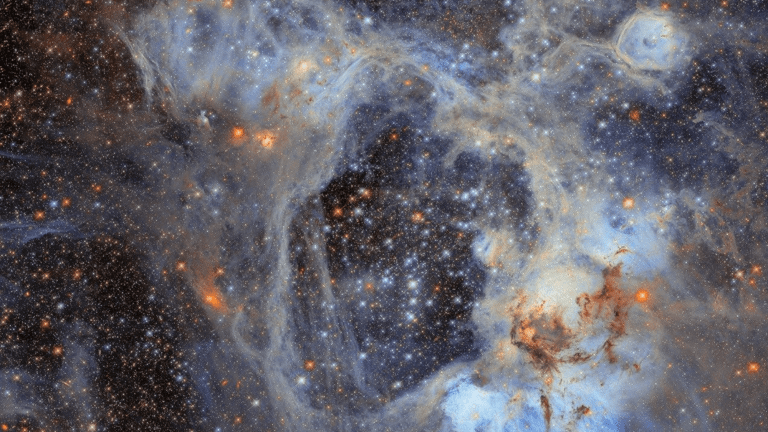
Dark Matter Map This is one of the most detailed maps of dark matter ever made. The location of the dark matter (tinted blue) was inferred through observations of magnified and distorted distant galaxies seen in this picture. NASA

Astronomers using the Hubble Space Telescope have made one of the most detailed dark matter maps ever, taking advantage of the dark matter’s own gravitational effects to bring it into the light.

The map suggests massive galaxy clusters may have formed earlier than expected, before dark energy stunted their growth, according to the Space Telescope Science Institute.

To measure the dark matter, astronomers used Hubble’s Advanced Camera for Surveys to snap pictures of the galaxy cluster Abell 1689, located about 2.2 billion light-years away. The cluster is so massive that its gravity warps the light from galaxies behind it, an effect called gravitational lensing. Faraway galaxies appear as warped smears or distorted blobs, like you would see in a funhouse mirror. By studying the warped smears, astronomers determined how much mass is in the Abell cluster. (More mass leads to more distortion.) Then they could subtract that from the mass they could see — stars and the like — to figure out the amount of dark matter, and its distribution throughout the cluster.

Dark matter makes up most of the universe, and through gravity, it acts to pull things together. Dark energy, on the other hand, pushes things apart. Astronomers can study this tug-of-war by mapping the distribution of dark matter in galaxy clusters, which formed early in the universe’s history.

The new map says Abell has a lot more dark matter than expected for a cluster of its size, which leads to some interesting questions about the genesis of galaxy clusters. In order to get so big, Abell and similar clusters must have started clumping together much earlier than previously thought, when the universe was still pretty dense.

An upcoming experiment will shed some more light on this problem. The Cluster Lensing and Supernova survey with Hubble (CLASH) survey will study 25 clusters over the next three years for a total of one month of observing time, so astronomers can map their dark matter distributions. The studies could provide more evidence of early cluster formation, and maybe even evidence of primordial dark energy.

[Hubblesite]

4 Comments

Why can't we get rid of these stupid ad spammers?!?!? it's the garbage all the time!

Rant aside...

this very interesting, using the lensed galaxies to map the dark matter. Good work.

It looks like a dna strain haha
Pretty amazing.. Astronomy.. Always moving forward

yeah i know what u mean logical_atheist (about the spam)

..their business must be pretty shoddy, to use stoopid@ss techniques like that as their front, pfft
>comments prob shouldnt allow links in the first place tbh

Buht yeah, another 25 surveyed is definitely the next logical ;) step in this type of research imo... Who knows, it could have been skewed by something, or they could be right on the money and we could perhaps start using in-be-tween galaxies as binoculars to see farther into the cosmos one day in the near future ;D

you know, I still wonder if an idea I had has any merit. I don't know the precise math and tests that would need to be done to tell the difference, but what if the case wasn't dark matter inside the galaxies pulling them together (an attractive force), but an exotic matter form pushing against normal matter (a repulsive force), which would be in essence negative-matter (ie, has negative mass, *NOT* an opposite charge like anti-matter, which still has positive mass)

Conceptually at least, it seems that you could create a near-identical result, so how do you tell the difference between being pushed together (A 'valley' of space-time created by 'hills' of negative matter) and being pulled together (A 'valley' of space-time created by a 'depression' of positive matter)?

Of course, this idea is built on a simple reversal of the simplified 2-D model of space-time & matter/gravity, but from what I can figure out, works for a more complicated 3D model too. Visually at least. Mathematically, I have to leave it to the professionals.


July 2013: The Future Of Flight

The incredible innovations, like drone swarms and perpetual flight, bringing aviation into the world of tomorrow. Plus: today's greatest sci-fi writers predict the future, the science behind the summer's biggest blockbusters, a Doctor Who-themed DIY 'bot, the organs you can do without, and much more.


Online Content Director: Suzanne LaBarre | Email
Senior Editor: Paul Adams | Email
Associate Editor: Dan Nosowitz | Email
Assistant Editor: Colin Lecher | Email
Assistant Editor: Rose Pastore | Email

Contributing Writers:

Kelsey D. Atherton | Email
Francie Diep | Email
Shaunacy Ferro | Email

circ-top-header.gif
circ-cover.gif