At the North American bat convention, biologists seek ways to reduce bat deaths at wind farms
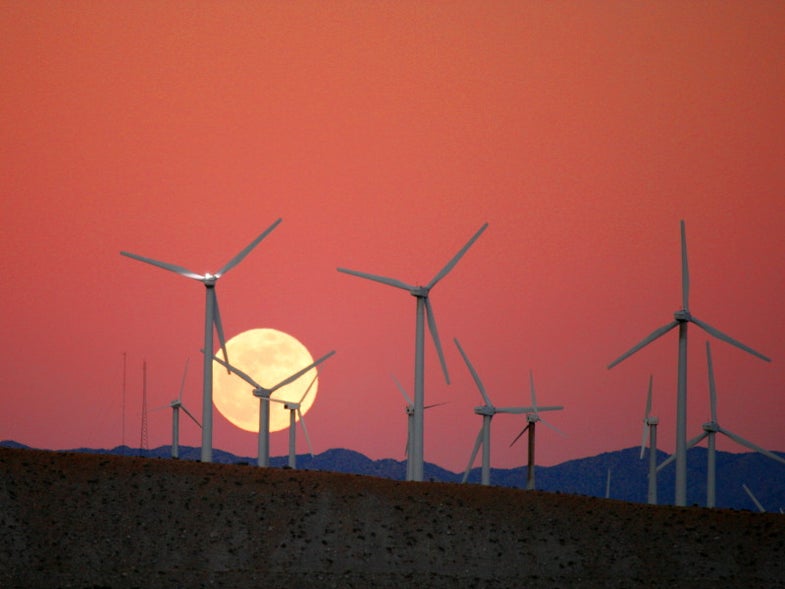
Turbines at Dusk Tree-roosting bats emerge at dusk to forage for insects, and when they fly near wind turbines, they enter negative air pressure pockets, causing their lungs to explode. Biologists are trying to figure out how to prevent migratory bat species from perishing at wind farms. via Flickr/ Chuck Coker

DENVER — Bad news for bats: Mother Nature is not the only thing wiping them out. Anthropogenic climate change and renewable energy technology are also wreaking havoc on bat populations throughout North America. Biologists are looking for ways to protect bats not only from a devastating fungus, but from wind turbines and global warming.

Warmer temperatures and drought brought on by climate change could disrupt migration and mating patterns, researchers said this week at the North American Society for Bat Research annual conference. Rick Adams, a biology professor from the University of Northern Colorado, published a paper in August that showed bat reproduction declines when conditions mimic climate change. Examining 15 years of data from bats along Colorado’s Front Range, he found as temperatures rise, the proportion of reproductive female bats goes down. A colleague at UNC, Mark Hayes, hypothesized that the same will hold for drier conditions.

A warmer climate could hold some unexpected benefits for white-nose syndrome — researchers think bats that are commonly found in the southeastern United States, like the tricolor bat, could move farther north and replace the little brown bat, which is being decimated by white-nose. What’s more, the fungus grows best in cold conditions, so if mid-Atlantic and northern caves get warmer because of climate change, it could spread more slowly or even die out. But Hayes’ study found warming climates will ultimately kill off bats, too.

Ironically, one method to ameliorate climate change could make matters even worse for bats. Wind turbines, favored for their carbon dioxide-free power generation, are deadly for bats, especially tree-roosting species that migrate over long distances. One study from the Blue Sky Green Field Energy Center in Wisconsin found for every megawatt of wind energy generated, 22 bats die every year.

Unlike birds, which often perish at wind farms when they collide with the turbines, bats die in blade vortices. Rotating turbine blades create negative pressure pockets, and when the bats fly through them, their lungs explode.

“Some wind sites are killing hundreds to thousands of bats in a single fall migration season,” said Paul Cryan, a research biologist with the US Geological Survey. One wind farm in New York is estimated to kill more hoary bats every year than have ever been collected for scientific studies, he said.

Some scientists have proposed turning off wind turbines during peak migration periods, and others have proposed unconventional solutions like painting turbines darker colors to baffle the bats. But a new study to be published Monday in the journal Frontiers in Ecology and the Environment says there could be a simple fix: Reducing the cut-in speed, or the wind speed at which wind turbines switch on.

Most wind turbines in the US are programmed to begin rotating and producing power once wind speed has reached about 8 to 9 mph, according to the Ecological Society of America. Ed Arnett, a biologist with Bat Conservation International, says raising that speed to 11 mph can reduce bat fatalities from 43 to percent up to 93 percent. Even better, the annual energy loss was less than 1 percent.

Wind turbines will still kill bats — during two summers of study at a Pennsylvania wind farm, Arnett sometimes found fresh carcasses even when turbines turned on less frequently. But when they turn on at higher wind speeds, they will not kill as many. For the most part, bats don’t fly when it’s too windy.

“Rarely do you see such a win-win result in a study,” Arnett said. “There is a simple, relatively cost-effective solution here that could save thousands of bats. This is good news for conservation and for wind energy development.”

Researchers still don’t know why bats are attracted to wind turbines, however. Some hypothesize that they mistake them for trees, which explains why 75 percent of bat deaths are among tree-roosting species. Most bat deaths at wind turbines happen in early fall, which is mating season; the “tall tree hypothesis” suggests that bats think wind turbine towers are attractive mating sites. “Tall things are mistaken for singles bars,” said Craig Willis, a biologist at the University of Manitoba.

To study this, Willis and Cryan examined the mating readiness of bats killed by wind turbines in New York, Manitoba and Alberta, and found most male bats were ready to reproduce. The researchers couldn’t find evidence that the bats were copulating at the wind farm, but their genitalia indicated it was the right time of year, Cryan said.

“It’s easy to come up with these hypotheses, but this is one I hope we can disprove,” he said. “If you are selectively causing the death of the reproductive class, you are in trouble from a conservation standpoint.”

Bats are a keystone species — disruptions to their reproductive patterns and populations will have cascading effects throughout entire ecosystems. Protecting them from wind turbines is just one more thing for conservationists to worry about.

23 Comments

I hate wind turbines, if you've ever driven past a wind farm they are unbelievably massive and stretch for miles and miles. Lets work on nuclear and forget about renewable until it doesn't need to use thousands of acres to power hundreds of homes.

More like hundreds of acres for thousands of homes, but still kind of a bad deal.

I wish the article had indicated what percentage of bats flying through *were* roosting species. Knowing what percentage *killed* were roosting species doesn't really tell you anything without knowing the percentages going in.

omg who really gives a toss about bats? seriously, most people are creeped out by them & would run at the sight of them, our world is that perfect we have people working to protect BATS....ffs.

People care about bats because they keep the insect population under control. If bats go extinct, you'll soon miss them, trust me. They may not be seen, but they do their part.

@swiper-like dude!-OMG-like...we don't need anything but people...yo, this planet is like...ours, to do, whatever...how do you find the bathroom in the morning?

Wind farms are a bad idea. For the area they take up, I'm pretty sure Solar panels that capture both Sunlight and Heat would provide more energy, and they don't kill anyone or anything or cause noise pollution. Nuclear energy is awesome but people still see them as "too dangerous" or expensive.

@Cookiees453 - natural selection has taught us something will replace them, don't panic like a lil girl, let them die gracefully.

@drchuck1 - very constructive waste of 30 seconds.

"omaracoustic" has the best idea. With the advancement in Solar Panels, they can produce 25% more energy and can be placed on every building or on poles like street lights. Geothermal can produce 2,000 times the energy America uses in a year and the new ones can even be build in the cities and the people might not even know they are there. It takes about 5 million to build one advanced Geothermal and from 10 to 50 billion to build a nuclear power plant - depending on the class of nuclear - class 4 at 50 billion dollars. The Geothermal power plant there in California, that has been pumping out free power for nearly 50 years, is leaving zero foot print and solar and geothermal has killed zero bats or birds. With the cost of one class 4 nuclear power plant, you can build enough Geothermal power plants to power all of America for thousands of years.

@swiper-this planet is not here just for us-we should not be doing the selecting-everything is connected-the diversity that is being lost is vital to the health of the only planet we have-we should act to protect wildlife affected by our activity-nuclear power should be a priority-it is the only power source capable of replacing fossil fuels for at least a few decades-howerver, considering the future projected world energy consumption, we will need all alternatives in order to faze out fossil fuels-your ignorant earlier comment shows how little compassion you have or your just trolling, so get bent

@ james davis-very few areas have geothermal potential-solar is decades away from providing sufficient power to make a dent in the world's energy consumption

I know bats are important and all by why does it have to take up half the popsci page up with stuff about bats. i care but not that much. besides with out efficient renewable energy like wind turbines there would be other side effects for not only bats but many other creatures.

I wonder if playing recordings of predictors like hawks or owls would keep the bats away? Perhaps just an ultrasonic siren would work, if it hurts the bats ears they wont fly near it.

I would think that an airflow powered ultrasonic whistle - along the idea of those deer whistles some people mount on their car bumpers - could be designed that would in some way warn off or scare bats. Perhaps there is an ultrasonic component in some sort of bat call indicating danger that could be simulated? Definitely worth study. Trust me, living in an area that had significant mosquito populations this last year, declining bat populations are important to humans. Ever hear of Malaria or West Nile disease?

One big advantage of wind farms is that there is minimal disruption of the land they are placed on. The fastest growing wind farms are being put on farm and ranch lands with almost no loss of productivity on those lands. Although urban solar would also have minimal land use disruption, solar farms do render that land unusable for other purposes. Wind is also capable of producing energy during the night. I hate to break it to the naysayers but wind power is an established technology (and has been in some form for thousands of years) and is not just going to go away.

Not to mention nuclear energy has been proven to be far more dangerous - remember a place called Chernobyl? That accident had measurable worldwide and long term consequences. A mechanical failure or sabotage at a wind farm simply cannot have any consequences beyond the farm except for the loss of power production. And don't give me a line about proper safeguards or regulations - the Deepwater Horizon drilling rig was required to have safeguards that would have prevented the Gulf spill, and corporate greed and shortsightedness made those policies irrelevant. It is naive to think nuclear would be any different. And until we find a permanent solution for waste disposal all the "temporary" storage solutions put us at way too much risk from accidents or sabotage.

I am not saying we should abandon any of these energy sources. All sources have risks and disadvantages. I am just pointing out that knee-jerk decisions on these issues are short-sighted and moronic. And that bats are very important to humans.

@drchuck1 - "swiper-this planet is not here just for us" - uhhh yes it is, we have evolved to be the rulers of it

global warming by human activity is an unproven myth, heard of temperatures rising and falling naturally? if bats can't keep up with the environmental changes why are we obliged to save them when we can't even save ourselves from social & economic issues that kill thousands of humans each day.
But hay, ignorant & no compassion me for not being able to give a toss about bats.

I dont mind wind farms really. I think they look pretty amazing. as long as they are not in my back yard, but isnt that always the case. besides. Do you really think they will be around that long? 50 years. 100 years tops. By then we will have figured this energy thing and rendered them useless. Enjoy them while you can. because they will be replaced by GIANT receiving dishing to get power beamed from satellites in orbit.

One percent? Hail no!

... Bats fear snakes and are very sensitive to high frequencies ...

Are you telling us that rubber snakes an/or ultra-sonics won't warn the bats away from those farms?

I am musing that some sort of "disharmoniuos" and/or intermittent, ultrasonic "blasts" would VERY likely be totally effective and would consume almost NO energy!

It is a well known fact that various predator recordings and ultrasonic aversion technologies are already being used, against several "pest" species, to great effect.

Let's think this one out ... Bats are VERY picky (wary) about where they roost ... maybe we can use those fears and dislikes to their benefit.

There must be some simple "turn-off" or "fear factor" or natural "danger warning" which can be exploited, at negligible cost.

I think "psycho-acoustics" is the most viable avenue of research and will, with minimal initial outlay, provide a VERY efficient solution to this problem.

I also think the ONR might explore the use of whale and dolphin "danger calls" to clear training and test areas (of sea mamals), prior to sonar exercises and underwater weapons tests. ... Either by simulating danger calls or through acoustic aversion. Start off at a low volume (SPL) and increase it to max over 24 hours, prior to such operations.

Is this any more than a 3 day exercise for any team of bat scholars and aeronautical engineers to solve? Wingtip vortex generators, like jets have, could minimize the low pressure zone. And, how about old Portuguese windmills with the varying size jugs on them to whistle at different pitches according to wind speed? What if they strung just one strand of fine wire from the three tips of the turbines to create a large, circular radar image to warn the bats off? PopSci should sponsor a "Save The Bats AND Turbines" contest. Bats would benefit, birds too.

Bet something as simple as UV/IR leds in the tips would save the birds and bats.

@swiper-your ignorance shines-congrats

@drchuck1 your just a troll

@swiper-good one-i call you what you are and you respond like a child-your true colors are showing-go away and grow up

This #wind article is informative. I learned that #bats don't usually fly in windy conditions. I learned how they know that they were there for mating. And I was reminded that color makes a difference. I read the article where they suggest the color purple can repel (or not attract) insects--their diet. I look forward to further research on EMF, color, echolocation to repel bats, rotor shutdown, and even odors or perhaps a stuffed predator atop. Anything to remove the negative stigma placed on wind turbines. Thanks #RebeccaBoyle. I love your work.

swiper - People who are concerned about the world's environment realize that every animal serves a purpose in keeping our planet healthy. Bats are the 2nd largest order of mammals with over 1,000 different species. North America has only 45 species of bats. Our bats are voracious bug eaters. One cave in Texas, Bracken Cave, hosts 40 million bats each summer and they eat the equivalent weight of 22 Asian Elephants in bugs NIGHTLY! Unless you want your food sources heavily dosed with pesticides or infested by bugs, you should be concerned about the extinction of bats due to wind turbines, white-nosed syndrome, and ignorant humans!
Visit my website at www.incrediblebats.com


July 2013: The Future Of Flight

The incredible innovations, like drone swarms and perpetual flight, bringing aviation into the world of tomorrow. Plus: today's greatest sci-fi writers predict the future, the science behind the summer's biggest blockbusters, a Doctor Who-themed DIY 'bot, the organs you can do without, and much more.


Online Content Director: Suzanne LaBarre | Email
Senior Editor: Paul Adams | Email
Associate Editor: Dan Nosowitz | Email
Assistant Editor: Colin Lecher | Email
Assistant Editor: Rose Pastore | Email

Contributing Writers:

Kelsey D. Atherton | Email
Francie Diep | Email
Shaunacy Ferro | Email

circ-top-header.gif
circ-cover.gif
bmxmag-ps