Gray Matter: In Which I Set Myself On Fire
Any scientist can tell you how people catch fire in the movies. Only our columnist sets himself ablaze
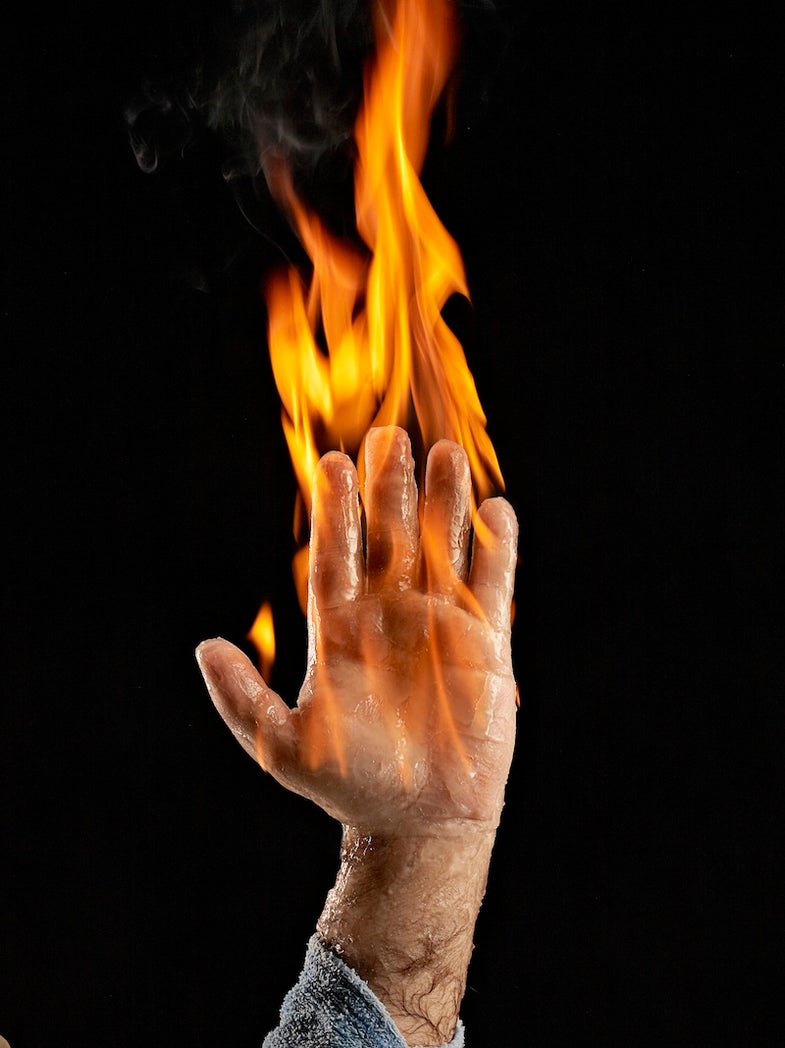
There are a few perks to my job as a mad scientist, and one of them, as I recently learned, is being able to tell my colleagues that I can’t attend their terribly important meeting because I’m going to set my hand on fire.
In the movies, people on fire stumble out of burning buildings all the time. If you look closely, however, you’ll notice that they are almost always fully dressed, and that they tend to keep moving. These are two important factors that make the stunt much easier.
To function and avoid injury while on fire, you need to put something between yourself and the flames. But you can’t coat yourself with plain water because it just runs off. So stuntpeople use clothes containing super-absorbent polymer fibers, which keeps the water in place (it’s pretty much the same material used in diapers). A layer of clothes treated this way will keep them cool for quite a while, but they have to continue to move forward so the breeze keeps the flames out of their uncovered face.
If a scene requires showing bare skin on fire, stuntpeople use a special fire-protective gel containing water, which can be applied in a smooth, clear layer that is nearly invisible, especially when the action is moving fast and there’s a lot of fire to distract the viewer. To show you what it looks like up close, I covered my hand in the gel and then painted on some thinned-down contact cement, which produces a very nice opaque yellow flame when lit.
Because we needed my hand to be perfectly still for the camera, I couldn’t use any movement to help stay cool, and my hand started to feel pretty warm after just a few seconds—but not before we got photographic proof that my meeting excuse was for real!

Hot Head
I extend thanks to Dr. Thomas Kuntzleman of Spring Arbor University for
suggesting this topic and providing assistance.
Serving as an excellent companion piece to this is last month’s column, wherein our Mr. Gray plunged his hand into liquid nitrogen. Fire and ice, as they say. Check that video out here.
ACHTUNG! Do not try this—people who play with fire get burned. This stunt requires professional training and preparation, and still there are plenty of things that can go wrong.