Feature
She manipulates simple laws of physics to create “bullets” made of sound waves
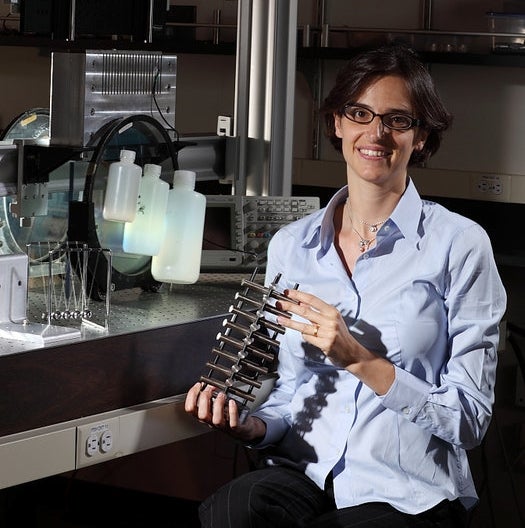
Chiara Daraio John B. Carnett

Chiara Daraio loves the pick and roll. As a former member of Italy's junior national basketball team, she knows that although the effect of the play is complex and devastating, its parts are simple. It goes like this: Daraio blocks a defender’s path, her teammate darts past, Daraio rotates away from the pursuing defender and waits, unguarded, for her teammate's quick pass and an open shot. Pick. Roll. Pass. Shoot. It's a straightforward process with a sophisticated result.

Daraio, an applied physicist, still prefers the basics. She studies the elastic properties of nanofibers to develop impact-absorbing foams. She identifies ancient rocks by analyzing their carbon deposits. And she based her nonlinear acoustic lens, a device that fires "sound bullets," on the principles of a simple toy.

The lens works like Newton’s cradle, the click-clack desktop toy that demonstrates the law of conservation of momentum. Swing one ball into the others, and energy transfers neatly from one ball to the next, until the last ball swings away. Daraio’s lens consists of 21 parallel rows of 21 solid-steel pinball-size balls. A hammer strikes the rows at one end of the array. That impact generates impulses that travel through each row in a wave. When the wave emerges from the last row, it spreads through the air like a ripple through a pond.

Daraio builds her sound bullets by focusing these waves into a defined point in space by squeezing the balls in the outer rows together more tightly. Each wave’s energy is relatively low, but when they combine, the total energy is amplified many times over. “If we could train that point on, say, a tumor, we might be able to break it up while sparing more of the tissue around it than with today’s techniques,” she explains. She says bouncing the waves off organs--or airplane fuselages--could also create high-resolution images of structural imperfections. The jump from current ultrasound imaging to what the lens could provide would be like going from black-and-white to high-definition television.

Daraio has fired the bullets into a hard polymer to map where in space their force converges. Next she’ll test her nonlinear acoustic lens in water and, perhaps someday, on human tissue. But first the lens needs upgrades. She would like to replace the balls with other mediums whose focus point is easier to calibrate. Calibrate. Strike. Focus. “If you try to think simply,” she says, “it’s generally going to work.”

See the rest of PopSci's Brilliant 10 for 2010.

4 Comments

She knows the Wierding Way! The Quizat Haderach will clean the planet Dune for the righteous.

@ lunatik96: Kanly!! You will be destroyed for being the ghola Mentat assassin you are!

Hey, Babe ...

I would recommend she attempt to create standing acoustic waves by using a focused array of "columnated" piezo-acoustic "cannons".

So ... a crude prototype would be to try to mount piezo-actuated buzzers (diaphram = thin metal plate). of different diameters, inside some acoustically "dead" pipe (tubes).

The piezo-diaphram could be a disk, but could also be any shape ... conic ... parabolic ... hemispherical (convex or concave), etc.

Depending on the density and viscosity of the xmission medium, and the goal (additive focus upon a point in space-time).

I would try pulses ... as she HAS been ... but standing waves might be more "tunable" and "observable", depending on the xmission medium.

I would also brush up on interferometry and acoustic re-enforcement, vs. cancellation, both in atmospheric and hydro-dynamic conditions.

DARPA or US-ONR might be able to provide some guidance or help to source the proper software tools and instrumentation ... It never hurts to just shoot ONR and DARPA an eMail, and ask.

... An experiment which might provide *some* insight ...

Try an array of magnets, suspended in a container of ferro-fluid. (or arranged, outside the container of ferric micro-particulate, suspended in fluids of various viscosities.

G'Luck!

Also ... There are now many inexpensive, off-the-shelf toys that might be reverse-engineered, hacked, bent (bended) or otherwise modified, to expand your insight, your toolset, and to meet your goals.

I am thinking of the surround-sound on-camera microphones, now avalable, for Panasonic and Canon pro-sumer camcorders ...

I am thinking about how home theaters will "automagically" calibrate the phase and volume of the surround speakers, no matter where you place them, and some systems even will calibrate the EQ, depending on how "live or dead" the acoustic space appears, to various frequencies ... You may (at least) be able to use some of those techniques and algorythms, even if not the actual hardware or logic chips.

I am thinking about how many DAW's (Audio Production Software Suites) offer phase inversion (for M-S Middle-Side recording (look that up on Wiki-P) and how these DAWs come with (often) hundreds of filters and hundreds more after-market plug-in filters and "chains" of filters ... how they provide visual wave-forms on a scalable time-line, with an unlimited number of audio tracks, that can be enabled, or muted.

While these tools may not provide the necessary performance envelope (parameter ranges) required for Chia's research, those tools and algorythms may, at least, provide a basis for further progress.

Sounds like fun! And, you can watch Avitar, in surround-THX, right in the LAB ... And mix your own Ibiza Trance tracks ! ... What's not to like ?


June 2013: American Energy Independence

Five amazing, clean technologies that will set us free, in this month's energy-focused issue. Also: how to build a better bomb detector, the robotic toys that are raising your children, a human catapult, the world's smallest arcade, and much more.


Online Content Director: Suzanne LaBarre | Email
Senior Editor: Paul Adams | Email
Associate Editor: Dan Nosowitz | Email
Assistant Editor: Colin Lecher | Email
Assistant Editor: Rose Pastore | Email

Contributing Writers:

Kelsey D. Atherton | Email
Francie Diep | Email
Shaunacy Ferro | Email

circ-top-header.gif
circ-cover.gif
bmxmag-ps