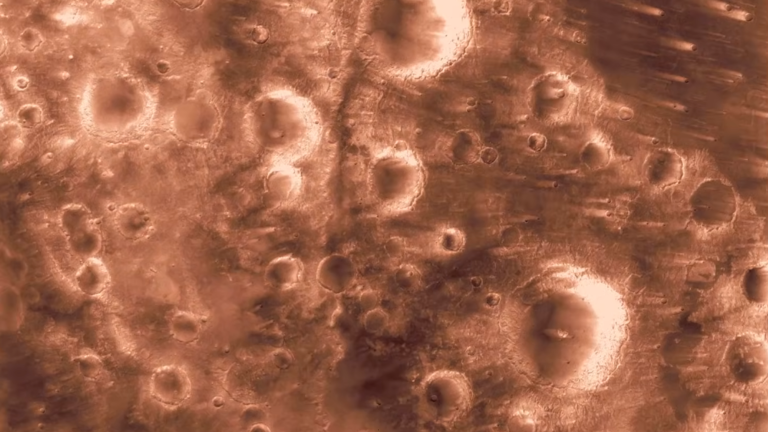
Ascension Island Charles Darwin's artificial forest captures moisture from clouds that drift over the volcanic peaks on Ascension Island. Google Earth

The father of evolution apparently played God with a tropical ecosystem 160 years ago, and the results could inform future experiments to terraform Mars, botanists say.

The BBC recounts how Charles Darwin helped build an artificial forest on Ascension Island, one of his subjects of study from his trips on the HMS Beagle. Today, the island is home to species of plants that would not naturally co-exist. Darwin and his friends put them there, and nearly two centuries later, their grand experiment is living proof that we can transform natural environments.

Originally used as an outpost to keep an eye on Napoleon in exile, Ascension Island, between South America and Africa, was a busy Atlantic waystation in Darwin’s day. It had meager fresh water supplies, however, so Darwin and his botanist friend, Joseph Hooker, set out to change things.

The BBC interviews Darwin biographer David Catling, a professor at the University of Washington-Seattle, who says he believes Darwin decided to build a lush “Little England” on the volcanic island after visiting it in 1836.

Darwin’s friend Hooker explored Ascension a few years later, and in 1847, Darwin convinced Hooker to get his father -- director of the Kew Gardens -- to send trees, hoping they would capture rain, prevent erosion and reduce evaporation.

Beginning in 1850 and continuing each year, ships brought an assortment of plants from botanical gardens in Europe, South Africa and Argentina, the BBC says. By the late 1870s, eucalyptus, Norfolk Island pine, bamboo, and banana had taken hold.

Today, Ascension is home to a cloud forest that would have taken millions of years to evolve naturally, according to Dave Wilkinson, an ecologist at Liverpool John Moores University in the UK.

It’s proof that humans can build a fully functioning ecosystem simply through trial and error, he said. As the BBC reports, the same principle could be used in future Mars colonies: “Rather than trying to improve an environment by force, the best approach might be to work with life to help it find its own way.”

Intelligent design, indeed.

18 Comments

Nice!!! great job for Darwin and his Hooker friend :P

Your not going to terraform Mars ever. It can't hold an atmosphere so any attempt at introducing life will fail. Stop wasting time on Mars. Instead, look to the future where mankind can block the sun enough to cool Venus down and begin to seriously terraform a sister planet with .91 the gravity of earth. That would be a nice planet to retire to if it was terraformed because the lower gravity would add youth to tired old bones.

Mars cannot be terraformed. Reason: No magnetosphere.

gizmowiz
Venus has the opposite probem mars has, one has no atmosphere to use the other has so thick an atmosphere that it's like being at the bottom of the sea.
the pressure alone can kill you.
not to mention hydrocloric acid rain and high levels of vocanism.
you could block the sun from getting to venis but the planets inner heat would keep things boiling for thousands of years, possably millions

right now they find Mars interesting becouse there are simple earth life forms that can live there now even with it's thin cold climate and get enough microbes working together to liberate oxygen from the soil and you may just find the air getting a bit thicker without a massive project

No planet or Moon in our solar system has true potential for being terraformed, for space habitats we should focus on things more like O'Neil cylinders.

I can completely understand popular science's (the field of interest, not the magazine) interest with terraforming Mars, it seems like such a grand way to expand and preserve the human race, basically allowing our species to exist eternally so long as we keep moving away from the sun. With that being said, though, it always disappoints me that the focus is apparently on "hey if you stick enough plants on Mars and pump CO2 into the atmosphere it'll turn green". It's not intellectually dishonest, it's just dumb and more than a little trite.

The issues of being geologically dead and the resultant issues of lacking a magnetosphere and experiencing radiation storms are arguably far more important than being able to breath the wispy Martian air.

Still, this is actually a really need story and is worthy of a full story without the Mars touch. I could not give a rat's ass about trying to plant trees on Mars, terraforming a volcanic island on Earth? Well that's pretty cool.

Venus is not an option for Terraforming for two big reasons.
One, Venus's rotation on it access takes longer than it does to orbit the sun. It would take more energy to get it spinning faster then we could hope to make at this time.

Two, even if we did cool the planet down and decrease the atmosphere there is still very little water left on the planet for us to use. We would have to move millions of comets to get the water we would need on a planetary scale.

alright, I understand being against terraforming mars (wait... no I don't...) but being a venusian terraforming proponent AT THE SAME TIME? Things like cloud city in ESB would be possible, maybe even easily constructible, but full terraforming? no. not any time this millennium (unless singularity happens, then maybe). We could make an atmosphere by melting mars's frozen CO2 ice caps, or by having factories using ground materials to manufacture methane, or both. Radiation storms are still a huge barrier to survivability, so why not construct a magnetosphere?
The way I see it, you have a large grid of electromagnets at a Lagrangian point in between mars and the sun, so you protect orbit and only have to cover half the planet. It'd be an enormous feat of engineering, but far less than the proposition of starting a planet's rotation, blocking out the sun and removing 92 atmospheres worth of carbon.

In the future humans will be able to generate their own magnetosphere.

I picture terraforming mars and venus at the same time. Picture huge balloon ships, dropping long carbon fiber hoses in to the venusian atmosphere filling the ship with pressurized co2. Then using a portion of that pressure expelled to slowly wend to mars drop off most of the co2, using a little to send its way back slowly to venus to repeat the cycle. Very little extra energy used.

Then use http://en.wikipedia.org/wiki/Bosch_reaction to create water and suck up some of the extraneous heat. The hydrogen would come from the solar wind with collectors near the planets.

Ahh, to dream.

Well, you'd be emptying the ocean with a teaspoon ... almost literally in terms of scale.

Yeah, no, the real story here is damned intriguing. I think the most interesting information is in the image caption - that the freshwater production happens because the vegetation collects water vapors.

Also, the final line of the article is why I love PopSci. = )

Hey, how about terraforming Earth to the parameters of circa 1800 or so?

Darwin applied what farmers, shepherds, agronomists and gardeners have known for thousands of years: fiddling with the natural processes of living organisms can achieve a desired result. Brilliant. BBC's science reporter concludes that scientists are deaf to the idea. Wow, really? I guess all those NASA funded experiments on developing sustainable artificial ecosystems and growing plants in inhospitable environments were, you know, just a hoax (like the moon landings...ha ha ha).

The Ascension Island project is fascinating. The reporting however, smacks of the most irritating sparkly-eyed environmentalist hubris: "rather than trying to improve an environment by force, the best approach might be to work with life..." No kidding. And who is suggesting improving an environment by force, and what kind of force exactly?

Are farmers improving the environment by force or "working with life" when they divert water to arid land in order to grow crops where none grew before? How about geneticists who develop a hybrid rice that grows in environments that won't sustain "natural" rice?

In fact, if you really want to think deep thoughts, has anyone yet produced "artificial life?" Completely from scratch, working with lifeless amino acids, or other raw materials? Without tinkering with existing biological processes that were set in motion millions or billions of years ago? The designer of those original organisms was quite an engineer. Now that was intelligent design.

We humans are like viruses that take ahold of our hosts and manipulate them to our own benifit, leaving destruction in our wake, and we spread to go onto the the next victim. Gotta admit, we got a lot in common ;)

@pottzy87

In my opinion, all living things are parasites, but we only have a problem with the one's that attack other living things.

One way they could terra form mars is by doing what earth did billions of years ago... put photosynthetic algae in a big thing of water and let the algae produce the oxygen with a little help from humans...it might take a while but eventually it can happen

As a lifeform, we are doing what we were programmed/meant to do. I get the frustration in our lack of understanding exactly what that is, but our puny brains cannot yet make sense of any of it. That does'nt mean we're on a path divergent from our purpose.
And please... enough with the belief we are relevant to the point of determining the life expectancy of the earth. Folks, we aren't that important to universal outcomes.
At some point, we may well begin the steps to enable a move from our current temporary settlement. If and when the will, technology and neccesity reach the critical mass to drive and enable such an endeavor, we will certainly have a better grasp as to our direction than we do at this point in time. If, in fact, we advance to a level of having options before some unknown but certain future calamity envelops our frail world, then we amy be able to achieve some level of control over our future as a species.
Unil then.... Keep thinking. Keep plugging, and things will play out one way or another.


138 years of Popular Science at your fingertips.

Innovation Challenges


Popular Science+ For iPad

Each issue has been completely reimagined for your iPad. See our amazing new vision for magazines that goes far beyond the printed page


Download Our App

Stay up to date on the latest news of the future of science and technology from your iPhone or Android phone with full articles, images and offline viewing


Follow Us On Twitter

Featuring every article from the magazine and website, plus links from around the Web. Also see our PopSci DIY feed


February 2012: The Future of Fun

Science is reinventing play, from extreme sports to gamification to ridiculous roller coasters to the playgrounds of tomorrow, and this issue is chock full of fun. Also, on a less fun note: Did global warming destroy my hometown?


circ-top-header.gif
circ-cover.gif