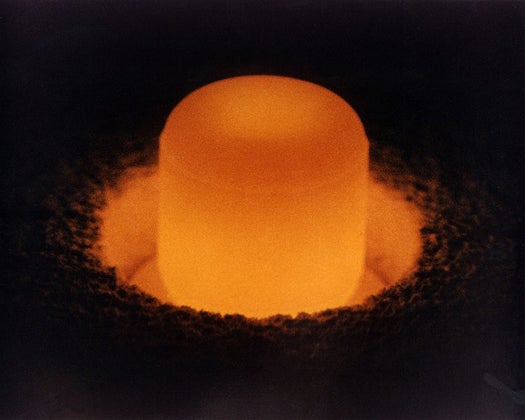
Fuel Shortage Dwindling supplies of plutonium-238, the fuel NASA uses to launch probes into deep space and to power Mars rovers, threaten to set back some missions for a decade. Los Alamos National Laboratory

As rare-earth metals become less common, and as nuclear non-proliferation treaties proliferate, it may get harder to send probes into deep space. Preparing for that eventuality, the European Space Agency is stockpiling smoke-detector parts for a possible new fuel source.

Most solar system explorers use special generators that convert the heat from radioactive decay into electricity. But the world is running short on fuel, specifically plutonium-238, used to power spacecraft like the Voyagers, Cassini and the plucky Mars rovers Spirit and Opportunity. NASA has enough left for the upcoming Curiosity (Mars Science Lab) rover, but that's about it, unless Russia wants to sell us some.

The European Space Agency is turning to americium-241, according to New Scientist. The isotope -- named for the land of the free, where it was discovered in 1944 -- is commonly used in household smoke detectors.

New Scientist quotes ESA's director of science and robotic explanation, David Southwood, who says "we really don't know of any other way to have an electric power supply going into the deep solar system."

Americium-241 has a half-life of just 432 years, but decays more slowly than plutonium-238, which could potentially allow for longer missions, New Scientist reports. On the other hand, spacecraft would need more of it to supply one unit of power, a possible problem in an industry where every ounce matters.

ESA and NASA are planning a joint mission to Jupiter's icy moon Europa, scheduled to launch around 2020, and the space agencies might use Am-241 for fuel, New Scientist says.

New Scientist

10 Comments

Americium 241's critical mass for an unreflected sphere is approximately 60 kilograms or about the amount contained in 214.3 billion smoke detectors

Might be a good time time to consider splitting spacecraft into two payloads. From what I understand computer controlled docking is coming along at a somewhat decent pace and if you could launch a "fuel" section and an "instruments" section with a secondary launch vehicle for breaking orbit once assembled it might allow for more fuel and more sensors. I'm not sure if all the extra effort equates to extra payload or if it's better to just design booster rockets to slap on the sides of the usual vehicle get a bigger spacecraft into orbit.

each smoke detector only holds 0.2 micrograms of americium.....good luck NASA

This would magically be solved if we magically had something to launch spacecraft from at a high altitude, say... a space elevator (with the capacity and strength to carry spacecraft parts very high).

--------------------------------------------------------------
It's not the Vt=Vi+at that kills you. It's the F=mΔV/ΔT.

These use the heat from natural decay as an energy source. They produce remarkably little power. Perhaps we should directing resources towards reactors to power space craft with a much higher energy density. It is nearly impossible to use thermal isotropic generators to power something like a mars vasimr tug but a space reactor should work fine and could use much more plentiful fuels.

Stop being such pussies and make more Pu-238. It has an isotopic power of 0.57 W/g compared to the pitiful 0.11 W/g of Am-241.

"Americium 241's critical mass for an unreflected sphere is approximately 60 kilograms or about the amount contained in 214.3 billion smoke detectors"

They're not trying to make a reactor. They're going to use it for Radioisotope Heater Units and Radioisotope Thermoelectric Generators for satellites heading to Mars and beyond.

They're not taking the americium-241 from freaking smoke detectors, they're taking it from spent LWR fuel as a byproduct. If you let spent LWR fuel sit and cool for a decade or two and then reprocess it you'll find about 1 kg of Am-241 per tonne of fuel.

Who is being held accountable for the consequences of this feel good, non proliferation policy that got us to this feeble situation?

At least with a private company like BP, the company and share holders can be held responsible and accountable.

With government policy, nobody is held accountable for misguided, shallow, and destructive policy.

I think we need another CERN type project. Meaning multi-nation plant producing nuclear fuel for spacecraft. This can also be a hub for nuclear research which would benefit the world.

Oh, and the multi-nation bit has the added benefit of "Well if we're all doing it together we can't get in trouble."

Yes soylent I'm aware of both; just stating a fact. I know they aren't trying to make a bomb out of smoke detectors. The point is not to be afraid of your smoke detectors due to this article's linkage of 241Am with plutonium.


July 2013: The Future Of Flight

The incredible innovations, like drone swarms and perpetual flight, bringing aviation into the world of tomorrow. Plus: today's greatest sci-fi writers predict the future, the science behind the summer's biggest blockbusters, a Doctor Who-themed DIY 'bot, the organs you can do without, and much more.


Online Content Director: Suzanne LaBarre | Email
Senior Editor: Paul Adams | Email
Associate Editor: Dan Nosowitz | Email
Assistant Editor: Colin Lecher | Email
Assistant Editor: Rose Pastore | Email

Contributing Writers:

Kelsey D. Atherton | Email
Francie Diep | Email
Shaunacy Ferro | Email

circ-top-header.gif
circ-cover.gif
bmxmag-ps