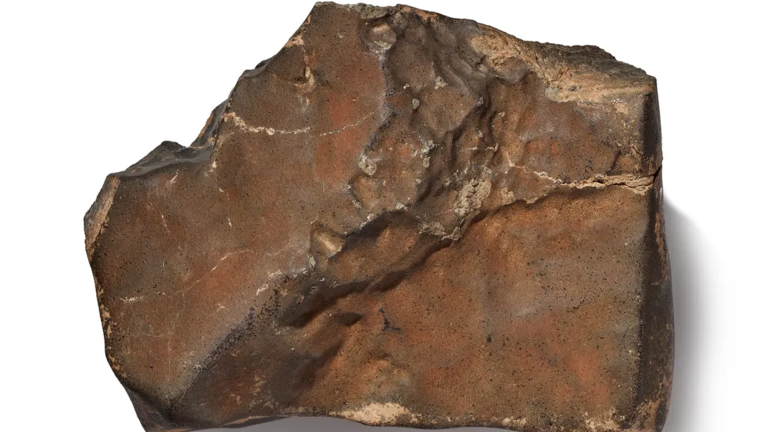
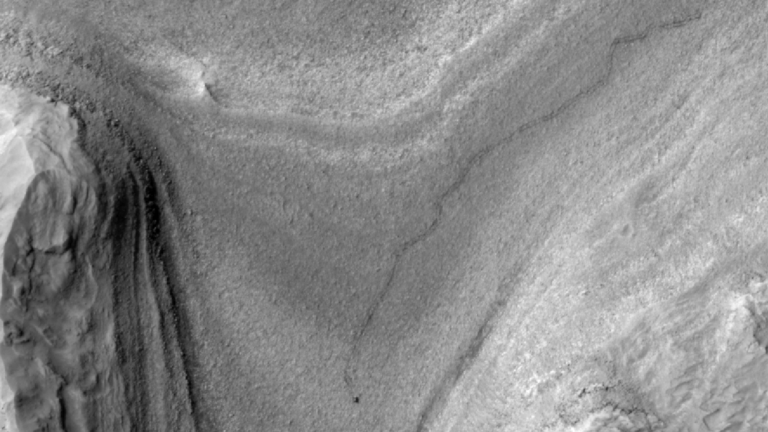
In April, Kathie Thomas-Keprta told a standing-room-only audience at the Astrobiology Science Conference that she had found evidence of life on a three-billion-year-old Martian meteorite. And no one was surprised. That’s because she and eight other researchers at several universities and NASA’s Johnson Space Center had reported the same thing about the same meteorite in 1996. They were met with criticism and ridicule back then. But this time, the reaction was more favorable.
The five-pound rock in question was discovered in 1984 in the Transantarctic Mountains and is known as the Allan Hills Meteorite, or ALH84001 in astrobiology circles. Many scientists considered the gray-green meteorite a dead end, but the NASA team never stopped studying it and, thanks to improved microscopy techniques, the case for life on Mars is stronger than ever. “You can almost feel the tide turning,” Thomas-Keprta says. “People are looking at our research again.”
The first time around, critics argued that the markings that resembled Earthly bacteria were too small to have been alive (bacteria of the same size have since been found here) and that the organic material in the rock formed in Antarctica. But the killing blow came in 2003. Thomas-Keprta’s group had asserted that magnetite crystals, structures that Earthly microorganisms make, were formed in the meteorite by Martian bacteria. In 2003, however, researchers ran computer models that indicated that geological processes occurring at temperatures too hot to sustain life could have created these magnetites.
Now science is again considering the possibility that ALH84001 is full of fossilized nano-ETs. In Thomas-Keprta’s new magnetite study, she used a focused ion beam to isolate a fraction of the magnetite. When she analyzed the sample’s chemical composition, she found that the magnetites were similar to those created by Earth microbes, and that their specific atomic makeup could not have formed at the high temperatures suggested by critics. “This doesn’t definitively show that the magnetites in ALH84001 are biological in origin,” says Dennis Bazylinski, a bacteriologist at the University of Nevada who refereed Thomas-Keprta’s paper. “But it does show that the thermal mechanism popular among those who think strongly that the magnetites do not have a biological origin is extremely unlikely. I think Kathie really put a nail in the coffin for that explanation.”
Convincing doubters that this means Mars was teeming with life, however, will be difficult. “ALH84001 is a really nice rock, full of lots of cool stuff about early Mars, but nothing in it points in the direction of life,” says David Blake, a NASA exobiologist who studied ALH84001 in the 1990s. “To look at a rock 140 million miles from where it formed and turn it into a whole world is tough.”
Recent studies by other groups of two other Martian meteorites, the Nakhla meteorite, found in Egypt, and Yamato 593, another Antarctic specimen, have yielded features similar to ALH84001. Later this summer, Thomas-Keprta will turn her ion beam on these rocks—which formed in a wet Martian environment ripe for microbes—in hopes of revealing whether it contains biological by-products, and possibly uncovering fossilized cell walls.


140 years of Popular Science at your fingertips.
Each issue has been completely reimagined for your iPad. See our amazing new vision for magazines that goes far beyond the printed page
Stay up to date on the latest news of the future of science and technology from your iPhone or Android phone with full articles, images and offline viewing
Featuring every article from the magazine and website, plus links from around the Web. Also see our PopSci DIY feed
The 6th annual Invention Awards are here, from an inflatable tourniquet to a better lobster trap to spring-loaded hocket skates. This issue is all about the celebration of invention.
Plus: Making synthetic biology breakthroughs in a garage, building a constantly-moving ping-pong table, and a ridiculously overpowered barbecue.
I know that these scientists were lambasted by the scientific establishment for their original findings, perseverance paid off.
Here is something interesting "Thomas-Keprta’s group had asserted that magnetite crystals, structures that Earthly microorganisms make"
According to the Phoenix Lander science team there was a lot of magnetite in the Mars Phoenix Landers soil samples. The science team also noted that all the nutrients to sustain life is at the Phoenix Lander site.
These time lapse images from the Mars Phoenix Lander have microscopic maggot-like and scorpion-like movements that are caused by unknown forces; the strong magnet that tested for magnetized soil weren’t turned on at the time of some of these movements. Wind can't be the cause of these movements because the highest wind speed recorded at the Lander site was 5 m per second, not strong enough to move particles 500 time more massive than the Martian dust fines.
See most of the movement in the Phoenix Lander microscopic soil samples here:
www.youtube.com/watch?v=zhfSjJeQf58
Ron Bennett