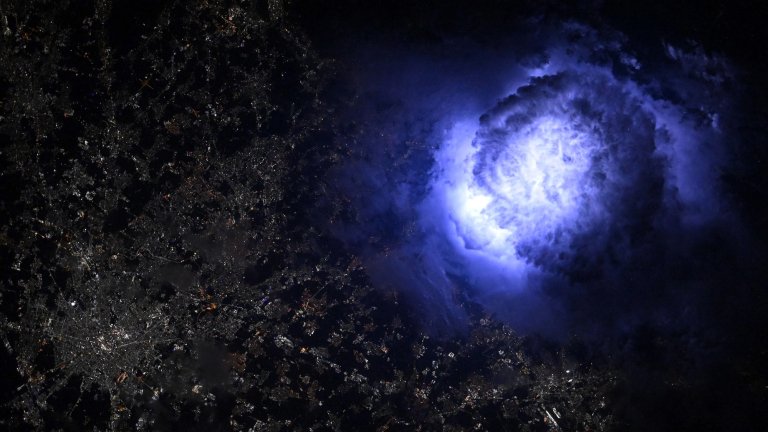
The Aurora Australis, As Seen from the ISS on May 29 NASA

Sometimes you're just at the right place at the right time. Astronauts aboard the ISS experienced just such a moment when they captured this captivating image of a rare aurora australis over the Southern Indian Ocean likely caused by a coronal mass ejection from the sun late last month.

The auroras -- aurora borealis near the North Pole, aurora australis near the South Pole -- are one of the atmosphere's most beautiful phenomena, occurring when energetic ions from the sun collide with oxygen and nitrogen in the upper atmosphere, temporarily exciting those particles such that they emit light as they return to their normal states. This particular ribbon of ion activity appears green, the result of excited oxygen atoms at wavelengths near 0.558 millionths of a meter. Other wavelengths produce red, blue, or purple hues (you can see a little bit of red left of center).

This particular aurora is unique in the sense that it was spotted fairly far away from the South Pole over the southern Indian Ocean, likely as a result of a large ejection of energy that burst from the sun on May 24. The photographer is looking south toward Antarctica, though you can't see the southernmost continent in the photograph. The ISS orbits at around 220 miles, while the aurora was located somewhere in the ionosphere between 60 and 190 miles above the planet's surface.

[NASA Earth Observatory via Discovery]

19 Comments

that's one of the most amazing photo's I've ever seen. i want to go to space soooo hard.

Breathtakingly beautifully...

Ivan Malagurski

ITS THE ANGEL OF DEATH!! AAARRRrrgg.....

Abremms, you and I are on the same page here.

its amazing that people can look at things like this and still not believe in God.

Considering how fast the ISS is moving, the photographer managed to capture a fantastic image! If you want to see more Aurora images check this out! www.infocusimagery.com Northern hemisphere, but worth a look!

hatandboots, why would looking at this make me believe in God? This is easily explained scientifically.

Setarip,

Because the clearly random nature of the universe clearly dictates that the aesthetically appeasing "random" occurrences that you observed was caused by a "random" confluence of images that caused an enjoyable southern hemisphere that made a "purty green line" (we're all so lucky to live right now). (whew, yeah this much constant random is boggling my mind too...)

Oh yeah, hey. Awesome you saw this :) Wish we had more southern Aurora Bore-alas (*)

Science and God don't contradict each other.

@pindlcrazny southern aurora borealas is a contradiction, it's aurora australis. Wit ruined.

@CoolHand032 Mhmm, indeed.

Hence why I phrased it Bore-alas(*)(to pierce-sorrow/concern (ET AL)).

Wit maintained.

Hah, Hatandboots, this picture makes me think the opposite of what you said. The universe is just so mindbogglingly huge, yet people still say that some dude created it all in seven days. Why don't people just see the natural beauty of stuff like this without looking for some higher power to go along with it? Plus, the aurora can be explained perfectly well scientifically.

Hah! I know Galactic Defender. Beautiful pictures make me think of the thought that some singular beauty isn't done till it's destined by singular beauty. Hah! LOTS more than seven people make a nuclear joke!

Happens whenever someone drags religion into an article. Just stop arguing and appreciate nature.

Isn't this pretty far North? I believe I can see India int he upper left hand of the picture.

Let's not forget what causes this fine display. It is particles from the sun crashing into earth's atmosphere. I would certainly NOT want to be above earth's capture of these particles like the astronauts in space at the time!!

Major cellular damage, mutations, etc.

Referring to Setarip's comment regarding how easily the Aurora Australis can be explained scientifically...

The means by which the picture was taken is even more easily explained scientifically, but no one here would argue that it was taken and posted on the internet without intelligent design being involved somewhere along the way.

It is an amazingly striking image. I believe caused by the fluorescent decay of excited oxygen - same color as the yellow-green LED indicators on computer monitors.

Yes it may look beautiful but also indicates that our magnetic field is weakening. It is not usual to see Aurora that far from the poles.

Does anyone know if this is a bad thing? It's sort of scary!


138 years of Popular Science at your fingertips.

Innovation Challenges


Popular Science+ For iPad

Each issue has been completely reimagined for your iPad. See our amazing new vision for magazines that goes far beyond the printed page


Download Our App

Stay up to date on the latest news of the future of science and technology from your iPhone or Android phone with full articles, images and offline viewing


Follow Us On Twitter

Featuring every article from the magazine and website, plus links from around the Web. Also see our PopSci DIY feed


February 2012: The Future of Fun

Science is reinventing play, from extreme sports to gamification to ridiculous roller coasters to the playgrounds of tomorrow, and this issue is chock full of fun. Also, on a less fun note: Did global warming destroy my hometown?


circ-top-header.gif
circ-cover.gif