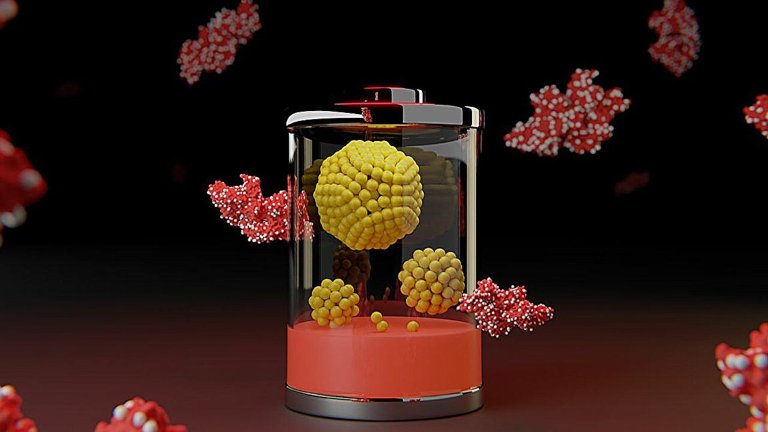
Since untold quantities of oil started flowing into the Gulf, there's been a lot of talk about bacteria that eat oil. While those microbes might help remediate those millions of barrels of crude, one geoscientist thinks we might be able to use them to keep oil in the ground in the first place. By pumping such carbon-devouring, methane-producing bacteria into the oil wells or carbon sequestration sites, University of Calgary professor Steve Larter thinks we could biodegrade petroleum and waste CO2 into cleaner fuels like natural gas and hydrogen.
The bacteria, yeasts, and other microbes Larter is talking about occur naturally in nature, and at sites where oil seeps from the ground -- naturally or not -- these organisms feast on the carbons therein. As when burning oil, the byproduct of this decomposition is carbon dioxide, but these microbes turn that CO2 to methane (natural gas), as well as produce other useful gases like hydrogen.
At a conference today Larter presented the idea that we could perhaps pump these microbes into oil wells where they could convert crude into cleaner burning natural gas before it is ever extracted from the ground. He also suggested that we could do the same with sequestered CO2, pumping it into the ground with these microbes where it would be turned back into usable fuel.Pretty interesting stuff, even if it is only on paper for the time being. If we could produce methane from greenhouse gases sequestered from our power plants and other polluting installations, we could at least tighten up the energy loop to the point where burning natural gas for electricity is somewhat closer to carbon neutral.
The incredible innovations, like drone swarms and perpetual flight, bringing aviation into the world of tomorrow. Plus: today's greatest sci-fi writers predict the future, the science behind the summer's biggest blockbusters, a Doctor Who-themed DIY 'bot, the organs you can do without, and much more.


Online Content Director: Suzanne LaBarre | Email
Senior Editor: Paul Adams | Email
Associate Editor: Dan Nosowitz | Email
Assistant Editor: Colin Lecher | Email
Assistant Editor: Rose Pastore | Email
Contributing Writers:
Kelsey D. Atherton | Email
Francie Diep | Email
Shaunacy Ferro | Email
Finally, a decent popsci article in a long time.
I'm not 100% happy with converting oil to methane, but I hope we can get the bacteria to convert our CO2 to methane if we ever store CO2 underground.
This would be cool but it has its ups and downs. For example, oil is used for much much more than just transportation. Chemicals feedstocks come from oil that produce plastics, pharmacuticals, fabric, tires, etc. So converting all our chemicals to methane would be a bad move. However, in some wells where the oil has hard to extract (such as the shale) or even from the waste from the tar sands extraction up north it might be a worthwhile venture. However, even these hold valuable chemicals. If there are bacteria that can convert C02 to methane that should be the pathway we should be pursuing. Anytime we can make a waste product useful its a win-win.
According to the Intergovernmental Panel of Climate Change, methane has a global warming potential of 7.6 (meaning it's 7.6 times effective as carbon dioxide at trapping heat) after a period of 500 years. After just 20 years, methane's GWP is 72. If they try to do this, they better keep a tight lid on whatever methane is produced by the bacteria, especially if they try to sequester and convert the less dangerous, yet more abundant carbon dioxide into methane using the bacteria. What they should do is create some bacteria that can ingest methane and produce hydrogen as a waste byproduct. Methane emissions from cow dung and garbage could be taken care of while simultaneously producing hydrogen for fuel cells with zero carbon emissions.
...Guys?
Are you saying like, say, some kind of *life form* that *ingests CO2* and *releases O2*?
Does that sound at all *familiar* to y'all?
Oy....
The article is intriguing, but it's definitely a concern that we really kind of need oil as oil as it is for plastics.