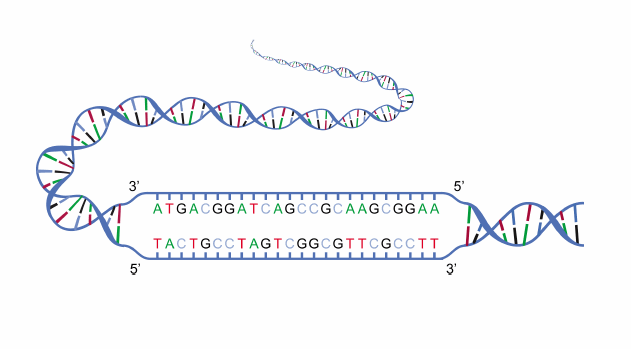
These Are Your Genes. These Are Your Genes On Alcohol Berkeley's incoming freshmen will get DNA tests instead of summer reading assignments, in a program meant to educate students about healthy behaviors. wikimedia commons/Human Genome Project

First universities started using RFID chips to track students' attendance. Now they want their DNA. The University of California-Berkeley, that bastion of hippiedom and experimentation, is replacing its summer reading list with a call for incoming students to voluntarily provide DNA samples.

New freshmen will be given cotton swabs with which to dab their cheeks. They'll be collected and anonymously analyzed, showing the students' ability to tolerate alcohol, absorb folic acid and metabolize lactose, according to USA Today. Students can log in to a Web site to check their results, using an anonymous bar code that comes with the cotton swabs.

The idea is to inform students if they should eat more salad, for instance, or limit their milk or alcohol intake.

Jasper Rine, a professor of genetics, genomics, and development who will perform the testing, said the goal is not to identify potentially dangerous genes, but to point out traits that can be managed through behavior, USA Today reports. The university will host a Web site with related genetics reading material, and students will be able to attend lectures and special panel discussions about ethics in genomics.

Which is interesting, because last year, Berkeley scientists themselves warned of the potential dangers of using take-home DNA kits to trace ancestry or individual medical risks. The tests can be misleading and lead to problems, including skewed ethnic data or misdirected medical decisions, UC researchers said.

So why are they testing incoming students' genes? In the Berkeley tradition, the university's answer is, "Why not?"

The university's dean of biological sciences says a look at personalized medicine made sense -- it's just a research tool now, but in the coming years it will become everyday medical practice, he said.

"You won't see this anywhere else in higher education," dean Mark Schlissel told a San Francisco Bay Area TV station.

[USA Today, KTVU]

8 Comments

If it's just the things mentioned in the article, like "ability to tolerate alcohol, absorb folic acid and metabolize lactose," then I think this is fantastic.

If they go further and mention possible susceptibility to genetic diseases, then this should not move forward. Nobody would want that hanging over their heads, especially freshman in college with the most fun and stressful years of their lives about to begin.

@CoolHand032 Actually a great many people choose to have DNA tests to determine if they have or are carriers of a genetic disease or hereditary diseases. I myself was tested to determine if I was a carrier of Cystic Fibrosis. This allows them to make choices based upon this information, for example whether to have children. This is why the prevalence of Huntingdon's Disease is decreasing in some areas despite the genes being autosomal dominant.

A disposition or increased risk to a certain disease based on ones genes is different, and where caution is advised. However once again people do choose to have this test, I am looking into it for myself.

sounds cool as long as it was kept to just medical uses. I'd rather have a home DNA testing machine thing but that's just not too practical...

It could actually be very useful if they could tell susceptibility to mental illness since many mental illnesses are triggered by stress and college is one of the most stressful times in ones life.

Is this confidential information? )))

It is confidential. That's what it's anonymous - at least in theory. Though I can imagine a variety of civil rights and criminal investigation problems emerging from this practice.

I get it.

Sure it is confidential.
Until some girl gets raped. Or cries rape.
Hey, if you have nothing to hide why not submit your DNA?
And fingerprints. And take a polygraph test. And be interrogated for hours without a lawyer.
What could go wrong? This is academia, they are level headed...
Just ask those Lacrosse boys.....


June 2013: American Energy Independence

Five amazing, clean technologies that will set us free, in this month's energy-focused issue. Also: how to build a better bomb detector, the robotic toys that are raising your children, a human catapult, the world's smallest arcade, and much more.


Online Content Director: Suzanne LaBarre | Email
Senior Editor: Paul Adams | Email
Associate Editor: Dan Nosowitz | Email
Assistant Editor: Colin Lecher | Email
Assistant Editor: Rose Pastore | Email

Contributing Writers:

Kelsey D. Atherton | Email
Francie Diep | Email
Shaunacy Ferro | Email

circ-top-header.gif
circ-cover.gif
bmxmag-ps