Could build better batteries, solar cells
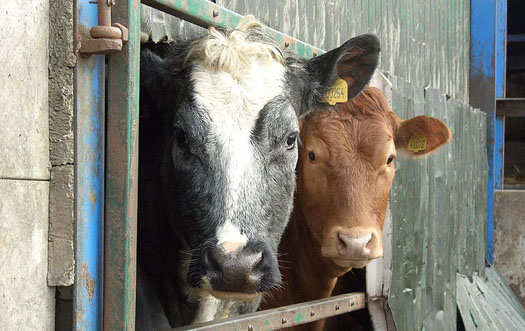
Cow Brains: Rich in Clathrin rightee via Flickr

When we think of farming energy, we generally think of feedstocks like corn that can be processed into ethanol, or perhaps other plant life we can culture and harvest like algae. But don't underestimate the livestock; we've recently seen methane-trapping schemes that can power farms and giant cattle treadmills that turn idle dairy drones into power-producing machines. Now, a team of Stanford researchers wants to use a protein found in cow brains to make better batteries.

The concept centers on a particular protein called clathrin, which has a unique knack for assembling itself into versatile structures that foster the formation of complex molecules. Clathrin is present in every cell in the human body, but cows possess a vast wealth of it in their bovine brains that make them an ideal source for the stuff. And given the right biochemical directions, researchers think they can coax clathrin into creating better batteries and solar cells.

In cells, clathrin plays a key role in cell transport. Its tripod-like structure allows it to create a honeycomb-like lattice on the outer surface of cell walls. Atoms and molecules then attach themselves to clathrin according to the protein's will; when the right cargo is attached, the lattice collapses inward, pinching off the cell wall and delivering it's molecular payload into the cell's interior.

It's this ability to connect into structures and lure in the right molecules that makes clathrin an ideal candidate for creating battery electrodes and solar cells. Scientists can bend clathrin to their will relatively easily, coaxing it into a variety of very useful skeletal structures that they can then attach molecules to. By adding the right blend of inorganic atoms or molecules, the researchers can create electrodes, catalysts, and other battery cell building blocks.

The group has already mashed up gold and titanium dioxide into a material they call "titania" that has photocatalytic properties that allow it turn sunlight into a catalyst for water splitting. Other materials are in the works, all aimed at turning chemicals or sunlight into sweet, sweet energy. Show us an ear of corn that can do that.

[PhysOrg]

18 Comments

why are we advocating using animals for new forms of energy? what is the comparison of this new idea to the amount of food it takes to feed these cows and the amount of methane gas their waste produces?

Our milk surplus would go down if we killed our cows.

I don't know about anyone else, but I never see brains at the supermarket...Perhaps we can utilize the waste from our already substantial red meat consumption instead of killing more cows merely to harvest their brains? Makes sense to me...

So first sheep couldn't get a break and now the cows have to die the death of a 50's sci-fi movie or something.

@Surge64: it's possible to use the brains of beef cows we eat

@ Lucify and Surge: Who said anything about using cows for anything but food and milk? Let alone breeding more cows just for this protein?

It says the protein is found in cow brains, that doesn't mean there is no other means to produce it.

Researchers already have the protein on hand, assumed since they're running tests on it that provided the content for this article. From there, all they have to do is genetically engineer bacteria to produce this protein, which is a known pharmaceutical practice.

No cows need be harmed in the proliferation of this research.

Seems impractical to use actual animals for this. I trust that they are only scraping proteins from cow brains for research, and large scale productions would require cultured or synthetic proteins.

Ha ha Ha.... Welcome to the Mootrix :)

Those cows are staring at me very eeeeeerily!

I don't recall reading anything about killing cows for brains...

For the PopSci writers and editors, if you read your comments sections, there's a typo in the last sentence of the third paragraph. "it's molecular payload" should be "its molecular payload". It's a fairly common mistake to confuse the two words.

Interesting research. Cows are too useful for there to be any concern about any being harvested for their brain alone. It's more likely that they will use brains from cows being slaughtered for beef/leather. Currently they are used to make feed for chickens and stuff, I think. Cattle farmers can have hope that this technology takes off. It will likely raise the price of cow brains significantly!

“My cell phone is going dead. I need to charge my cow brain battery!”

Why do I have the feeling that soon cows will be walking on treadmills, a plug up there you know what to collect methane, and then harvested for meat and "brain power".

Mad cellphone disease, anybody?

Why do some commenters think this is a problem? We already slaughter millions of cows every year for beef and other products. Finding a use for their neural tissue just means the slaughterhouses have one more reason to separate the brainy bits from the brawny, only now it's because they can sell it rather than just keeping madness from the masses. If it's worth money to them, they'll actually do it right.

Please note ExQor Technologies (Boston MA) has multiple issued patents on bio-engineered Clathrin, and more pending, that protect us for this and other applications of Clathrin protein, including Clathrin bio-nanolasers. E.g., in one issued patent 7,393,924 Vitaliano, et al. July 1, 2008, here are some of the claims directly relevant to the work at Stanford:

6. An isolated bio-nanoparticle element according to claim 1, comprising one or more types of coatings on part or the entirety of cage and or one or all or a subset of cargo elements.

16. An isolated bio-nanoparticle element according to claim 1, wherein cage produces ordered scaffolding, creating self-assembling multi-layer structures having one or more dimensions.

This also appears in our issued patent's text: "In one embodiment, one or more...elements are batteries or components for storing electronic charge.

Regards

Franco Vitaliano
President & CEO
ExQor Technologies, Inc.
Boston MA
francov@exqor.com
www.exqor.com

I agree with Onihikage the brain concept is a somewhat practical idea but there has got to be regulations so the baddies dont go around slaughtering cows mercilessly also so the chance of greed is eliminated, Chesstoh Onihikage Chesstoh!!

Unlike Stanford, ExQor does not use cow brains, which have their own processing issues, e.g., the possibility of their containing prion diseases like "Mad Cow". Another big reason for ExQor not using cow brains is our bio-engineered Clathrin is also designed to be used in our patented biomedical applications for people--Cow tissue is definitely out.

Regards

Franco Vitaliano
President & CEO
ExQor Technologies, Inc.
Boston MA
francov@exqor.com
www.exqor.com

Two articles discussing a nanolaser made out of Clathrin protein recently appeared,

nextbigfuture.com/2010/05/protein-computing-bio-based-quantum.html

eetimes.eu/en/will-living-proteins-revolutionize-computing.html?cmp_id=7&news_id=222902142&vID=209


June 2013: American Energy Independence

Five amazing, clean technologies that will set us free, in this month's energy-focused issue. Also: how to build a better bomb detector, the robotic toys that are raising your children, a human catapult, the world's smallest arcade, and much more.


Online Content Director: Suzanne LaBarre | Email
Senior Editor: Paul Adams | Email
Associate Editor: Dan Nosowitz | Email
Assistant Editor: Colin Lecher | Email
Assistant Editor: Rose Pastore | Email

Contributing Writers:
Rebecca Boyle | Email
Kelsey D. Atherton | Email
Francie Diep | Email
Shaunacy Ferro | Email

circ-top-header.gif
circ-cover.gif
bmxmag-ps