We've already added elements 116 and 118 to the periodic table, and now a collaboration of Russian and U.S. scientists at the Joint Institute for Nuclear Research in Dubna, Russia, has created the superheavy element 117 that is about 40 percent heavier than lead -- for a fleeting moment, at least.
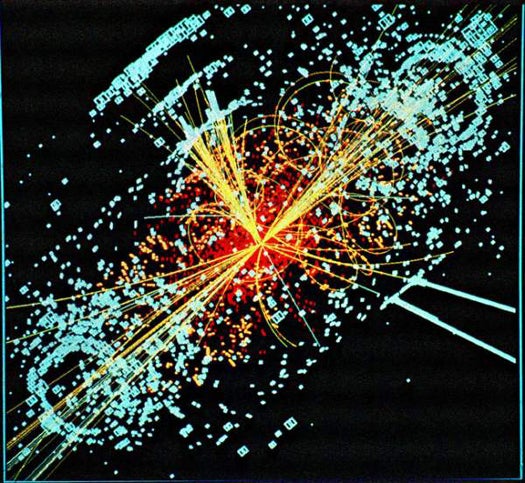
The team conjured element 117 -- called ununseptium for now, though that could change -- by smashing together calcium-48 and another heavy, hard-to-find element, berkelium-249. Element 117 only hung around for fractions of a second before exploding into a shower of lighter particles and other elements. But by studying those leftovers, the researchers were able to confirm that the element did briefly exist.
Therein lies the importance of this discovery; finding element 117 brings researchers closer to establishing that an island of stability exists at the top end of the periodic table. Though the element checked into and then out of this world very quickly, it actually hung around longer than many elements of lesser mass. So the discovery of ununseptium not only fills a key gap in the periodic chart, but it further confirms what physicists have been suspected for quite a while now concerning the nature of superheavy elements.Of course, rare elements that exist only in the blink of an eye have limited potential for practical use. But they do tell us a lot about subatomic particles and the hows and whys that explain the proportion in the universe of elements lower down the chart. So synthesizing heavier and heavier elements could teach us not only about this superheavy "island of stability" that exists in the periodic tables triple-digits, but hopefully more about the nature of the universe at large.
And if learning more about the elements that make up our universe is your thing, you should definitely this out.
[PhysOrg]
Five amazing, clean technologies that will set us free, in this month's energy-focused issue. Also: how to build a better bomb detector, the robotic toys that are raising your children, a human catapult, the world's smallest arcade, and much more.


Online Content Director: Suzanne LaBarre | Email
Senior Editor: Paul Adams | Email
Associate Editor: Dan Nosowitz | Email
Assistant Editor: Colin Lecher | Email
Assistant Editor: Rose Pastore | Email
Contributing Writers:
Rebecca Boyle | Email
Kelsey D. Atherton | Email
Francie Diep | Email
Shaunacy Ferro | Email
Maybe here is a new weapons material, even more efficient than depleted uranium?
Oh I'll this is out alright.
If, in theory there's really a stability ilsand, to create new synthetic elements should be a great experimental way to investigate the nuclear strong force and quantum physics, or even more, in the future we may find evidences about the location of the misterious dark matter in that stability ilsand, in theory of course.
But who knows what we can reach?
I am uncertain what the practical applications would be of either this or similar atomic heavy weights. First, energy used to grams produced seems overwhelming. Second, think of the material's sheer weight. Not something you would likely want to use in pure form. That said, the doping of more conventional materials with a few of these atoms might produce desirable applications. But given the afore mentioned drawbacks, I suspect we have much more untapped potential to explore in the previously known elements. Thus I have to assume any useful application of this new element is well beyond my life time and yours.
@Whys333: Scientists didn't decide to smash particles together just to only find practical applications for the new particles they discover. If you understood how understanding works, then you would have already seen the practical application was that it was discovered. Everything we find adds to our knowledge and understanding. Regardless of your presumption that it means nothing useful to a modern human, I couldn't be more happy about this.
Exactly highdobb, many of Tesla's inventions had no practical application during his lifetime. However, the research he did then is now being applied to wireless electricty transmission. Also, the fact that the "island of stability" is currently a theory is a good enough reason to pursue this in my opinioin. Mainly because by proving that theory it could help us find other islands. And besides, if the future is full of free energy from fusion the cost to produce these elements will be nil right ;)
personally I think it should be called something like spartanium or masterchiefonium.