Planck Satellite Illuminates Filaments of Cold Interstellar Dust
Gosh, look at all those dark materials ... I mean dust
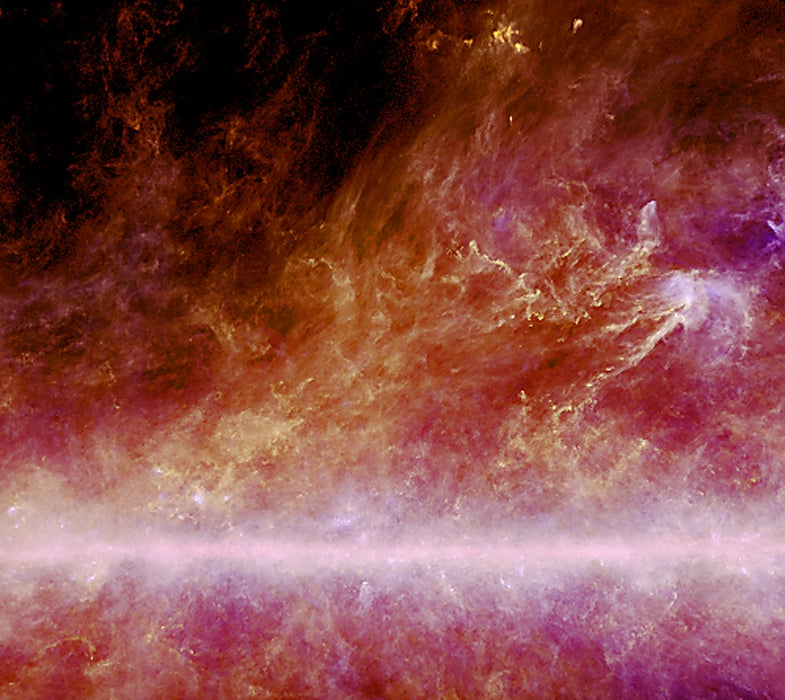
Huge filaments or threads of interstellar dust link to our Milky Way galaxy, seen as a bright pink horizontal in a new image taken by the European Space Agency’s Planck satellite.
Planck is the first European mission to study leftover radiation from the time of the theoretical Big Bang, or the beginning of the universe. The satellite launched alongside the Herschel Space Observatory in 2009, and has since helped astronomers understand both the origins of the universe and the formation of galaxies.
This latest image comes from Planck’s first all-sky survey at microwave wavelengths, and also uses data taken from the IRAS satellite. White-pink colors represent dust with temperatures of just a few tens of degrees above absolute zero, while deeper colors represent dust at a chillier -261 degrees C — just 12 degrees above absolute zero.
Warmer dust appears in the plane of the Milky Way, and brighter spots in the image represent denser clumps where star nurseries may be forming.
Astronomers remain unsure as to why the dust takes on the shapes that it does. Galaxy rotations create spiral patterns, gravity tugs every which way on dust and gas, and radiation from stars also pushes the dust around. Magnetic fields may also have a more subtle influence.
If that image has you excited, we’d recommend checking out an IMAX-sized cosmic flythrough of the universe, courtesy of Hubble 3D‘s Hubblegasm.