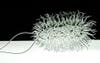
Seen Clearly: In this depiction of the rod-shaped E. coli, two flagella trail from one end while hairlike pili surround a capsule full of tangled nucleoids.  Luke Jerram
This 41-inch-long sculpture of the Escherichia coli bacterium is part of British artist Luke Jerram’s “Glass Microbiology” series of portraits. Other organisms he has vitrified include HIV, SARS and swine flu.

To create each one, Jerram used images from an electron microscope and had guidance from virologist Andrew Davidson of the University of Bristol in England. “Scientists have to jump from what they can see [in the microscope] to what they know through chemical analysis, and then they have to piece together a kind of jigsaw,” Jerram says. He takes the scientists’ microscopy data and analysis a step further, transforming diagrams and images into three-dimensional models. But why glass? The color-blind artist wished to challenge the mainstream media’s love for artificially colored images of these minuscule attackers by rendering the organisms in a less fanciful palette.

7 Comments

nice job! a fine piece of art! not sience, please don't be confused.

So this is HIS interpretation of the data. I second Azorus....not science....and who really cares. It's not like this has any use in the classroom or research.

scanning electron microscopes don't show "true" color anyways and are often color coded just to make different details stand out from each other. most organisms at this scale don't have any apparent color individually anyways so this is a pretty accurate model for the classroom mr areyoukidding. Plus I've seen the microscope images of E.Coli before and thats quite an accurate model in that sense as well. and it is science! science was used to know what the model should look like and the making melting and shaping of glass is all very scientific as well though art at the same time. I'm getting sick of all these sceptics and negative criticisms of the articles here and most of the time the people being so negative have no idea what they are talking about. so here's a hint if your not educated on it and your not asking questions to learn more then do some research before passing judgement and posting it your making yourselves look like idiots.

It must've taken forever to melt all those individual "pili" onto the bigger part. This is really nice, but like everyone says, it's not science. Unless you account for the fact that organisms at this small a scale usually don't have color, like Laced said.

Aside from all that, I wonder how much this stuff goes for. Probably in the thousand dollar or more range? $1500-$10,000?

Sorry, It will never truely replicate what e-coil is. It is art, an artist interpitation, however accurate it may be.

next thing you will tell me is that all the pictures of models on mags are science because they are a true picture of what they are. Tell that to demis thigh.


June 2013: American Energy Independence

Five amazing, clean technologies that will set us free, in this month's energy-focused issue. Also: how to build a better bomb detector, the robotic toys that are raising your children, a human catapult, the world's smallest arcade, and much more.


Online Content Director: Suzanne LaBarre | Email
Senior Editor: Paul Adams | Email
Associate Editor: Dan Nosowitz | Email
Assistant Editor: Colin Lecher | Email
Assistant Editor: Rose Pastore | Email

Contributing Writers:

Kelsey D. Atherton | Email
Francie Diep | Email
Shaunacy Ferro | Email

circ-top-header.gif
circ-cover.gif
bmxmag-ps