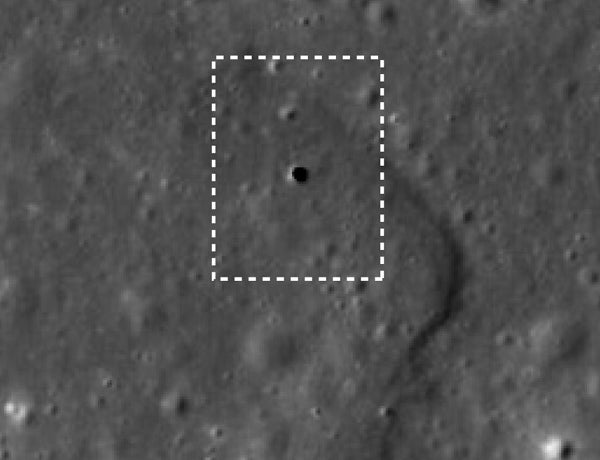
The moon may be a harsh mistress, but lately she has been giving up her secrets. Scientists have spotted a deep hole in the lunar surface that goes at least 260 feet down and is believed to open into an underground tunnel more than 1,200 feet wide.
The discovery is powerful evidence for long, winding tunnels carved by lava beneath the lunar surface. Such tunnels, whose existence has long been hypothesized, could provide shelter for future astronauts or colonists against the harsh radiation and surface temperatures on the moon.
Previous signs of such tunnels only existed as surface features called rilles, which hinted at hollow lava tubes below. Researchers only found the hole by poring through images taken by Japan's deceased Kaguya lunar probe.
Scientists told New Scientist that rubble or solidified lava may have blocked off much of the underground tube. But the Kaguya team continues to search for more openings, and NASA's Lunar Reconnaissance Orbiter could also begin snapping new shots of the area that are 10 times sharper.
So let's get this all straight. Water on the moon, check. Supergun concepts for space launches, check. And then there's the underground tunnels for colonists. All we need now is a reality show: Robert Heinlein's Survive the Moon.
[via New Scientist]
Five amazing, clean technologies that will set us free, in this month's energy-focused issue. Also: how to build a better bomb detector, the robotic toys that are raising your children, a human catapult, the world's smallest arcade, and much more.


Online Content Director: Suzanne LaBarre | Email
Senior Editor: Paul Adams | Email
Associate Editor: Dan Nosowitz | Email
Assistant Editor: Colin Lecher | Email
Assistant Editor: Rose Pastore | Email
Contributing Writers:
Kelsey D. Atherton | Email
Francie Diep | Email
Shaunacy Ferro | Email
AWESOME!!! next stop... orbital elevator!
and what happens when the tunnels callapse...
ps..first!
Cool.
I wrote a short science fiction story a year ago called "Caverns of the Gods" about the moon. It was about astronauts exploring a newly discovered 150 kilometer diameter underground cavern. The cavern located on the far side of the moon was centered several kilometer's below the surface in the Aitken crater, the largest crater in the solar system. My inspiration was from Jules Verne's "From the Earth to the Moon."
The Cavern was completely enclosed-in, no outlet to the vacuum of space, it had running water and a large lake. Your probably asking how can liquid water exist on the moon, it's simple it is like an aquifer on earth completely enclosed-in. In an enclosed environment water can form from the build-up of gasses and water vapor from ice sublimating creating an artificial atmosphere within the cavern, as a result a warm artificial atmosphere allows water vapor to form into a liquid because of the constant underground temperature and pressure.
The rest of the story I may share with you someday, it is about 40 paperback pages long.
Note the Aikens crater I was refering to above is the South Pole-Aitken basin, an impact crater about 2500 kilometers in diameter and 13 kilometers deep. The only impact basin close to it in size is the 2100 kilometer Hellas PlanitiaHellas Planitia.
A new crater about 4 times as large as Aikens basin covering the northern part of Mars has just been hypothesized by the lead scientist of the MER rovers team at Cornel university, Steven W. Squyres.
When is the first Luna colony scheduled to be populated? I hope soon.
Probably in the 2030's. It could be sooner, but as with everything in this World, it depends on the politics and money. If NASA get's enough funding then it'll happen sooner rather than later. Though, the private sector could always take over.
Come on people can't you think strait? What do you see on the surface of the moon? Craters right. What do you think made those craters? With no atmosphere to burn up little golf ball size stuff they hit mighty hard. Oh, before you start giving me a hard time about how rare impacts are on the moon check out the night sky on a day when we are having a meteor
shower here on earth. No shield for you on the moon hence the craters. Just a thought....
Of course there are tunnels on the Moon, that's were the Clangers live.
Living on the Moon should be more than a century away. Until the human race stops using fission reactors, stops burning coal, stops burning oil, stop burning non renewable sources of natural gas and replaces those toxic energy sources with renewable energy sources like solar, wind and small scale hydroelectric plants, and until every member of the human race has the same standard of living as the upper middle class has in the US, not one tax payer dollar should be spent in research to build a lunar colony. Such research with tax payer money, with the level of poverty and unemployment in the US, is immoral.
ellenbetty- You have a good and caring heart. But if we did things your way, we would would not have evolved into a US middle class society worth wanting to share with others. If you were Columbus's Mother he would still be looking for a job in Portugal. Like all things, balance in multiple government objectives can strengthen the whole.
(I only take the liberty of saying this because I am old enough to be your Mother's Hubby!)
I wonder if the soild on the moon could be used to grow plants on earth because volcanic soil is very furtile.