Earthly organisms undergo tests in Mars-like conditions
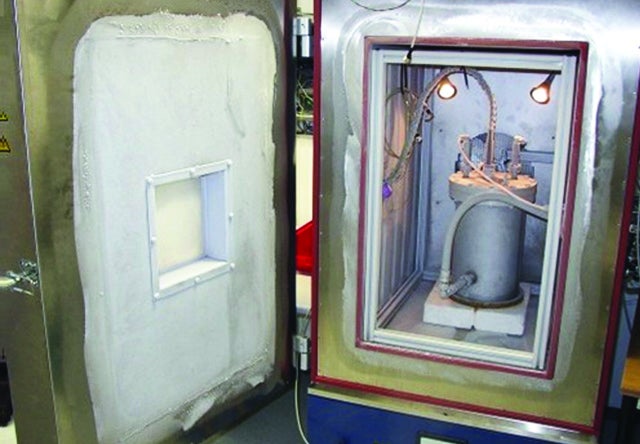
Deep Freeze Bacteria survive despite cold temperatures inside this Mars simulator. Courtesy DLR Berlin/Institute of Planetary Research

In a Berlin basement sits a small torture chamber. The air inside the hermetically sealed steel chest consists of a choking 95 percent carbon dioxide, some nitrogen, and traces of oxygen and argon. The pressure within is 1/170 that on Earth, and the thermostat is set to –50˚F—in other words, a nice afternoon on Mars. Experiments at the facility regularly subject some of Earth’s hardiest creatures to this hell, and they do just fine.

This August, several dozen scientific institutes combined forces to test a variety of Earth species in Mars-like conditions. Identifying life-forms that can survive on another planet, what mechanisms they use to do so, and what by-products they leave behind will give scientists a more specific idea of what to look for when searching for E.T., says Jean-Pierre de Vera, a biologist at the German Center for Aeronautics and Space Research (DLR), where most of the experiments are carried out.

At press time, the scientists had tested Deinococcus radiodurans, a bacterium known for its radiation tolerance, Xanthoria elegans, a lichen that thrives in Antarctica and low-oxygen conditions, and Bacillus subtilis, a comparatively ordinary bacteria found in soil around the planet. “I was astonished that organized, symbiotic communities such as lichens [which consist of fungi and photosynthetic algae or bacteria] can survive,” de Vera says. After 22 days, 80 to 90 percent of the lichens were not only alive but active—it seems that complex life-giving processes can happen off-planet. For one thing, de Vera says, “this is the first evidence that organisms might conduct photosynthesis on Mars.” Next he plans to investigate whether methane-producing bacteria, which could account for Mars’s methane clouds, can make it on the planet.

6 Comments

That would certainly make terra forming a bit easier should they ever decide to pollute Mars with Earth seed. Simply lob a couple lichen filled canisters from space and wait a few thousand years.

^ But then we might never be certain about the existence of native Martians.

^At some point preservation won't be a primary concern. At some point real estate will be more important than a few martian amoebas or lichen. I'm not saying we should start shooting today by any means. I just think we'll have to come to the realization of a very real fact. We'll outgrow our planet some day and need life on other extraterrestrial bodies to sustain our growth. No matter where we go in the universe, we'll be polluting and possibly killing off a native species. It's all a matter of what's more important to you, a martian wooly bear or human existence. I don't think the image of man finding habitable planets is a very real one. I think we'll have to make them our own to a more real degree than was envisioned in scifi.

No doubt they will eventually throw in the hardiest of them all the water bear, tardigrade.

"Tardigrades are polyextremophiles and are able to survive in extreme environments that would kill almost any other animal. Some can survive temperatures of -273°C, close to absolute zero, temperatures as high as 151 °C (303 °F), 1,000 times more radiation than other animals such as humans, more than a century without water, and even the vacuum of space. In September 2007, tardigrades were taken into low Earth orbit on the FOTON-M3 mission and for 10 days were exposed to the vacuum of space. After they were returned to Earth, it was discovered that many of them survived and laid eggs that hatched normally, making these the only animals shown to be able to survive the vacuum of space."

www.en.wikipedia.org/wiki/Tardigrade

Or how about the nematode, they survive the Columbia Space Shuttle reentry disaster.

I'm not even sure it would take thousands of years to terriform via biology.

1) Like kudzu in the south or rabbits in Australia, when there are no natural preditors, life expands exponentially. L lichen that spreads 2' a year will in its hundereth year cover square miles of planet.

2) Man is involved. Consider the speed of natural selection against the speed of creating a new dog breed.

3) Explore-tation. Mars is a pretty blank slate. That CO2 atmosphere is ripe for exploiting. Anything that likes the cold and metabolizies CO2 is going to thrive that level to an equilibrium, brining things ever closer to a balance with each organism.

4) Life = heat. Heat = speed. Enough said.

So, shoot away. We know life on Mars, if there, is small and of litle consequence. Putting life on Mars, however, is not just good for man, but good for LIFE. Earth is a big rock away from lifelessness. Seeding other planets might not make them habitable for man before his extinction, but still allows LIFE to do what LIFE does, grow and breed, in a James Lovelock kind of way.

Just a thought, if there were martian lichens why havn't they populated the planet as demonstrated Oakspar's point #1. If it somehow lacked speed, etc, natural selection would have weeded them out while the fast growing ones survived.....

counclusion: No life on mars


June 2013: American Energy Independence

Five amazing, clean technologies that will set us free, in this month's energy-focused issue. Also: how to build a better bomb detector, the robotic toys that are raising your children, a human catapult, the world's smallest arcade, and much more.


Online Content Director: Suzanne LaBarre | Email
Senior Editor: Paul Adams | Email
Associate Editor: Dan Nosowitz | Email
Assistant Editor: Colin Lecher | Email
Assistant Editor: Rose Pastore | Email

Contributing Writers:
Rebecca Boyle | Email
Kelsey D. Atherton | Email
Francie Diep | Email
Shaunacy Ferro | Email

circ-top-header.gif
circ-cover.gif
bmxmag-ps