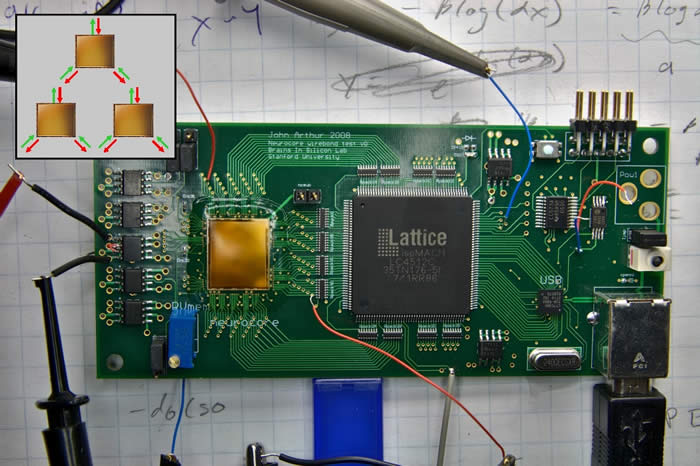
According to Kwabena Boahen, a computer scientist at Stanford University, a robot with a processor as smart as the human brain would require at least 10 megawatts to operate. That's the amount of energy produced by a small hydroelectric plant. But a small group of computer scientists may have hit on a new neural supercomputer that could someday emulate the human brain's low energy requirements of just 20 watts--barely enough to run a dim light bulb.
Discover Magazine has the story on how the Neurogrid computer could completely overhaul the traditional approach to computers. It trades the extreme precision of digital transistors for the brain's chaos of many neurons firing, with misfires 30 percent to 90 percent of the time. Yet the brain works with this messy system by relying on crowds of neurons to shout over the noise of misfires and competing signals.
That willingness to give up precision for chaos could lead to a new era of creative computing that simulates the unpredictable patterns of brain activity. It could also represent a far more energy-efficient era -- the Neurogrid fits in a briefcase and runs on what amounts to a few D batteries, or less than a watt. Rather than transistors, it uses capacitors that get the same voltage of neurons.Boahen has so far managed to squeeze a million neurons onto his new supercomputer, compared to just 45,000 silicon neurons on previous neural machines. A next-generation Neurogrid may host as many as 64 million silicon neurons by 2011, or approximately the brain of a mouse.
This new type of supercomputer will not replace the precise calculations of current machines. But its energy efficiency could provide the necessary breakthrough to continue upholding Moore's Law, which suggests that the number of transistors on a silicon chip can double about every two years. Perhaps equally exciting, the creative chaos from a chaotic supercomputer system could ultimately lay the foundation for the processing power necessary to raise artificial intelligence to human levels.
Stay up to date on the latest news of the future of science and technology from your iPhone with full articles, images and offline viewing
Carry everything you need to make a smart buy on HDTVs, cameras and 14 other product categories right in your pocket
Featuring every article from the magazine and website, plus links from around the Web. Also see our PopSci DIY feed
Share links with friends, comment on stories and more
Innovative fixes for five of the country's biggest infrastructure messes, plus a look the quest to read the human mind, the LCD screen that might finally kill paper dead, and the world's scariest science.
Read the issue here.
So when will we make digital people and what rights will they have?
from Ojai, California
Except that each neuron is more like a small computer than a transistor (varying degrees of one-or-more of thousands of neurochemicals for a yes/no signal?), and that glial cells (10X more common) also have processing power, and we don't know how the inside of either of those cells work.
Oh, and also software is harder to make than hardware; we still haven't got an ai that's as smart as an ant. So, we're more than slightly away from the laptop-human.
you know what I don't get with moore's law is why don't we
just make the silicon chip bigger???
Fashion I guess lol and making it smaller is part of what makes it faster as well. Plus to make a more powerful computer that's exactly what they do :P
So it takes that much power to run the human brain??
I know some people whose brains aren't getting nearly enough power, it seems.
a few millivolts here and there.
20% of total oxygen consumption.
70% of total glucose.
Wow dude, that makes total sense to me dude!
RT
www.private-web.se.tc
So, what would happen if the brain got a bit more electrical energy, anyone? Would it run faster, more efficiently, or maybe just burn out?
@ V3RTIGO
In the army if you work with electricity you have to go through a school. We are trained how to use a voltage meter, and while being trained we told never to push the pins in under our skin. Long story short they had someone kill themselves with a 9v batt. So I don't think more energy to the brain would be good.
@ Azorus
The reason you should never push pins in under your skin is that if you were to induce a current in your blood stream it could pass directly to your heart. It only takes a few milliamps of current applied directly to your heart to kill you.
@ V3RTIGO
Sadly, the human body doesn't work like that. If that were the case then all the psychiatric patients that get shock treatment would momentarily be geniuses...
Sounds like overclocking is not an option.
@zip55
Moore's law refers to the density of transistors per unit area. Chips can still get bigger, but doing so won't keep up with Moore's law.
Are these not light impulses of the brain?
And if so; would it not be appropriate to use
fiber optics to simulate the millions of neurons packed
in so tight?
And would that not also be less energy used then?
@ Advancer
I know the reasoning, I took the course. Just tried to keep it short.
_____Matchcougar.com_____ is the best and largest online personals site dedicated to men and
rich women seeking a higher caliber online dating
experience. Our clients include CEOs, Professional Athletes, Doctors, Lawyers, Investors,
Entrepreneurs, Beauty Queens, Fitness Models, and Hollywood Celebrities, just to name a few
.Everyone is welcome here. You don't have to be wealthy or famous.
Leave a Comment
@Azorus and Advancer
I think your talking about a Ohmmeter (not a voltmeter) which actually uses a precise amount of voltage and then measures the current received, or conversely could use precise current and then measure voltage.
A voltmeter is completely passive, as it is a larger resistor that has some circuit which measures the voltage across the resistor.
Ohmmeters can blow out semi-conductors if applied to the wrong set of pins, whereas a voltmeter cannot. A ammeter (non-inductive) looks like a short to the circuit so although you need to be careful using it on energized circuits it is harmless to the body, except for the whole blood, infection thing.
I suppose the size and rating of a ohm meter could be a factor in how much power the leads generate for the measurement. Dry unbroken skin resistance is in Mega Ohms, whereas inside the skin is much lower, (a couple of Kilo Ohms only) 5mA across the heart is enough to fibrillate the heart, which will kill you.
shadowsufur,
the brain takes about 75 percent of the total calories you eat each day. it also make the most heat of your body.
Great, so a "super" computer with the unpredicatbility of a human brain... With my luck, any computerized system I would have that would use this system would likely behave like a woman with premenstrual syndrome... or make that just a woman. Ouch. Women, commence the throwing of insults back at me. It will just prove your irrational selves and solidify my point.
Does this mean that Windows will be even MORE troublesome than it already is? j/k
The human brain will never be duplicated, but with tech advances a machine can be taught to make more and more "judgments" based on a complex set of rules. Still, since we have to program the machines, that makes them forever less capable than we are because we don't fully comprehend the complexity of our own minds, and on top of that no programming is perfect. Never mind the unquantifiable aspects of our minds like intuition, reading inflections of the spoken word, along with a moral conscience and emotion. We are amazing beings!
Maybe someday we can make robots to mow our grass and cook for us, but don't expect something with independent and creative thought.
No need for AI software. We just need to find a way to "download" our minds into such a neuron supercomputer that would be able to handle such a download.
BRAIN = Hardware.
Mind = Software.
yes, you are correct. A neuron is more complicated than a transistor. Neurons are Gaussian wavelet interference machines that is thousands of times more complicated than a transistor. However, one electron can model the universe. Therefore it is possible to use that strength to model the brain. And it is possible to download a poor copy of a person's mind into machine.
It is possible to build a system would have zero clock speed (1 octillion cycles per second? ) working on quintillion data bytes of analog wavelet storage. Energy requirements to run the memory, 7.4 volt rechargeable battery for $8. No heat produced in the calculations. It however may get very cold if it absorbs thermal energy as observed in previous models. It would requires no operating system or CPU.
This as ying/yang/yani system using electrostatic analog holographic opponent process. A electrostatic system by definition means you are using the wavelet properties of infinite data storage in multiple electrons.
from Ft St John, BC
The fact that soldiers needed to be told not to stick pins under thier skin speaks volumes. I guess basic training involves showing them which end of the gun goes TOWARD the enemy!
also: A single electron can model the universe?
It needs no CPU or OS?
Well hell! All we need is the I/O device! Pffft!
from Ft St John, BC
Hmmm Deep blue..... ronblue... are you actually a Turing machine here to test us? I think if you were to check, a machine with ZERO clock speed would have infinite cycles per second.
Remember: The Single Electron is watching YOU!