The Army flies a blimp that can detect cruise missiles up to 300 miles away
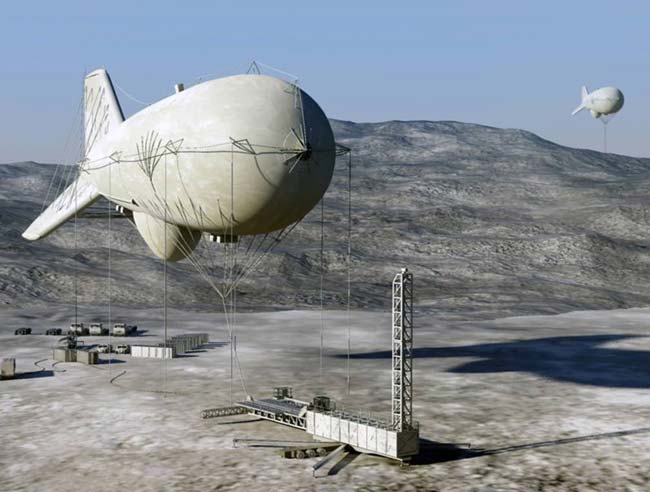
Blimps for Warfighters Blimps fly high for missile defense. Raytheon

Blimps first soared above battlefields in 1794 to spy on Austrian and Dutch troops. Now the U.S. Army wants them as radar platforms for defense against cruise missiles. A Raytheon-designed blimp made its first flight yesterday at Elizabeth City, North Carolina.

The $1.4-billion blimp carries radar that can see 360 degrees and track down terrain-hugging cruise missiles up to 300 miles away. Another planned blimp would carry fire-control radar to provide targeting info, helping surface-to-air missile systems intercept and shoot down incoming threats, which may also include large rockets and ballistic missiles in the early ascent phase.

"Missiles that were once limited by their organic radars can now meet their full kinematic potential because of the extended ranges provided by JLENS radars," said Lt. Col. Steve Wilhelm, project manager for the Joint Land Attack Cruise Missile Defense Elevated Sensor (JLENS) program.

Space News reported earlier that the blimps can go for 30 days without a break, before coming down for eight hours of maintenance and flying another 30 days. They can operate at 2 miles above the ground with a tether connected to a mobile mooring station.

Previous demonstrations showed that the blimps also have fairly good survivability under fire. Wilhelm noted in his Space News interview that aerostats have stayed aloft for hours after being riddled with bullets, and would not be easy to target by radar because of their relative lack of motion.

The military has also examined other airship designs as possible surveillance platforms that could hover above areas for weeks at a time, and stay in the air for longer than the growing swarm of drones currently operating above battlefields.

Want to read more articles on the military, aviation, and space? Subscribe to Popular Science and enter to win $5,000!

5 Comments

this really struck me as I read this:
"Previous demonstrations showed that the blimps also have fairly good survivability under fire."

FAIRLY good survivability?!
that billion-tax-dollar monster getting knocked down?!
how good is "fairly good"?
how much explosives would it take?
I doubt it can survive a SINGLE bomber swooping down and letting loose...
on that staitionary, large target :O

I'm guessing that the 3km tethers are going to make these puppies a bit of a hazard to friendly aircraft.

Havent you heard of WW2 era Barrage Balloons?

@Technofreakface

The military hasn't just started fighting wars four years ago. They've been doing it for awhile now. Obviously, there would be air defense systems surrounding the general area. Any area that is worth guarding won't just have one of these blimps in place. We have surface to air missiles for defense too, ya know. They work in conjunction with other assets to protect an area. I imagine the Air Force would patrol the skies, or at least have aircraft and crew on alert to intercept anything that gets too close. Meanwhile, the Army would have surface to air missile batteries on the ground.

The idea is to protect those areas from cruise missiles...which are long-range standoff weapons. You don't send a bomber in before the cruise missile destroys the radar antenna, would you? Because obviously, the radar would alert the missile crews to the presence of the bomber and they would fire off a few Patriots at it. Splash one bomber.

The comment about the blimps being relatively survivable from small arms is about small infiltration teams of soldiers who try to destroy the blimp. Of course, if they decide to shoot at the blimp, they'd reveal their presence as well as their location, wouldn't they?

Also, fairly good survivibility means how long it stays up in the air with holes in it.

Blimp- 90% airbag, 10% exspensive sensors.

So, if you shoot up the ballon, it settles to the ground, gets patched, refilled, and put back up. It is only if the sensors are blasted that real damage has been done.

Since its purpose is air defence, no airborn target is going to get near this. Small arms and should based anti-air weapons are the only things that should be able to sneak close to this thing.

I think a greater threat would be someone suiciding the base and this thing goes floating off downwind, shot down, and the tech stolen and sold off. (Which would take more doing that the kinds of forces we currently are facing).


Download Our iPhone App

Stay up to date on the latest news of the future of science and technology from your iPhone with full articles, images and offline viewing


Follow Us On Twitter

Featuring every article from the magazine and website, plus links from around the Web. Also see our PopSci DIY feed


Become a Fan On Facebook

Share links with friends, comment on stories and more


December 2009: Best of What's New

In our December issue, Popular Science names the 100 best innovations of the year: bombproof wallpaper, self-parking cars, the fastest helicopter, and 97 more. Plus inventor profiles and videos.

Check out the best of what's new here.

Popular Science Photo Pool


Share your photos in the Pop Sci pool at www.flickr.com!
tags_sprite.png
POP_embeddedForm_cover_May09.jpg