The James Webb Telescope's beryllium mirrors are designed to warp in the cold of space

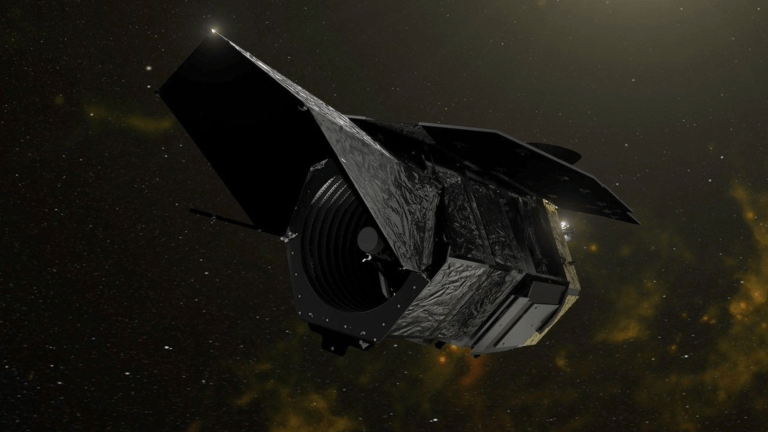
Full-scale model of James Webb Space Telescope, on display in Munich The model weighs 12,000 pounds. EADS Astrium

As NASA prepares for the launch of the last Hubble Space Telescope servicing mission next week, astronomers are already anticipating the construction and 2013 launch of the beloved observatory's successor.

In the coming weeks, engineers will wrap up testing the segments of the primary mirror on the James Webb Space Telescope, NASA's newest space-bound observatory. Like astronomer Allan Sandage, it will pick up where Hubble left off -- by studying the redshifted galaxies speeding away from us, in an attempt to understand the nature of the accelerating universe and its origins.

"We generally refer to the James Webb Space Telescope as a successor for Hubble. It's not really a replacement for Hubble; it's intended to take the next, deeper look into the universe," said John Decker, deputy project manager for the James Webb project, based at Goddard Space Flight Center in Greenbelt, Md.

But like any proud parent, Decker had to do a little bragging: "The images that we will see will be very much like the Hubble images, only better," he said.

The scope was conceived, designed and executed with an aim at ingenuity. Among JWST's engineering feats are the space umbrella that will unfurl to keep the scope cool once it reaches its outpost a million miles from Earth, and the design of its primary mirror, which will contain 18 segments that come together somewhat like the eye of a fly.

When the pieces are put together, Webb's primary mirror will be 6.5 meters wide, about three times the size of Hubble's. If engineers used Hubble-esque materials to make JWST, the scope would weigh 10 times what Hubble does -- way too much to get off the ground.

"It would be like trying to launch Palo Alto into space. You wouldn't want to do that," said Scott Texter, telescope manager for Northrop Grumman, which is NASA's main contractor on JWST.

So how to make a lighter, yet light-receptive mirror? Scientists turned to beryllium, a space-worthy material that's as hard to find on Earth as it is in the heavens.

single page
Page 1 of 2 12next ›last »
Want to read more articles on the military, aviation, and space? Subscribe to Popular Science today, for less than $1 per issue!

23 Comments

If it's 1 million miles away from earth, what is this going to orbit around?

kingz1991

from Orono, Ontario

1 million miles isn't that far, but your kinda right, its not going to be orbiting per se, it will be in the earth sun Lagrangian point L2, where it will be kept in place in the same location in respect to the sun and the earth, by the gravity from the earth and sun. this puts the satellite behind the earth if looking inwards towards the sun.

also what i think about this is they need something way better than this to see what we need to see, something like a few hundred meter wide mirror, maybe on the moon? once we eventually have a moon base, this is something they should aim for to utilize the low gravity and no atmosphere and plenty resources, if they can figure how to use it, this could also be used as giant solar power collector when the sun is shining stopping the usability of it as a telescope

kingz1991

from Orono, Ontario

oh and they could make it out of a crater, just find one with a good shape, change it a bit to concentrate the light where you want it, and coat it with something to get a mirror surface. If it was only that simple

I could be mistaken but positioning the telescope one million miles from earth might make servicing missions a little difficult to accomplish. One could conclude that those who are engaged in designing and building the telescope assume that it will work as intended without the need for hands-on tinkering.

I have had fun playing with some Hubble images. Although my original intent was simply to intensify image detail, I got a little carried away with distortion filters. www.flickr.com/photos/rightlightphotos/

ted logan

from Elon, NC

Does anyone else almost weep at the beauty of this kind of engineering marvel?
What will those from the future consider our great works? I doubt any modern art, music or literature will make it, but hope that our engineering marvels are recognized as the best that Homo sapiens could do. More like Roman aqueducts than stone spear heads.

Wow - a million miles from earth. Cool. Great article! Hey Editor - how come we can't get articles like this in the print magazine. I really enjoy a relaxing night watching TV but mostly I am perusing the latest magazine from pop sci. Much better than reading it on my iPod

I like the idea of a permanent base on our moon where we could set up a permanent observatory. That would be awesome.

:) Actually, the Bible clearly teaches that the heavens and the earth are right around 6,000 years old... not billions and millions of years. God created Adam as a fully grown man, and He also created all of nature in the same manner. :) Some like to "have faith" that everything was packed into virtually nothing, that it exploded, and from that explosion everything randomly fell into place as it... But others have the right faith that God just created it.

The book of Genesis was written by Moses, who did not actually witness any of the creation events. The idea of devine authorship states that every biblical author was given divine inspiration. With this in mind, the book is written by a man who didn't see what happened, inspired by a divine being who we do not fully understand. No one knows if the "day" mentioned in the creation account refers to 24 hours or 2 billion years.

From my understanding, according to the Big Bang Theory, the first periods of light and darkness were each approximately 1-2 billion years in length.

"There was darkness and light, the first day."

There is nothing clear about it.

It's not exactly a replacement for Hubble JWST is an infrared telescope.
Hubble is mostly visible light and near UV.

L.David Korkia
Is Gold being used because of its metamaterial characterstics with respect to light ? The European Space Agency is getting ready to launch a space telescope that uses silicon carbide. Is the difference in meta-material use due to the size of the telecope lens since the ESA mirror will only be 2 meters wide ?

First - am I the only one who is disturbed that the Hubble is now obsolete? I mean yeah - it's 2009 - Hubble was sent up 20 years ago! Okay I'm getting old.

Second - This is fantastic and incredibly exciting. Where will we be in 20 more years. Perhaps 10 million miles...perhaps just beyond Pluto. What will that do for us...

It's a shame we can't put more of these types of platforms in space "commercially". Would love to see how that would transition space.

To: ultraphotosonic

Re: here's a quarter. if you don't know what to do with it, you should.

this is a S-C-I-E-N-C-E forum, not mythology. if you disagree with the basic premise, then why are you bothering to read the articles? and don't you dare tell me or anyone else how to believe in or pratice the religion of our choice. i am a devoute christian who happens to believe that creationism explains who and why, science explains how. people like you, whom i laughingly refer to as religiously idiotic, have got a lot of gall telling everyone else that only Y-O-U have the "correct" faith, and that the rest of the world is deluded.

YOU, however, are nothing more than a rather small and un-funny punchline. good-day, sir!.......isaidgood-day!!!

Lol, I agree with cowboy82.

At this crisis condition, NASA still can make an amazing "event"... Congratulation!!

WWB
_________________________________
http://www.prirodnjackimuzej.org/

Good luck to NASA and the James Webb Space Telescope, I say. Hubble showed some great images, let's hope JWST can go even better.

Michael O'Hare
http://www.citiesforpeople.net

The best I have seen from NASA is the Hubble space telescope and the mars rover. It would also been good to have an orbital probes in fixable formats orbiting each of the planets. Now THATS THE RIGHT STUFF!

http://pspgames247.com

NASA never stopped to amaze me. I do believe that one day mankind can live on Mars

I love it when there is a little arguments like in the comments above. If I may add my grain of salt, the hubble is supposed to be obsolete after 2 decades. In fact the technology of 20 years ago is obsolete for the most part is it not? So what about the Bible with whatever statements in it? At around 2000 years old, is it not obsolete?
----------------------------------------------------------
http://obama4poker.com/

We must wait a very long time until it touch something new in this huge university.
----------------
http://a1article.co.cc

I love the space very much, I wish that I can go to space one time.
http://tinyarticle.com

Great share

www.AdvanceLoan.net

thanks. Never before I had crossed over like an informative post like this. I was totally sick with your post you shared .Awesome share dude

www.AdvanceLoan.net

The seeker of knowledge who seeks to reach beyond the stars to go where no mans gone before to see things no man has seen and bring these experiences back for the whole world to hear and see.

Dont worry one day i will become president and nasa will get better funding i see the greatness in bringing humaninty to the star not for love riiches or money but to see my fellow being take the first leap in asintion for we cannot live on this planet forever eventually resources will run out and then it will be an emergency to go some where else but dont worry i will make it happen i believe these newer telescopes and other communications and defence technology in space will form the ground work for the technology needed to get man out of are galaxy.This is TrulyVisionary.til next time cya. p.s if you would like to read my blogs go to politico.com.live lone and prosper


140 years of Popular Science at your fingertips.


Popular Science+ For iPad

Each issue has been completely reimagined for your iPad. See our amazing new vision for magazines that goes far beyond the printed page


Download Our App

Stay up to date on the latest news of the future of science and technology from your iPhone or Android phone with full articles, images and offline viewing


Follow Us On Twitter

Featuring every article from the magazine and website, plus links from around the Web. Also see our PopSci DIY feed


April 2013: How It Works

For our annual How It Works issue, we break down everything from the massive Falcon Heavy rocket to a tiny DNA sequencer that connects to a USB port. We also take a look at an ambitious plan for faster-than-light travel and dive into the billion-dollar science of dog food.

Plus the latest Legos, Cadillac's plug-in hybrid, a tractor built for the apocalypse, and more.


Online Content Director: Suzanne LaBarre | Email
Senior Editor: Paul Adams | Email
Associate Editor: Dan Nosowitz | Email
Assistant Editor: Colin Lecher | Email
Assistant Editor:Rose Pastore | Email

Contributing Writers:
Rebecca Boyle | Email
Kelsey D. Atherton | Email
Francie Diep | Email
Shaunacy Ferro | Email

circ-top-header.gif
circ-cover.gif