
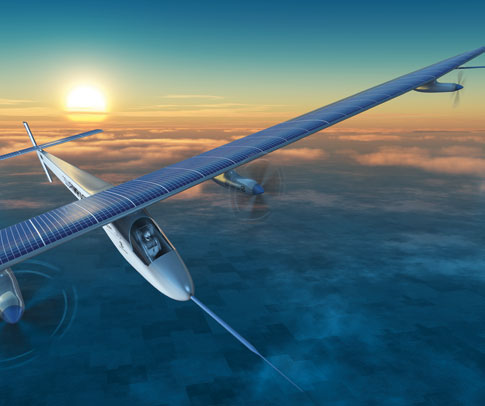
A solar-powered plane gears up for a round-the-world flight

Light Flight Swiss adventurer Bertrand Piccard will take to the skies in a ray-powered plane this fall Graham Murdoch (See an annotated version of Solar Impulse)

This fall, Swiss adventurer Bertrand Piccard and his team will begin test flights of a prototype of Solar Impulse, a sun-powered plane designed to circumnavigate the globe without burning a drop of oil. Piccard wants the project to demonstrate the potential of green technology, and he’s feeling the pressure. "We still have to prove that this plane will fly," he says.

Led by CEO André Borschberg, the team has implemented major design revisions since announcing the project in 2003, such as bowing the wings to improve handling and substituting lightweight engines, but the basic idea is the same. Photovoltaic cells on the wings will gather solar energy, recharging the batteries that power its propellers.

Traveling at a leisurely, energy-efficient 45 mph, Solar Impulse will take three weeks to loop the world, landing every few days to change pilots and show off the technology to the public. Piccard hopes the sight of the plane in flight will prove that renewable energy can transform even the most energy-hungry human activities, sparking interest and investment in green tech across the globe.

Takeoff of the full-size plane is slated for 2011, but Piccard and Borschberg are currently focused on getting the prototype off the ground by September and working their way up to 36-hour overnight flights. "We have the plane," Piccard says. "This is really the moment of truth."

Want to read more articles on the military, aviation, and space? Subscribe to Popular Science and enter to win $5,000!

7 Comments

The article by Tom Clynes on Pages 28-29 (June 2009), Racing the Sun states, "The plane is designed to circumnavigate the globe without burning a drop of oil." If it is solar-powered and will lift off with battery power, why have you labeled it's electrical "motors" as engines? Engines are internal combustion, and motors are electrically powered depending on their design.

Joseph C. Hyde
Cerro Gordo, Illinois 61818

Oh here we go again with the old engine vs. motor debate...
The statement in a previous comment that "Engines are internal combustion" is not strictly true, as external combustion engines (such as steam engines) can also rightfully be called "engines". So perhaps we should not be so quick to criticize other's statements if we can't seem to make correct statements ourselves. ;-)

Still, that gives support to my idea of a solar garage. The garage would charge batteries all day long, while your electric car is out and about. When you get home, you could charge from the garage's batteries overnight.

You might have solar cells on the car, and even a solar carport at the office. The others would appreciate the shade (if they live in Oklahoma) and you could plug in and draw power while you are working.

Ought to pay for itself in gas savings in about 50 years.

Meanwhile, if I were that guy, I think I'd pump a little helium into the wings and fuselage. And I'd bring along a balony sandwich and a case of beer.

cgil501...What is wrong with the author's reference to the electrical motors, as engines?...that is a reference for the mechanical devises that turn the propellers by electric motors, there is that clear enough for you?! Now go clean your garage or something!!!

Anyway, I am glad to see another team effort...since the Gossamer Penguin in 1980 and the Solar Challenger, which was capable of reaching an altitude of 12,000 feet (3,700 m). On July 7, 1981 the Gossamer Penguin, piloted by Steve Ptacek, successfully flew the English Channel's 262 kilometer (163 mile) flight from Paris to Manston in the UK.

Wouldn't it be great to see some American University teams challenge the Solar Impulse team, for the first to circumvent the globe...that would be like the days of old of Lindbergh vs. French ace Rene Fonck to cross the Atlantic! Would the American team of aviation pioneers please step forward for the challenge...come on MIT and Embry-Riddle let's beat these guys, in the memory of Steve Fossett...we can be first!

gerd1022

from W. Spfld, MA

what is more important, however, is how they can power four 10 hp motors (40 hp) on 6 kW of electricity (8 hp) from the panels... and that's an average power production... can 8 hp even keep that plane in the air? (especially because after storage and other inefficiencies it would be more like 6-7 hp)

I sure hope it works!

Thats a very good point. How would it stay aloft for 12 hours without sunlight you can only put so many batteries in a airplane?


Download Our iPhone App

Stay up to date on the latest news of the future of science and technology from your iPhone with full articles, images and offline viewing


Follow Us On Twitter

Featuring every article from the magazine and website, plus links from around the Web. Also see our PopSci DIY feed


Become a Fan On Facebook

Share links with friends, comment on stories and more


December 2009: Best of What's New

In our December issue, Popular Science names the 100 best innovations of the year: bombproof wallpaper, self-parking cars, the fastest helicopter, and 97 more. Plus inventor profiles and videos.

Check out the best of what's new here.

Popular Science Photo Pool


Share your photos in the Pop Sci pool at www.flickr.com!
tags_sprite.png
POP_embeddedForm_cover_May09.jpg
