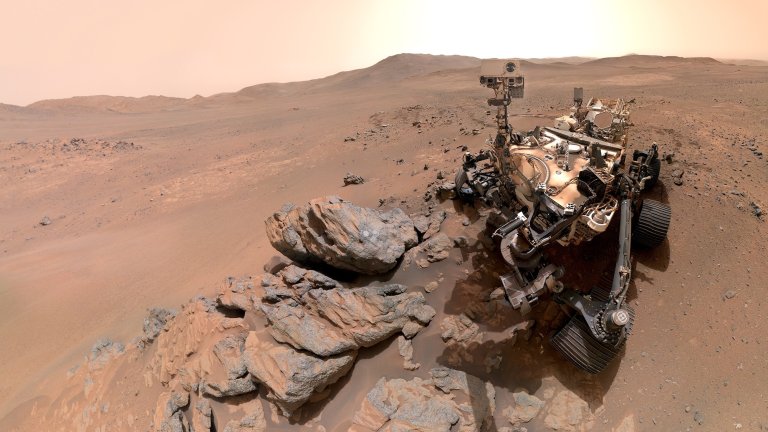
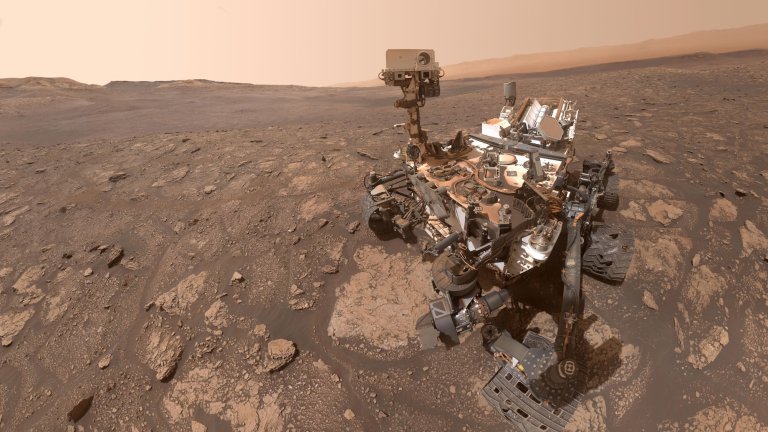
By next fall, NASA plans to launch its biggest Red Planet rover yet, the $1.8-billion, SUV-size Mars Research Laboratory. Even though the MRL will be able to haul five times as much equipment as the Spirit and Opportunity rovers that are already on Mars, a group of Swedish researchers say that they could accomplish far more if accompanied by a squad of helper ’bots. Fredrik Bruhn, the CEO of Ångström Aerospace Corporation, and his colleagues have designed the small inflatable scouts to assist bigger, less mobile rovers in their hunt for signs of microbial life on Mars.
Each foot-wide, 11-pound ball can roll up to 62 miles, snap photos at any angle, and take soil samples, drawing its power from the solar panels on its shell. Unlike wheeled rovers, the rounded scouts have fewer motors to repair, never flip over, and are easier to seal from dust. Plus, they rarely get stuck. “The beauty of the system is it needs very little energy to go around rocks, so unless you’re landing on a surface that looks like a bed of nails, it should be fine,” Bruhn says.
In 2004, Bruhn helped found Swedish company Rotundus, whose Earth-based GroundBot is now test-patrolling a harbor in Stockholm. By using GroundBot’s pendulum-propulsion mechanism, swapping in a radiation-proof computer, and designing a lightweight, inflatable shell, he thinks he could produce four of the Mars balls for as little as $6 million. “We just need to assemble the bits and pieces and test it,” says Bruhn, who shows his design to NASA officials this month.
Stay up to date on the latest news of the future of science and technology from your iPhone with full articles, images and offline viewing
Carry everything you need to make a smart buy on HDTVs, cameras and 14 other product categories right in your pocket
Featuring every article from the magazine and website, plus links from around the Web. Also see our PopSci DIY feed
Share links with friends, comment on stories and more
Innovative fixes for five of the country's biggest infrastructure messes, plus a look the quest to read the human mind, the LCD screen that might finally kill paper dead, and the world's scariest science.
Read the issue here.
This really really does not seem very feasible. Deploying a concept technology where tried and true robotics are needed.
Seems like a good concept for a "rover". However, since it's designed like a "ball", wouldn't it have difficulty in going up steep or not so steep inclines as it would not have much "traction". Or, it's designed for just running around flat surfaces most of the time?
Honestly, I'm so excited and my next question is - when or will we ever terraform Mars? "Wishful thinking" hehehe
Not only on steep hills, but if it gets caught in a sandstorm and buried even a bit , it may not be able to get out again. Think car stuck in a snowbank and no one to come dig it out.
The ball can't get stuck because it has a back-up gerbil that inflates if it gets caught between the carpet and radiator.
from Portland, OR
it sounds like a good idea since they are small use little energy and assist the larger lab.
they sound very cost effective...
it's sounds very interesting and much more cost effective
it could get more done which is an advantage
I seem to remember that nasa tests designs up in the canadian arctic for similar conditions. It would be interesting to know if this has been done and how well this ball locomotion performed.
What if it....pops!
How do they plan to clean the "solar shell" from the dust that it will gather on it's surface as it rolls?
Hi!
Have a look at this page, too:
www.mein-zeug.de/jugend_forscht_ferngesteuerte_kugel.htm
(German site)
I invented nearly the same thing at nearly the same time - but i didn't have very much success with it. That's live!
PS: I hope my English isn't too bad...
Umm... it's Mars Science Laboratory (MSL), not Mars Research Laboratory (MRL) :)
I don't think durability should be a concern whatsoever. There are several materials that could carry out this job sufficiently. The fact of the matter is, if you actually think that the movment this type of robot could be controlled, you're dreaming. This would be a perfect idea if you were intending on using a large number of these things and taking a more chaotic approach to scope out entire regions. But for precision analysis of pinpointed areas, sending a beachball into a sandstorm won't get you the desired results. Weight to surface area ratio would send this thing flying.